
How Artificial Intelligence Has Transformed Education
Will our children walk hand-in-hand with the robots?


Artificial Intelligence (AI), the artificial brainchild of humanity, still an infantile technology within the first gasps of its breath, has already started rearranging the functions of many facades of life as we know it. Powered by ground-breaking machine learning technology, AI is reshaping every aspect of professional and personal functionalities. This powerful technology in education seems to be a game changer in terms of availability, accessibility, and efficiency for students, teachers, and educational institutions alike.
The education landscape plays a pivotal role in the evolution of humankind. And as such, it is ever-evolving. But at no point in history has teaching methodology and means gone through such a complete overhaul that each generation’s methods of learning have become outdated to the next. Virtual classrooms, augmented reality learning, and mobile phone courses are all new technologies designed to be available at the fingertips of users. These technologies provide instant classes and feedback, catering to a modern audience with short attention spans.
Before we dive into the details of the impact AI has made in transforming how smart classroom management strategies and functions work, let’s get a few fundamentals out of the way.
1. What is AI? Artificial Intelligence is a method by which machines are trained to analyze billions of big datasets within seconds. This enables computers to imitate human-like cognizance for problem-solving.
2. How big is AI in the education market? Global Market Insights has produced a report that predicts AI in the education market will exceed $80 billion in 2030.
3. What is the future of the education sector with AI? AI is predicted to have pivotal impacts on two-thirds of all the jobs in the world, and humans will be working hand-in-hand with AI.
These are all too much information to take—potentially it could be easier with some assistance from our good AI buddy. Until this point in time, parents and teachers walked the next generation hand-in-hand towards a brighter future. Soon, AI will be walking them forward, maybe even literally. Even if AI is still in its newborn form, it is safe to say that AI advancements are already reshaping the strategies that define teaching techniques and methods throughout the world. What the world has seen so far is but a fragment of the full power of AI technologies. And with that minute sample, there is no denying that AI is the future of education. Below are some key factors in how the EdTech sector is benefiting from the implementation of AI.
Automated Assessments, Grading and Feedback Systems
Teachers are the cornerstone of a society. The best way to employ AI to assist them would be to utilize its ability to automate the grading and assessment of learning systems. The power of AI can be deployed to automate most value-added teaching-related tasks, assisting teachers with various administrative tasks while providing them with invaluable feedback on improving work efficiency. AI can also be used to promptly detect malpractice. Automating daily mundane tasks not only saves time for teachers but also takes a big chunk of burden off their shoulders, making their lives easier and thus making their output more productive.
AI Teachers and Assistants
Even if an AI entity can never replace a human (and it never should), the technology has its own merits, working at unimaginable speeds for the human mind. AI can process vast sets of data within the blink of an eye and return precise, detailed information. This application can be resoundingly useful for teacher education, as not all teachers can be experts in everything, and it can bridge the information gap with the help of AI for educators. Some institutions already offer courses conducted by AI teaching tools and education software. These services will be perfected in the near future and seem to function quite well with minimal human assistance.
Personalized Learning & AI Powered Curriculum
Not all students learn the same. Where some students are naturally academically inclined, others might need different methods of learning to help them attain their potential. The latest machine learning algorithms can be used to train AI to identify the best means of providing guidance to young minds and design custom teaching programs and curriculum development for individuals and certain sets of pupils. AI leverages L&D (Learning and Development) techniques to identify and analyze patterns of why and how students learn skills. Once it has the data, it builds tailormade programs based on student needs. This eliminates the problem of traditional learning systems relying heavily on the hands of the individuals responsible for the development of children’s brain activity.
24*7 Interactive Chatbots for Student Support and Guidance
An automated AI chatbot that delivers accurate information to the curious minds of children seems like the best sort of educational companion that children need, especially children with special needs. Not only will this help children develop their cognitive abilities, but it will also boost children’s confidence by helping them overcome their shortcomings. When it comes to financial institutions, chatbots also assist students with numerous applications, such as answering academic-related queries, conducting research and education, brainstorming and passing ideas back and forth, or even discussing career paths. Thanks to AI, students can avail themselves of information, resources, and explanations 24 hours a day without actually contacting their teachers.
Most leading EdTech companies offer AI eLearning courses, online teaching apps, teacher apps, and classroom apps with personalized learning solutions, delivering the most optimizable learning programs at the convenience of consumers’ mobile devices at their own convenience. We live in a time when education has never been more easily accessible, and that too is delivered to the consumer the exact way they want it.
As technological advancements rapidly expand over every corner of civilization, there is a need to regulate this double-edged technology and ensure that future generations benefit greatly from such monumental technological advancements. One of the biggest concerns with AI among the masses is the fear of job security. The U.S. education industry professionals seem to be adapting well to the positive ramifications AI is bringing, despite some early clouds of doubt.
But if the impact of AI in education so far is any indicator, we are off to a great start. The benefits of the use of technology in education yield sovereign results. What the future holds is going to be nothing short of spectacular. The world of education will be privy to enlisting the best AI tools for students. There is a plethora of education articles related to AI on the internet for further understanding. In conclusion, AI is an undeniable fact that, when the future of humanity’s journey is told, it will be remembered as one tale of technology and education powered by AI. The full power of AI intelligence remains to be seen yet, limited only by the power of human imagination.
About the Creator
Abienesh M
Hi dear Vocal (written) friends,
I love writing! Yes, that's how it begins. Coming from a journalism background, I have been writing, proofreading and editing for over seven years now. I look forward to exciting times ahead. Good day.
Keep reading
More stories from Abienesh M and writers in Education and other communities.
The Critical Importance of Cyber Resilience
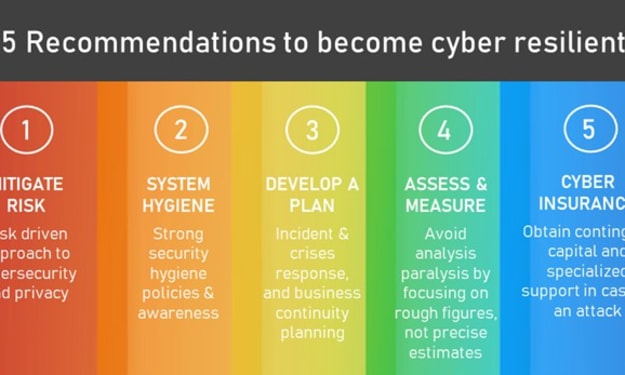
During the COVID-19 pandemic, the way companies reacted and functioned changed in many ways, further incorporating technological advances. Chief among these migrations is the conversion of traditional channels to digital. In this modern age, where new technological advancements are rapidly incorporated by companies seeking new ways to gain every competitive edge, the need to prepare, respond, and recover from cyber threats promptly arises parallelly.
By Abienesh Mabout a year ago in FYI
The Guiding Light: Spiritual Leadership and Its Lessons on Responsibility and Unity
Spiritual leadership offers a perspective on guiding people that goes beyond authority, titles, or formal positions. It emphasizes values such as compassion, integrity, humility, and a commitment to serving the greater good. In modern society, where fast-paced lifestyles and individual ambitions often take precedence, these principles provide a much-needed reminder of the importance of responsibility and unity. Spiritual leaders, whether in religious, cultural, or community contexts, have consistently demonstrated that true influence arises from the ability to inspire others to act ethically and to prioritize the collective well-being over personal gain.
By Iglesia Ni Cristoa day ago in Education
THE SPHERICAL SPACETIME - ALEXIS KARPOUZOS
I. The Question of a Spacetime without Centre From Aristotle to Kant, Western philosophy approached space and time primarily as conditions of the possibility of experience or as properties of reality. In the Aristotelian tradition, space is defined topologically — as the place of bodies — and time arithmetically — as 'the number of motions with respect to before and after'. In Kantian critical philosophy, space and time become a priori forms of intuition, transcendental conditions of all phenomenal experience. Yet in both traditions a common assumption is preserved: space and time are structures that organise phenomena from a — however implicit — centre of reference. Alexis Karpouzos radically challenges this assumption. The Spherical Spacetime he introduces is neither place nor intuition; it is a dynamic ontological structure that refuses every privileged point of reference, every external centre, every principle that precedes the very movement of the world. The question posed from the outset is this: what does it mean to think a spacetime that does not 'contain' beings but is the very manner in which beings are? And what ontological consequences does this displacement carry for the understanding of existence, consciousness, and truth?
By alexis karpouzos2 days ago in Education



Comments
There are no comments for this story
Be the first to respond and start the conversation.