
Hazrat Muhammad (SAW): The Last Prophet and Unifier of Arabia
A Visionary Leader Whose Spiritual and Political Influence Shaped the Course of History

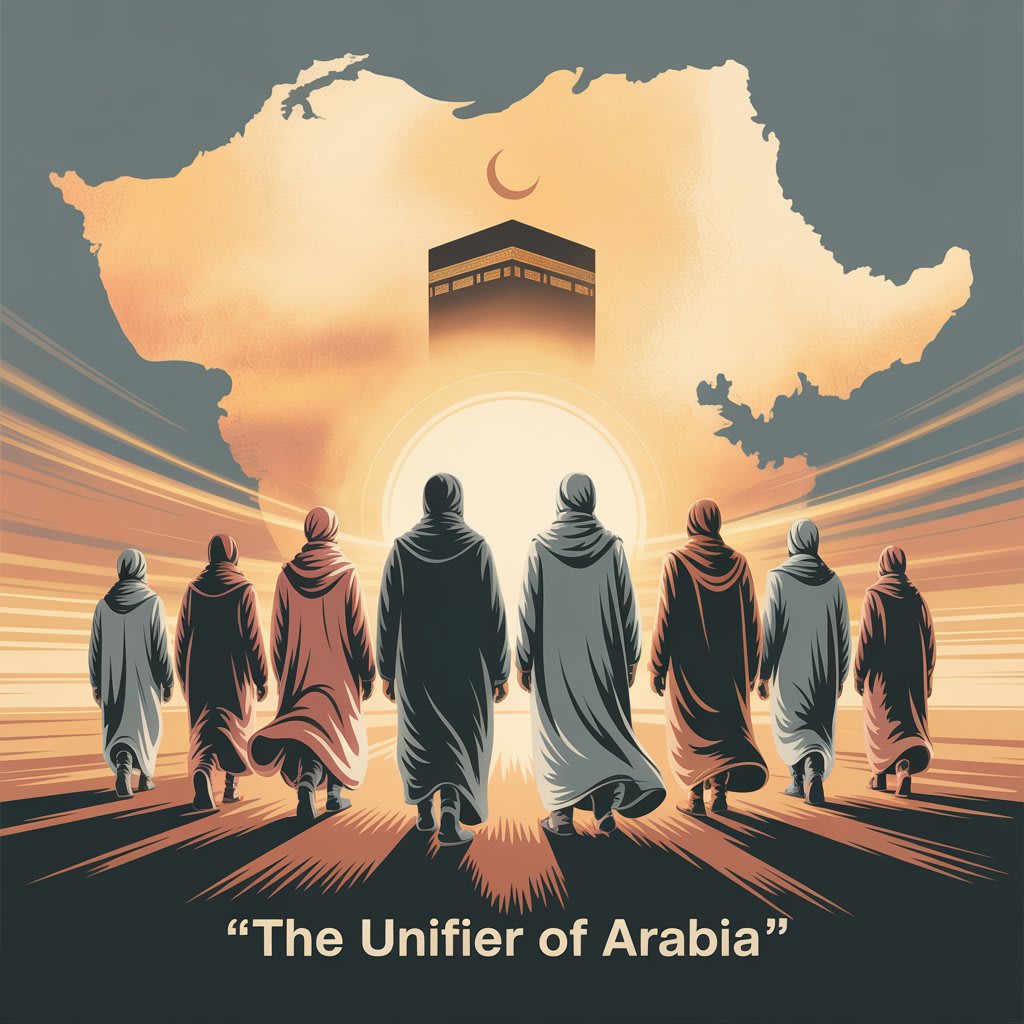
Hazrat Muhammad (peace be upon him), the founder of Islam, is one of the most influential figures in human history. His life and legacy have left a profound impact not only on the religious world but also on political, social, and cultural spheres. According to Michael H. Hart, in his book 100 Influential Personalities in History, Muhammad ranks as the most influential individual, due to the unparalleled spread and lasting effects of his teachings. This essay explores Muhammad’s unique role as both a spiritual guide and a political leader who unified Arabia and laid the foundations for one of the world’s greatest civilizations.
Early Life and Character
Muhammad was born in 570 CE in Mecca, a prominent city in the Arabian Peninsula. Orphaned at a young age, he was raised by his grandfather and later his uncle, both respected members of the Quraysh tribe. Even as a young man, Muhammad was known for his honesty and integrity, earning the nickname Al-Amin (the trustworthy). His early life as a merchant exposed him to the diverse social and economic conditions of Arabia, fostering in him a deep empathy for the oppressed and poor.
At around the age of 40, Muhammad began receiving divine revelations from Allah (God) through the Angel Gabriel. These revelations, delivered over 23 years, form the basis of the Qur’an, the holy book of Islam. His mission was to call people to the worship of one God, reject idolatry, and lead them towards moral righteousness.
Spiritual Leadership and Reform
Muhammad’s message was revolutionary. Arabia at the time was fragmented, with tribal rivalries and widespread idolatry. Society was deeply unequal; women, slaves, and the poor suffered significant injustices. Muhammad’s teachings challenged these norms by emphasizing monotheism and equality before God.
He preached that all humans are equal in the eyes of Allah, regardless of tribe, race, or social status. This was a radical departure from the existing tribal hierarchy. His calls for charity (zakat), compassion, and justice resonated with the marginalized but provoked hostility from the powerful elite in Mecca, who saw his message as a threat to their social order and economic interests.
The Hijra and Political Leadership
Facing persecution in Mecca, Muhammad and his followers undertook the Hijra (migration) to Medina in 622 CE. This event is so significant that it marks the beginning of the Islamic calendar. In Medina, Muhammad transitioned from solely a spiritual leader to a political and military leader.
He established the Constitution of Medina, an unprecedented social contract that united various tribes—including Muslims, Jews, and others—under a common legal and political framework. This constitution ensured mutual defense, religious freedom, and social cooperation. Muhammad’s ability to forge this pluralistic society demonstrated his visionary leadership and political acumen.
In Medina, Muhammad’s leadership extended beyond religious guidance. He adjudicated disputes, formed alliances, and led military campaigns to defend his community. His leadership style combined wisdom, patience, and strategic thinking. He balanced firmness with mercy, which helped him maintain unity in a region marked by tribal divisions and conflicts.
Military Leadership and Diplomacy
Muhammad’s military engagements were primarily defensive, aimed at protecting the fledgling Muslim community. Battles such as Badr, Uhud, and the Trench tested his leadership and military strategy. Despite facing larger and better-equipped enemies, Muhammad’s tactical ingenuity and the morale of his followers often turned the tide.
Perhaps one of his greatest demonstrations of leadership was the peaceful conquest of Mecca in 630 CE. Rather than seek revenge against those who had persecuted him, Muhammad granted a general amnesty and cleansed the Kaaba—the central religious shrine—of idols, restoring it as the monotheistic house of worship. This act of magnanimity not only solidified his spiritual authority but also helped unify the Arabian tribes under Islam.
Social and Legal Reforms
Beyond spiritual and political achievements, Muhammad introduced transformative social and legal reforms. His teachings elevated the status of women, improved rights for orphans and slaves, and emphasized honesty and fairness in business. The laws and ethical guidelines he set forth created a framework for a just society.
Muhammad’s insistence on social welfare—mandating charity, caring for the poor, and protecting the vulnerable—created a moral fabric that permeated Islamic civilization. These principles helped build a society that valued human dignity and social responsibility.
The Spread of Islam and Long-Term Impact
Muhammad’s death in 632 CE did not diminish the momentum of his mission. Within a century, Islamic empires had spread across vast territories, from the Iberian Peninsula to South Asia. The Islamic Golden Age saw advancements in science, medicine, philosophy, and the arts, influenced by the values and knowledge cultivated within the framework Muhammad established.
His influence is not confined to the past; today, over a billion Muslims worldwide look to Muhammad’s life and teachings as a guide for faith, morality, and governance. His example inspires movements for social justice, interfaith dialogue, and ethical leadership.
Why Muhammad is History’s Most Influential Person
Michael H. Hart argues that Muhammad’s influence surpasses that of any other individual because of the profound and lasting effects of his leadership. Unlike other religious founders who may have limited political impact, Muhammad combined spiritual guidance with practical governance. His successful unification of Arabia, establishment of a functioning state, and creation of a universal religion are unparalleled achievements.
Moreover, the religion he founded has endured and thrived for over 1,400 years, shaping civilizations and cultures worldwide. The Qur’an remains a central religious text, and Muhammad’s sayings (Hadith) continue to guide the daily lives of millions.
Conclusion
Hazrat Muhammad (SAW) was a visionary leader whose influence transcended spiritual boundaries to reshape the political and social landscape of his time and beyond. His life exemplifies the power of faith combined with wise leadership, compassion, and strategic vision. Michael H. Hart’s recognition of Muhammad as the most influential figure in history underscores the transformative impact he had on humanity.
From his early struggles in Mecca to his unification of Arabia and the global spread of Islam, Muhammad’s legacy is one of unity, justice, and profound moral insight. His teachings continue to inspire and guide millions, reminding the world of the enduring power of principled leadership.
About the Creator
Keep reading
More stories from Zain Ul Abedin Khan and writers in Education and other communities.
Profiles in Courage
Introduction John F. Kennedy’s Profiles in Courage, first published in 1956, stands as a timeless tribute to political integrity and personal sacrifice. Written while Kennedy was still a U.S. Senator, the book presents the compelling stories of eight U.S. Senators who risked their political careers to stand up for their principles, often in direct opposition to their party, their constituents, or the popular sentiment of their time.
By Zain Ul Abedin Khan9 months ago in Education
Foreclosure vs. Short Sale: 7 Key Differences Every Real Estate Pro MUST Know
You are driving through a target neighborhood and spot a classic "diamond in the rough." The lawn is overgrown, mail is spilling out of the box, and the shutters are hanging by a thread. To the untrained eye, it is just a neglected house. To a seasoned real estate professional, it is a potential high-margin opportunity.
By REI Data Solutions6 days ago in Education
Why Solar Gravity Bends Light: Gravitational Lensing, Einstein’s Theory of Relativity, and How the Sun Warps Space-Time
Introduction: When Light Does the Unexpected 🌌 Imagine staring at a distant star during a total solar eclipse. The Moon blocks the Sun’s bright glare, revealing stars that should not be visible in that exact position. Yet they appear slightly shifted—moved from where they “should” be.
By shahkar jalal2 days ago in Education
The First Rainbow Baby
Pitter-patter, pitter-patter. The rain fell in rhythmic splatters, slowly slowing, but still constant. Mira rolled onto her side pulling the blanket tight against her ears, but still she could hear chitter-chatter and scurrying feet of the creatures that refused to sleep in the lower decks.
By A. J. Schoenfeld3 days ago in Fiction


Comments
There are no comments for this story
Be the first to respond and start the conversation.