

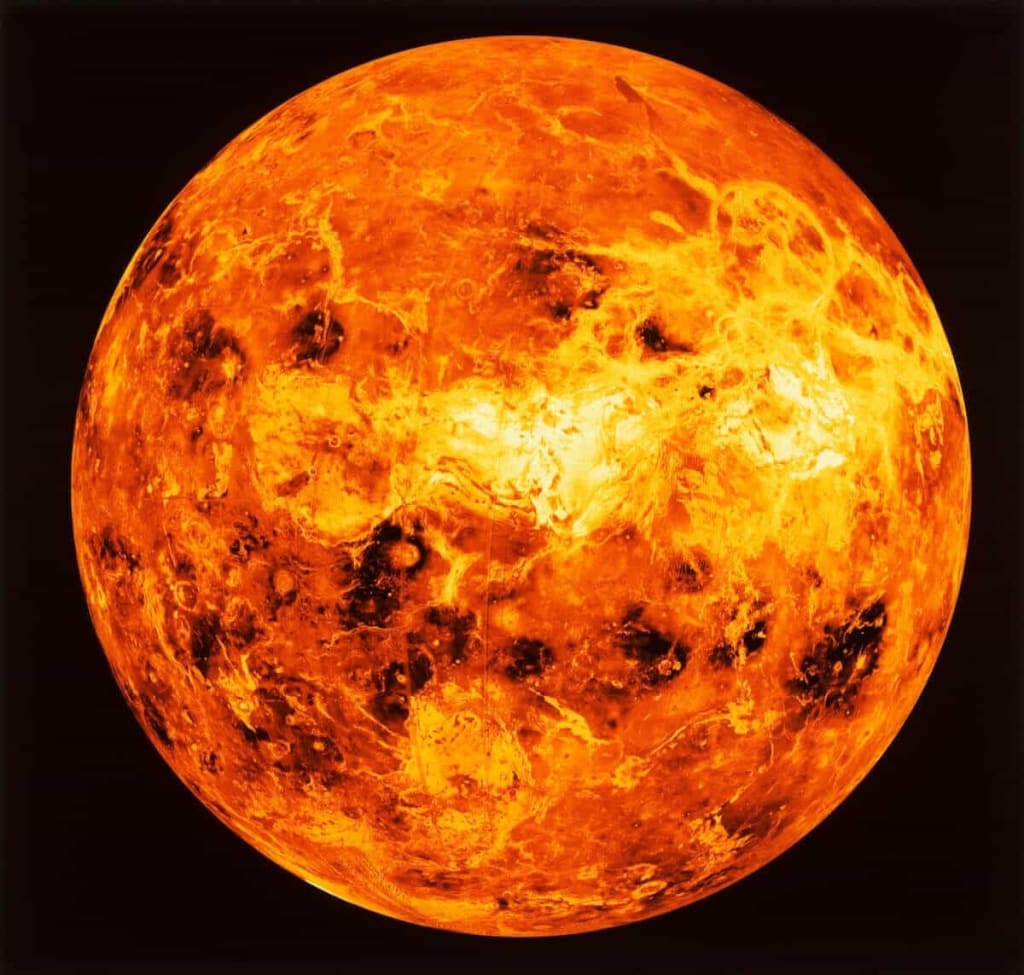
Venus, the second planet from the Sun in our solar system, is a fascinating and unique world with a complex history and a wealth of scientific intrigue. Here, in 600 words, we'll explore the many facets of Venus.
1. Closest Neighbor: Venus is often called Earth's "sister planet" due to its similar size and composition. It orbits the Sun at an average distance of about 67 million miles (108 million kilometers), making it Earth's closest planetary neighbor. Despite this proximity, Venus is vastly different from our own planet.
2. Size and Structure: Venus is nearly identical to Earth in terms of size, with a radius of about 3,760 miles (6,052 kilometers). Its structure consists of an iron core, a rocky mantle, and a solid surface crust. However, the conditions on the surface are anything but Earth-like.
3. Harsh Surface Conditions: Venus boasts some of the most extreme environmental conditions in our solar system. Its surface is perpetually shrouded in thick clouds of sulfuric acid, which create a runaway greenhouse effect. As a result, surface temperatures soar to over 880 degrees Fahrenheit (471 degrees Celsius), hotter than the surface of Mercury, the closest planet to the Sun.
4. Crushing Atmosphere: Venus has a dense and toxic atmosphere primarily composed of carbon dioxide, with clouds of sulfuric acid droplets. The atmospheric pressure at its surface is about 90 times that of Earth, equivalent to the pressure experienced one kilometer beneath the ocean on our planet. These conditions make it inhospitable for human exploration.
5. Venusian Volcanoes: The planet's surface is marked by thousands of volcanoes, including Maxwell Montes, a massive volcano nearly as tall as Mount Everest. These volcanoes, however, are thought to be mostly dormant.
6. Hostile Terrain: Venus has a rugged and rocky landscape with vast plains, highland regions, and numerous impact craters. Its surface is devoid of liquid water, and any attempts to land on Venus face immense challenges due to the extreme heat and pressure.
7. Unusual Rotation: Venus has a peculiar rotation pattern. It rotates on its axis very slowly and in the opposite direction to most other planets, including Earth. This means that a day on Venus (one rotation on its axis) is longer than its year (one orbit around the Sun).
8. Venusian Atmosphere: Venus' thick atmosphere traps heat, creating an extreme greenhouse effect. This is why the surface temperatures are hotter than Mercury, even though Mercury is closer to the Sun. The atmosphere also whips around the planet at astonishing speeds, with winds reaching up to 224 miles per hour (360 kilometers per hour) in its upper atmosphere.
9. Possibility of Past Oceans: Scientists speculate that Venus might have had a very different past. Approximately 2.9 to 715 million years ago, Venus could have had temperatures just a few degrees cooler than Earth's today. During this time, it might have had shallow oceans that could have potentially supported life.
10. Life in the Clouds: While Venus' surface is inhospitable, there is speculation that life could exist in its upper atmosphere. About 30 miles (48 kilometers) above the surface, conditions are more Earth-like, with temperatures and pressures similar to our planet. Some scientists have observed dark streaks in Venus' clouds, which may be evidence of microbial life.
11. Bright Evening Star: Venus is known for its exceptional brightness in the night sky. It is often referred to as the "Evening Star" when it appears in the western sky after sunset and as the "Morning Star" when it is visible in the eastern sky before sunrise. This brightness is due to its reflective cloud cover, which reflects 70% of the sunlight it receives.
12. Exploration of Venus: Over 40 unmanned spacecraft have visited Venus to study its surface, atmosphere, and geology. These missions have provided valuable insights into the planet's harsh conditions and geological features. However, due to the extreme challenges of landing on Venus and the focus on other celestial bodies, such as Mars, there have been fewer recent missions to Venus.
13. Future Missions: NASA recently announced two new missions to Venus as part of its Discovery program. These missions, named DAVINCI+ and VERITAS, aim to understand how Venus transformed into its current hostile state and to map its surface to better understand its geology.
In conclusion, Venus is a planet of extremes, with scorching surface temperatures, a crushing atmosphere, and a unique geological history. While it may not be a top priority for human exploration, it continues to captivate scientists and researchers, offering valuable insights into the diverse and dynamic nature of our solar system.
About the Creator
Keep reading
More stories from Arline Valencia and writers in Education and other communities.
General Geographic
The closest planet to Earth is a question that might seem straightforward, but the answer can vary depending on how you measure "closeness." In terms of average distance from the Sun, Mercury is the closest planet to Earth, followed by Venus and then Mars. However, if we consider the closest approach between two planets during their orbits, things become more interesting.
By Arline Valencia2 years ago in Education
Top 4 AI certifications to Land High-Paying Jobs in 2026
With artificial intelligence becoming a core business necessity in 2026, and organizations moving towards Agentic AI systems along with specialized infrastructure, the demand for professionals who can build, deploy, integrate, and even use these intelligent systems is growing.
By Anu shreya4 days ago in Education
UniversityGPT: In Defence of Gen-Z in the Age of Artificial Intelligence
Every generation is shaped—and judged—by the tools it adopts. From the printing press to the calculator, from the internet to smartphones, technological change has always been met with suspicion. Today, that suspicion has a new name: UniversityGPT. As AI-powered tools become increasingly common in academic spaces, Gen-Z finds itself under fire. Critics argue that students are “outsourcing thinking,” undermining academic integrity, and becoming intellectually dependent. Yet these arguments reveal more about the fear of change than about the realities of modern learning. Defending Gen-Z is not about excusing laziness—it is about recognizing evolution. Understanding Gen-Z: A Generation Born into Complexity Gen-Z, generally defined as those born between the mid-1990s and early 2010s, is the first generation to grow up in a fully digital, globally connected world. Unlike Millennials, who witnessed the rise of the internet, Gen-Z was born into it. But technology is only one part of their story. This generation came of age during: Global financial instability Climate change emergencies Political polarization A worldwide pandemic Rising tuition fees and student debt An unpredictable job market They inherited a world that is faster, harsher, and more demanding than ever before. To expect them to navigate this reality using outdated educational models is unrealistic. Gen-Z is not disengaged. They are overloaded. The Rise of UniversityGPT and Academic Anxiety UniversityGPT has become a lightning rod in debates about AI in education. For many educators and commentators, it represents everything that feels out of control: automation, speed, and the erosion of traditional authority. But history shows us a pattern. When calculators were introduced, students were accused of “forgetting math.” When Google became common, students were accused of “not researching properly.” When spell-checkers appeared, writing was said to be “dead.” None of these fears came true. Instead, expectations shifted. UniversityGPT is not the enemy of learning—it is the next phase of it. AI Does Not Replace Thinking—It Changes Where Thinking Happens One of the most persistent myths about AI tools is that they eliminate critical thinking. In reality, they reposition it. When students use UniversityGPT responsibly, they still must: Frame intelligent questions Assess the accuracy of responses Compare multiple viewpoints Edit, refine, and personalize ideas Apply concepts to real-world contexts AI generates information. Humans generate meaning. In fact, effective AI use requires higher-order thinking skills such as evaluation, synthesis, and judgment—skills that traditional rote learning rarely develops. Knowledge Is No Longer Scarce—Insight Is Previous generations learned in a world where access to information was limited. Libraries, textbooks, and lectures were gatekeepers of knowledge. Gen-Z lives in a different reality. Information is abundant. What is scarce is: Context Interpretation Ethical judgment Creativity UniversityGPT helps students move past mechanical tasks and focus on deeper understanding. This is not intellectual laziness—it is strategic efficiency. In a world driven by speed and complexity, efficiency is not a shortcut. It is survival. Outdated Education Systems Are the Real Crisis Much of the criticism aimed at Gen-Z ignores a fundamental truth: education systems have not evolved at the same pace as the world. Many universities still rely on: Memorization-based exams Rigid curricula One-size-fits-all assessments Minimal mental health support Underpaid and overworked faculty Students are expected to perform at elite levels within systems designed for a pre-digital era. Gen-Z did not create these contradictions—they exposed them. UniversityGPT gained popularity because it fills gaps left by institutional stagnation. Academic Integrity in the Age of AI The conversation around AI often centers on cheating. But cheating is not new—technology did not invent dishonesty. What AI does demand is new definitions of integrity. Instead of banning AI outright, institutions should be teaching: Ethical AI use Citation and transparency Critical evaluation of AI-generated content Responsible collaboration between human and machine Punishment-based approaches ignore reality. Education-based approaches prepare students for the future. Gen-Z understands that AI is not going away. They want guidance, not fear. Gen-Z and the Courage to Question Authority One reason Gen-Z unsettles traditional systems is simple: they ask uncomfortable questions. They question: Why education is increasingly expensive Why unpaid internships are normalized Why productivity is prioritized over wellbeing Why outdated traditions are protected without evidence UniversityGPT empowers this questioning by giving students faster access to knowledge and alternative perspectives. This is not rebellion—it is intellectual independence. Mental Health Awareness Is Not Weakness Another common criticism is that Gen-Z is “too sensitive.” In reality, they are simply more honest. They speak openly about: Anxiety Burnout Depression Emotional exhaustion Previous generations were taught to endure silently. Gen-Z chooses to address problems openly. UniversityGPT can reduce academic stress by: Helping organize thoughts Clarifying complex material Reducing time pressure Supporting non-native English speakers Using AI to manage cognitive load is not weakness—it is self-care. A healthy mind is essential for meaningful learning. Adaptation Is the Highest Form of Intelligence Human history favors those who adapt. Gen-Z is preparing for a future where: AI is embedded in every profession Jobs evolve constantly Lifelong learning is essential Collaboration with machines is normal Learning how to work with AI is not optional—it is foundational. UniversityGPT is not a threat to intelligence. It is a training ground for the future. The Real Question About AI in Education Instead of asking: “Why are students using AI tools like UniversityGPT?” We should be asking: “Why hasn’t education evolved to teach ethical, effective AI collaboration?” Blaming students for adapting faster than institutions is misplaced frustration. Gen-Z is not the problem. They are the preview. In Defence of Gen-Z Gen-Z is not lazy. They are overwhelmed—but resilient. Not entitled—but informed. Not disengaged—but redefining engagement. UniversityGPT does not weaken their minds. It reflects a world where intelligence is distributed, tools are powerful, and adaptability determines success. History is rarely kind to pioneers in the moment. But it is always shaped by them. When the future finally arrives, it will look remarkably like the world Gen-Z is already navigating—and mastering.
By Zahid Hussain2 days ago in Education
Affection and Healing for Yourself
During the night of the last quarter moon, I gathered my ritual supplies. I carefully handled the chunk of black tourmaline that would protect me from your overall negative and narcissistic energy. I carefully walked the house with my stick of selenite in hand, asking the universe to cleanse our working space.
By Alisha Wilkins ✒️🦋🖋️6 days ago in Fiction




Comments
There are no comments for this story
Be the first to respond and start the conversation.