
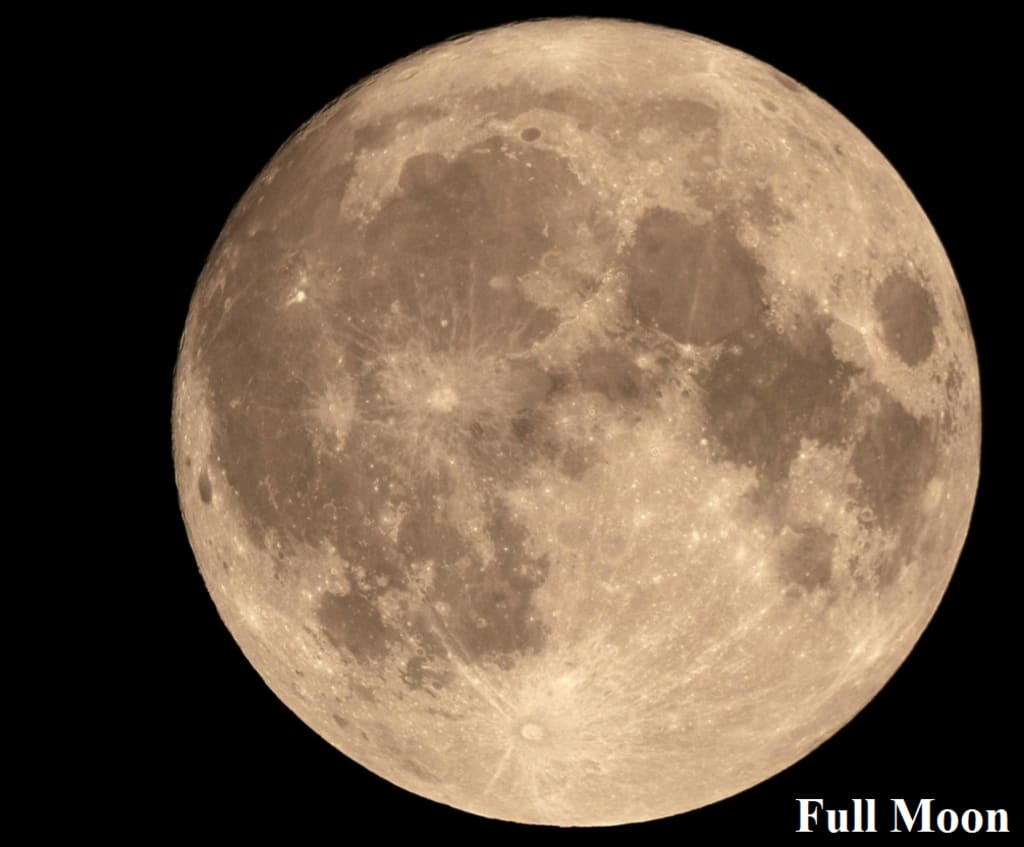
A full moon is a lunar phase that occurs when the Moon is fully illuminated by the Sun's rays. Here are a few key points to keep in mind when it comes to full moons:
1. A full moon occurs when the Moon is on the opposite side of the Earth from the Sun, causing the entire illuminated side of the Moon to face the Earth.
2. A full moon happens roughly once a month, and the exact time of a full moon can vary depending on your time zone and location.
3. The full moon has a significant effect on the tides, causing the tide to be high at the time of the full moon.
4. Many cultures and traditions have associated full moons with various spiritual and mystical beliefs, such as increased psychic energy or heightened emotions.
5. The term "lunacy" which refers to behavioral changes or irrationality, is associated with the full moon. But scientific studies haven't provided substantial evidence of this phenomena.
6. Full moon can also be observed as a beautiful natural event, and can be a great time for stargazing, photography, and other outdoor activities.
7. During a full moon, the moon can appear larger and brighter, it can cast interesting shadows and reflections.
8. The full moon has been used as a calendar in many cultures and it is still in use in some cultures, to set the timing of festivals, rituals and planting schedules.
9. The full moon has many different names depending on the cultures, for example in January is known as Wolf Moon or Old Moon
10. Full moons can have an effect on sleep patterns. The bright light from a full moon can disrupt the production of melatonin, a hormone that helps regulate sleep. Some people find it harder to fall asleep during a full moon.
11. Some people believe that the full moon can affect plant growth, and thus, it can be a good time to plant certain crops.
12. Full moons can also be used as a measure of time in different cultures, they have been used to mark the start of a month, a season, or even a year.
13. The full moon can also be used to measure the passage of time in the spiritual and ritual practice, it can be an important element in lunar calendars and traditions.
14. There are many different rituals, celebrations and practices around the world that are associated with the full moon. Some people use the full moon to set intentions, meditate, or make wishes.
15. The full moon has always been a source of inspiration for art, music and literature, it is often depicted in myths, stories and legends.
16. The full moon phase is also important for astrological practitioners, as it marks a time of fruition and culmination, it can be a time of heightened emotions and increased energy, which can manifest in a person's life.
17. The full moon can have an effect on the Earth's atmosphere and the weather, for example, full moon phase can affect the temperature, the pressure and the amount of precipitation.
It is important to keep in mind that many of the beliefs and associations with full moons are based on tradition and folklore, and there is no scientific evidence to support many of these claims. Nevertheless, observing full moon can be a beautiful and inspiring natural event, it can be a time to reflect and connect with nature.
Keep in mind that a full moon does not have any direct impact on human behavior or physiological conditions. Also, the effect of the full moon on the tide is due to the gravitational pull of the moon and the sun on the Earth's oceans. This pull causes the sea level to rise and fall twice a day, known as the tides.
About the Creator
✅ Mismatch: Life Skills of Learning to Walk and Mastering Writing, Fight Bullies ✅
✅ How can I become a better writer? ✅ It starts with mindfulness, , , Every year, many people go to the Emergency Room because they have fallen inside their own house, and for some elderly people a broken bone is a very serious matter; however, if you take a grappling art like Judo or Aikido, the first thing you learn is to fall, and the first part of mastering that lesson is to relax.
By SAMURAI SAM AND WILD DRAGONS5 days ago in Education
Why Are Coffee Beans More Than Just a Morning Habit?
Coffee is one of the most widely consumed beverages in the world, enjoyed daily by millions of people across cultures and continents. At the heart of every cup of coffee lies the coffee bean, a small but powerful ingredient that defines flavor, aroma, and quality. Coffee beans are not just agricultural products; they represent culture, lifestyle, and a major economic activity for many countries.
By Rohit Shah3 days ago in Education




Comments
There are no comments for this story
Be the first to respond and start the conversation.