
Foundation Year vs Foundation Degree: Choosing the Right Path
Compare the International Foundation Year and Foundation Degree in the UK. Learn which pathway aligns with your academic or career goals.
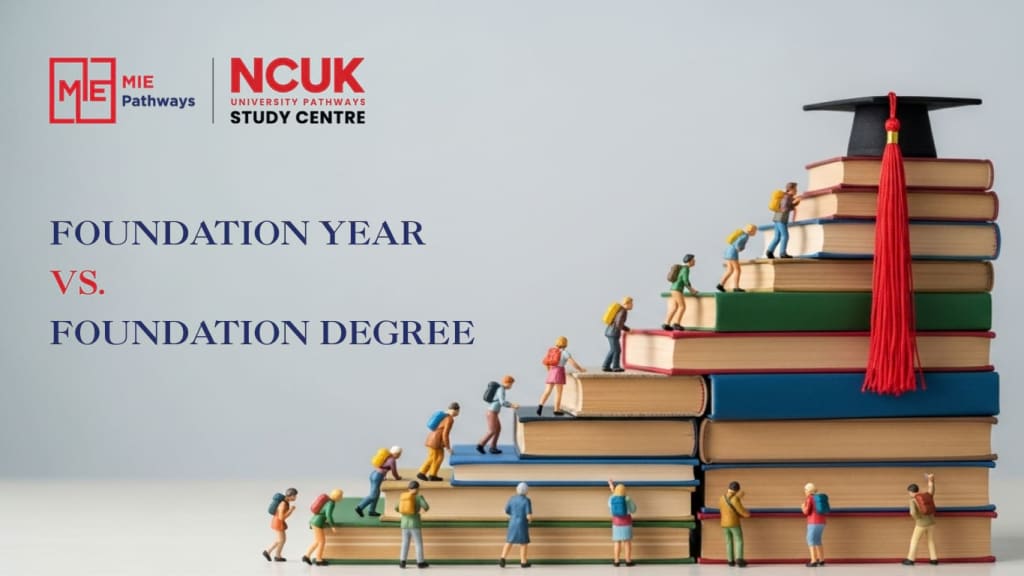
Students planning to study in the UK often come across two similar-sounding options: the International Foundation Year and the Foundation Degree. Both are important pathways, but their goals, structures, and outcomes are very different. One helps international students progress into university, while the other blends practical skills with academic study to prepare for employment. Knowing the difference helps students make informed decisions that match their ambitions. This guide explains each pathway in detail, compares their benefits, and highlights which choice may suit different types of learners.
International Foundation Year: A Stepping Stone to University
The International Foundation Year, often called IFY, is a one-year programme designed for students who do not meet the direct entry requirements for a UK bachelor’s degree. It is especially aimed at international students who may come from education systems that differ from the UK’s A-Level standard. For these students, the IFY acts as a bridge, helping them gain the knowledge, skills, and confidence needed to succeed at university.
Purpose and Student Profile
The IFY is mainly suited for students whose previous education did not prepare them for direct university entry. It helps them adapt to the academic standards of the UK while also supporting their transition to a new culture. This is particularly valuable for students who have never studied in the UK before. Universities often give IFY students access to facilities such as libraries, student clubs, and sports centres, helping them integrate smoothly into campus life.
Curriculum and Skills
The IFY curriculum blends academic preparation with skill development. Students take core subjects such as English for Academic Purposes, mathematics, and study skills. These courses focus on academic writing, research, and independent learning. Alongside these, students select subject-specific modules that align with their intended degree. For example, a business pathway might include economics and management, while a science pathway might involve chemistry, biology, and physics.
Some programmes allow flexibility. Students can sometimes change their chosen degree pathway during the foundation year if they discover a new interest. This makes the IFY more than just a preparatory step; it becomes a chance to explore subjects before committing to a three-year degree.
Progression Opportunities
A key feature of the IFY is guaranteed progression to a partner university once students meet the required grades and language scores. This progression promise removes the stress of reapplying through traditional routes. Students who complete the IFY successfully often move directly into the first year of their chosen bachelor’s degree. For many, this guarantee provides reassurance that their investment of time and money will lead to a clear outcome.
Foundation Degree: Combining Study and Work
The Foundation Degree, known as FdA for arts subjects or FdSc for science subjects, is a two-year qualification that stands on its own. Unlike the IFY, it is not a preparatory course. Instead, it blends academic study with practical, work-based learning. It is considered equivalent to the first two years of a bachelor’s degree and is highly valued in industries where vocational skills are essential.
Purpose and Target Audience
The Foundation Degree targets students who want to build direct career skills while studying. It suits both recent school leavers and mature students who are already in the workforce. Entry requirements are often flexible. Relevant work experience or vocational qualifications can be accepted in place of traditional academic grades, making the programme accessible to a wider audience.
This approach reflects the degree’s practical focus. It recognises that success in certain fields depends not only on academic ability but also on workplace competence.
Work-Based Learning
Work placements and projects are a core part of the Foundation Degree. These practical elements are not optional; they are built into the curriculum. By engaging directly with employers, students develop skills that cannot be learned in classrooms alone. They also gain valuable experience and create a portfolio of work that demonstrates their abilities.
This hands-on learning model addresses a common concern among employers: graduates with traditional degrees sometimes lack real-world experience. Foundation Degree graduates, by contrast, are seen as job-ready. They can contribute to the workplace immediately, which makes them attractive candidates in competitive fields.
Academic Progression
One of the greatest strengths of the Foundation Degree is flexibility after graduation. Students can enter the workforce directly with a qualification recognised by employers. Alternatively, they can continue studying by enrolling in a one-year top-up programme to achieve a full honours bachelor’s degree.
This two-plus-one model is highly adaptable. A student might choose to work for a few years after completing the Foundation Degree and then return later to complete the top-up. The final honours degree awarded is identical to the one obtained by students who followed the traditional three-year route.
Key Differences Between the Two Pathways
Although both carry the word “foundation” in their name, the International Foundation Year and the Foundation Degree serve very different purposes. The IFY is a preparatory course designed to help students meet university entry requirements. It is not a qualification that employers value on its own. Its worth lies in progression to a degree.
The Foundation Degree, on the other hand, is a qualification in its own right. It equips students with professional skills and experience while offering the option to continue to a full degree later.
Financial differences also matter. The IFY can be expensive for international students, sometimes costing more than £28,000 per year, with limited scholarship options. The Foundation Degree is often cheaper, particularly for UK students, with fees ranging between £1,400 and £8,500 per year. Funding support is more widely available, making it a more affordable choice for domestic learners.
Career outcomes differ as well. Foundation Degree graduates can enter jobs immediately, particularly in vocational fields such as childcare, computing, or business. By contrast, IFY graduates only gain career value once they complete a full degree.
Choosing the Right Path
The best choice depends on the student’s goals and background.
The International Foundation Year suits international students who aim for a bachelor’s degree at a UK university but lack the entry qualifications. It strengthens academic and language skills, eases cultural transition, and provides a clear route into undergraduate study.
The Foundation Degree is better for students who want career-focused learning or need flexibility between work and study. It combines academic and professional development, creating graduates who are confident in both theory and practice. The option to top up later also provides long-term flexibility.
FAQs
Can international students take a Foundation Degree?
Yes, but Foundation Degrees are mainly designed for domestic students. International students often benefit more from the International Foundation Year.
Is the International Foundation Year a degree?
No. It is a preparatory course that leads to a bachelor’s degree.
Can a Foundation Degree lead to a full bachelor’s degree?
Yes. By completing a one-year top-up, students can achieve the same honours degree as traditional three-year students.
Which option costs more?
The International Foundation Year is generally more expensive, especially for international students. Foundation Degrees are more affordable and often supported by loans or grants for home students.
Which is better for employment?
The Foundation Degree provides direct job skills. The IFY only prepares students for further study, so its career value comes from the degree it leads to.
Conclusion
Both the International Foundation Year and the Foundation Degree open valuable opportunities, but they serve very different purposes. The IFY prepares international students for university, giving them the skills and confidence to succeed in a degree programme. The Foundation Degree blends academic learning with professional practice, providing a recognised qualification and flexible progression routes.
The choice depends on whether a student wants to focus on academic preparation or practical career skills. By aligning the pathway with personal goals, financial situation, and long-term plans, students can make a decision that supports their future success.
About the Creator
MIE Pathways
MIE Pathways offers academic foundation programs to help Bangladeshi students transition smoothly into universities in the UK, USA, Canada, Australia, and more.
Keep reading
More stories from MIE Pathways and writers in Education and other communities.
Career Path for O-Level Students with the Foundation Year
Completing O-Levels is a milestone that opens the door to new academic opportunities. For many students, the decision of whether to pursue A-Levels or consider alternatives can feel overwhelming. The NCUK International Foundation Year (IFY) offered at MIE Pathways provides a direct route to university study, saving time and giving students the skills they need for success. This pathway ensures a smooth transition from O-Levels to undergraduate education at top universities worldwide.
By MIE Pathways4 months ago in Education
Half Dollars That Defied Time: Kennedy, Franklin & Walking Liberty
If you’ve found yourself holding an old half dollar, you’ve probably wondered: is this just pocket change, or could it be something more? I’ve had that same conversation with countless collectors in my eight years as a numismatist. The answer often hinges on three legendary names: Walking Liberty, Franklin, and Kennedy. More than just silver, these coins are tangible pieces of 20th-century America. This guide will help you understand their stories, values, and which one might be the perfect fit for your goals, whether you're building a collection or an investment.
By Laura Bennett4 days ago in Education




Comments
There are no comments for this story
Be the first to respond and start the conversation.