
Forex vs Binance
Understanding the Key Differences in Global Trading

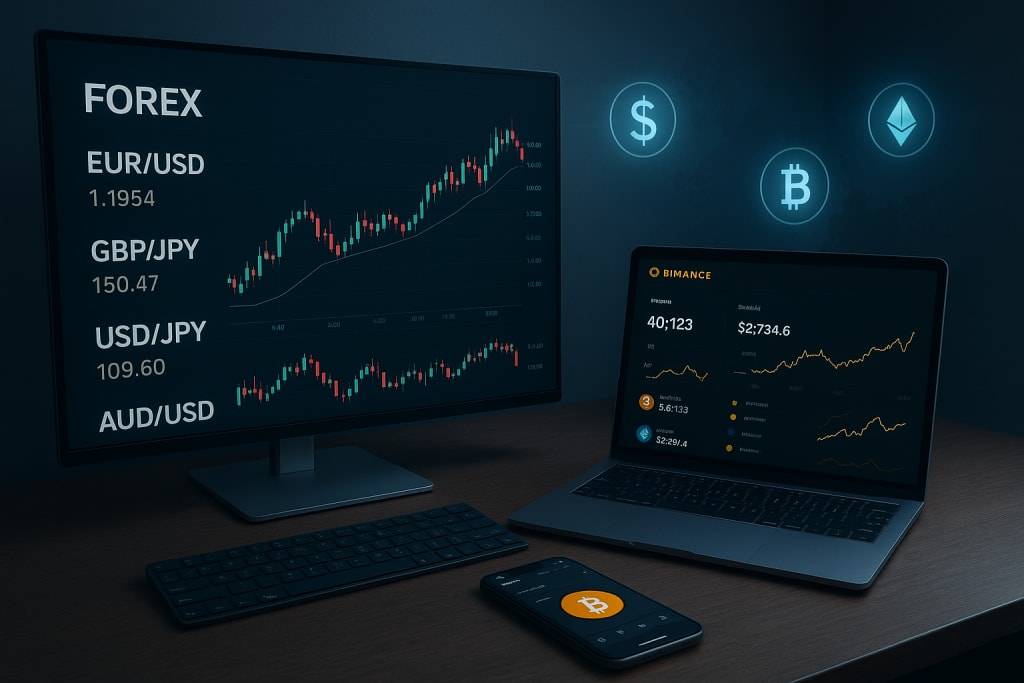
Forex vs Binance
BY [ WAQAR ALI ]
Understanding the Key Differences in Global Trading
In today’s fast-changing financial landscape, trading has become more accessible than ever. From traditional currency exchanges to cutting-edge cryptocurrency platforms, the opportunities to invest, trade, and grow wealth are expanding. Yet for newcomers, it can often be confusing to understand the differences between Forex (foreign exchange trading) and platforms like Binance, which represent the rapidly growing world of cryptocurrency. Both involve global markets, both thrive on speculation and strategy, and both offer the possibility of significant returns—but they operate in fundamentally different ways.
This article explores the major differences between Forex and Binance, helping you gain clarity on where they overlap, how they differ, and which might be a better fit depending on your goals.
What is Forex?
Forex, short for the foreign exchange market, is the world’s largest financial market. It involves the trading of national currencies—such as the U.S. Dollar (USD), Euro (EUR), Japanese Yen (JPY), and British Pound (GBP). Unlike stock markets, Forex does not have a centralized exchange; it operates 24 hours a day, five days a week across banks, brokers, and financial institutions worldwide.
Traders in Forex aim to profit from fluctuations in exchange rates. For example, if you believe the Euro will strengthen against the Dollar, you can buy EUR/USD and later sell it at a higher price. Forex is deeply connected to global economics, political events, and international trade, making it a market heavily influenced by real-world events like interest rate changes, inflation, or geopolitical conflicts.
What is Binance?
Binance is the world’s largest cryptocurrency exchange by trading volume. Founded in 2017, it quickly rose to dominance by offering fast, affordable, and user-friendly access to crypto markets. Unlike Forex, which deals only in fiat currencies, Binance enables users to trade digital assets like Bitcoin (BTC), Ethereum (ETH), and thousands of other cryptocurrencies and tokens.
Binance is more than just a trading platform—it is an entire ecosystem. It offers features like:
Spot trading of cryptocurrencies
Futures and options for advanced traders
Staking to earn passive income from holding certain coins
Decentralized exchange (DEX) for peer-to-peer trading
Launchpad for new crypto projects
Where Forex is tied to the traditional global financial system, Binance represents the new frontier of decentralized finance (DeFi).
Key Differences Between Forex and Binance
While both Forex and Binance are platforms for trading, they differ significantly in scope, function, and risk profile. Let’s break down the major differences:
1. Assets Traded
Forex: National fiat currencies (e.g., USD, GBP, EUR).
Binance: Cryptocurrencies, digital tokens, and blockchain-based assets.
Forex is rooted in government-backed money, while Binance deals in decentralized, blockchain-powered currencies that are not controlled by central banks.
2. Market Hours
Forex: Open 24/5, closing on weekends.
Binance: Open 24/7, with no breaks.
The crypto market never sleeps, which can be both exciting and stressful. Traders must be prepared for volatility at all hours of the day.
3. Volatility and Risk
Forex: Generally less volatile, influenced by macroeconomic events and policy decisions.
Binance: Highly volatile, with sudden price swings of 10–20% or more in a single day.
Forex offers relative stability, while Binance offers higher risk but also potentially higher reward.
4. Regulation
Forex: Heavily regulated by financial authorities in most countries (e.g., SEC, FCA, ASIC).
Binance: Crypto regulations are still evolving, and in some countries, Binance operates under restrictions or without full approval.
This difference makes Forex feel safer to many traditional investors, while Binance attracts those who prefer a decentralized and less restricted environment.
5. Leverage Options
Forex: Brokers often offer leverage ratios as high as 100:1 or more, allowing traders to control large positions with small capital.
Binance: Also offers leverage, but with restrictions depending on the region and asset type. Crypto leverage is riskier due to extreme volatility.
6. Technology and Accessibility
Forex: Traditionally accessed through broker platforms like MetaTrader 4 or 5.
Binance: Mobile-first, app-driven, with features designed for both beginners and experts.
Binance appeals to a younger, tech-savvy generation that embraces apps, blockchain, and digital wallets.
Which One is Better for You?
The answer depends on your risk tolerance, goals, and trading style.
If you value stability, regulation, and global economic relevance, Forex may be the better choice. It’s well-established, with decades of history and strong institutional backing.
If you want to explore cutting-edge financial technology, take advantage of rapid price movements, and diversify into digital assets, Binance provides exciting opportunities.
Many modern traders choose to participate in both markets, using Forex for consistency and Binance for growth potential.
The Future of Trading
The world of finance is changing rapidly. Forex will always remain crucial because national currencies are the backbone of the global economy. However, Binance and the broader cryptocurrency market represent a new era of digital finance. As blockchain adoption grows, the two worlds may eventually merge—imagine Forex brokers offering crypto pairs side by side with fiat pairs, or Binance enabling tokenized versions of traditional currencies.
For now, understanding the differences between Forex and Binance is key to making informed decisions. Whether you stick to Forex, dive into Binance, or balance both, one thing is clear: the future of trading has never been more dynamic or more exciting.
About the Creator
WAQAR ALI
tech and digital skill
Beginner Investing Blueprint: A Simple Path Toward Wealth and Financial Freedom
Investing is one of the most powerful ways to build wealth and reach financial freedom. Yet many people delay investing because it feels complex or risky. The truth is that investing does not need to be complicated. A clear beginner investing blueprint can help anyone start building a strong financial future.
By Millicent Prince2 days ago in Education
Education Technology SaaS Tools Market to Hit USD 155.4 Billion by 2034
Market Overview The Education Technology SaaS Tools market has grown rapidly as educational institutions increasingly rely on cloud-based software platforms to manage learning processes, administrative operations, and digital content delivery. Software delivered through the Software-as-a-Service model allows schools, universities, and training organizations to access scalable learning platforms without investing heavily in physical infrastructure. These tools support online learning management, student performance tracking, collaborative classrooms, and digital assessments.
By Roberto Crum7 days ago in Education
Early March 2026: 4 Goals Accomplished
It's early March and I've now accomplished my 4th writing goal for the year of 2026. Before diving into the behind-the-scenes of it... why not tell you up front what that accomplishment was? I was published in a 2nd publication for this year. Published in Helix Literary Magazine out of Central Connecticut State University. You can read it for free right now!
By Stephen Kramer Avitabile5 days ago in Writers



Comments
There are no comments for this story
Be the first to respond and start the conversation.