
Exploring the Universe: A Complete Overview of Our Cosmic Home
The universe is an extraordinary and mysterious place that has fascinated humans for thousands of years. From the smallest particles to the largest galaxy clusters, everything we know — and everything we have yet to discover — is part of this vast cosmic system. We will explore what the universe is, how it is structured, how it began, and the incredible phenomena that shape it.


What Is the Universe?
The universe refers to all of space and time, including every form of matter, energy, and radiation. It contains everything we can observe with telescopes and instruments, as well as things that remain invisible, such as dark matter and dark energy.
Even with advanced scientific tools, our understanding of the universe is still evolving — and many mysteries remain unsolved.
Major Components of the Universe
1. Galaxies
Galaxies are massive systems made of stars, planets, gas, dust, and dark matter. There are billions of galaxies, each with unique shapes and sizes.
Our galaxy, the Milky Way, is a spiral galaxy containing more than 100 billion stars.
2. Stars
Stars are enormous spheres of hot gas that produce energy through nuclear fusion. They vary in size, temperature, color, and lifespan. The Sun — a medium-sized star — makes life possible on Earth.
3. Planets
Planets are celestial bodies that orbit stars. They can be:
Terrestrial (rocky) — like Earth, Mars, and Venus
Gas giants — like Jupiter and Saturn
Astronomers estimate that there are trillions of planets in the observable universe.
4. Dark Matter and Dark Energy
These two components are invisible yet dominant in the universe:
Dark Matter: Holds galaxies together with its gravity
Dark Energy: Drives the accelerated expansion of the universe
Together, they make up 95% of the universe, while visible matter is only 5%.
The Structure of the Universe
The universe is not random; it has a beautiful and complex arrangement.
1. The Cosmic Web
Galaxies form giant filaments that stretch across unimaginable distances. These filaments create a web-like pattern separated by massive empty regions called voids.
2. Galaxy Clusters
Clusters are groups of galaxies bound together by gravity.
Our Milky Way belongs to the Local Group, which contains around 50 galaxies.
3. Superclusters
Superclusters are the largest cosmic structures.
We live in the Laniakea Supercluster, home to over 100,000 galaxies.
4. The Observable Universe
The observable universe is about 93 billion light-years across, but scientists believe the full universe could be far larger — or even infinite.
How Did the Universe Begin? (The Big Bang Theory)
The most accepted scientific explanation for the universe’s origin is the Big Bang Theory.
1. The Big Bang Event
Around 13.8 billion years ago, the universe started from a tiny, extremely hot and dense point. It expanded rapidly — and continues expanding today.
2. Formation of Elements
Within minutes, the universe cooled enough to form simple elements like hydrogen and helium.
3. Birth of Stars and Galaxies
Gravity pulled gas clouds together, forming the first stars. These stars later produced heavier elements, leading to the creation of galaxies, planets, and eventually life.
4. Ongoing Evolution
The universe continues to change — stars form and die, galaxies collide, and space keeps expanding.
Amazing Phenomena in the Universe
1. Black Holes
Regions where gravity is so strong that nothing — not even light — can escape. They form from collapsed massive stars.
2. Supernovae
Powerful star explosions that briefly outshine entire galaxies. They create heavy elements like gold and iron.
3. Neutron Stars
Ultra-dense remnants of supernovae. A teaspoon of neutron-star material can weigh billions of tons.
4. Galactic Collisions
Galaxies often merge. The Milky Way will collide with the Andromeda Galaxy in about 4.5 billion years.
5. Cosmic Microwave Background (CMB)
A faint glow left over from the Big Bang. It provides clues about the early universe.
The Expansion of the Universe
In the 1920s, Edwin Hubble discovered that galaxies are moving away from us. This meant the universe is expanding — and even more surprisingly, the expansion is accelerating.
The Role of Dark Energy
This acceleration is believed to be caused by dark energy, an unknown force that makes up 68% of the universe.
Possible Futures of the Universe
Scientists propose several scenarios:
1. The Big Freeze
The universe expands forever. Stars burn out, galaxies fade, and everything becomes cold and dark.
2. The Big Crunch
Gravity eventually stops the expansion and pulls everything back into a single point.
3. Continued Expansion
Dark energy continues pushing galaxies apart endlessly.
Conclusion
The universe is a vast, dynamic, and awe-inspiring place filled with mysteries waiting to be uncovered. From the Big Bang to the formation of galaxies, planets, black holes, and cosmic structures, every discovery brings us closer to understanding our origins and our place in the cosmos.
As science progresses, humanity will continue exploring the universe — revealing new wonders and expanding our knowledge of reality itself.
About the Creator
Keep reading
More stories from shahkar jalal and writers in Education and other communities.
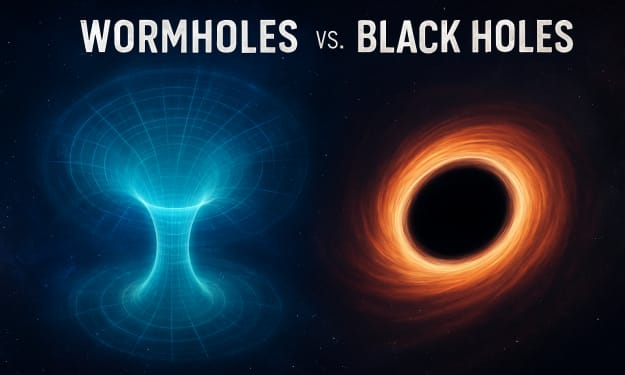
Wormholes vs. Black Holes: Understanding the Key Differences
What Is a Black Hole? Definition A black hole is an extremely dense region in space where gravity is so strong that nothing—not even light—can escape. This boundary around it is called the event horizon, and anything that crosses it is permanently trapped.
By shahkar jalal2 months ago in Education
Invisible Radiation in Everyday Life
We live in a world powered by invisible signals. From the moment you wake up and check your phone, to working on a laptop, connecting to WiFi, using Bluetooth earbuds, or scrolling before bed—your body is constantly surrounded by electromagnetic fields (EMFs). They’re an unavoidable part of modern life, yet most people rarely stop to think about how continuous exposure may affect their energy, sleep, focus, and overall well-being.
By Inamullah Momand 3 days ago in Education
Core Skills Every Finance Professional Needs Today
Financial analysis is one of the most critical abilities for anyone working in finance today. Companies rely on clear and accurate financial information to make smart business decisions. Finance professionals must understand how to read numbers, study trends, and guide action based on facts. These must-have financial analysis skills help workers become stronger, more confident, and more valuable in their roles. When used well, these skills support better planning, lower risk, and long-term success. Because of this, developing strong financial analysis skills is essential for finance professionals at every level.
By Andrew Lake2 days ago in Education


Comments
There are no comments for this story
Be the first to respond and start the conversation.