
Wormholes vs. Black Holes: Understanding the Key Differences
In the world of astrophysics, two mysterious concepts often capture our imagination: black holes and wormholes. Although both arise from Einstein’s theory of general relativity and deal with the fabric of space-time, they are entirely different phenomena. This article breaks down what they are, how they work, and why they matter....

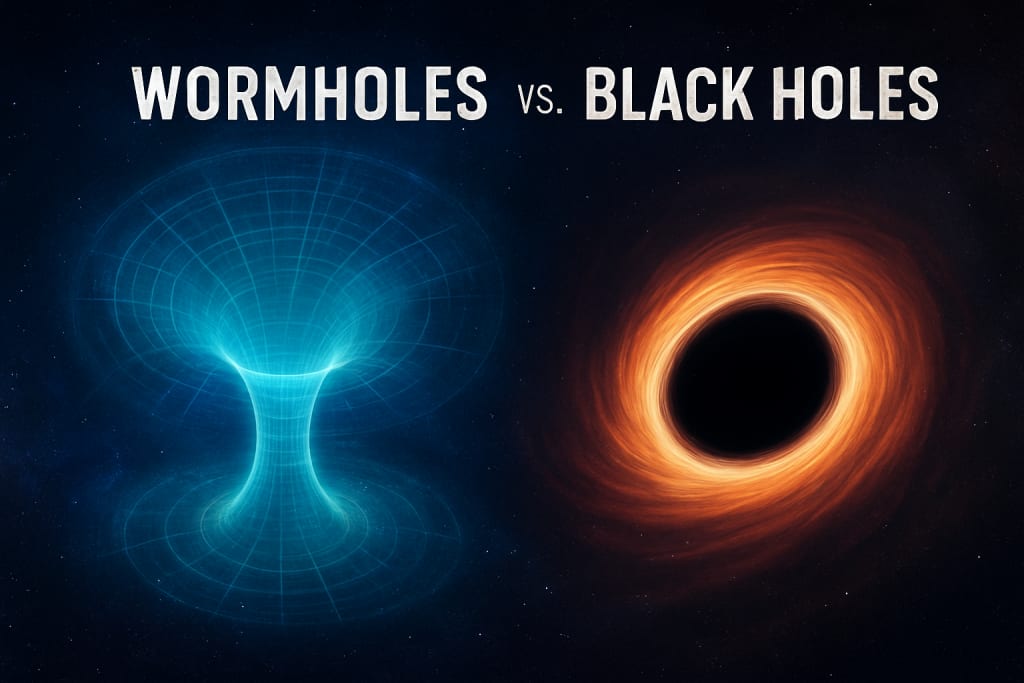
What Is a Black Hole?
Definition
A black hole is an extremely dense region in space where gravity is so strong that nothing—not even light—can escape. This boundary around it is called the event horizon, and anything that crosses it is permanently trapped.
How Black Holes Form
Black holes form through well-studied astronomical processes:
Life Cycle of a Massive Star:
Massive stars fuse elements in their core to generate energy. Over millions of years, they burn through their fuel.
Supernova Explosion:
Once the fuel is exhausted, the star can no longer fight against its own gravity. Its core collapses, and the outer layers explode outward in a supernova.
Core Collapse into a Black Hole:
If the remaining core is more than three times the mass of the Sun, it collapses into a black hole.
Types of Black Holes
Stellar Black Holes: Formed from single massive stars.
Supermassive Black Holes: Found at the centers of galaxies, containing millions to billions of solar masses.
Intermediate Black Holes: Mid-sized black holes believed to form through merging stellar black holes.
Evidence for Black Holes
Black holes are no longer just theoretical. Scientists have observed:
X-rays from matter heating as it falls in.
Gravitational waves from black hole mergers.
The first-ever image of a black hole’s shadow in galaxy M87.
All of this confirms that black holes are real physical objects.
What Is a Wormhole?
Definition
A wormhole is a hypothetical tunnel through space-time that could connect two distant points in the universe. If real, a wormhole could function like a cosmic shortcut, reducing travel time between far-away regions.
How Wormholes Work
Wormholes arise from mathematical solutions to Einstein’s theory of general relativity. These solutions suggest that space-time can bend and fold in such a way that two locations are joined by a short tunnel.
A wormhole would have:
Two mouths (entry and exit points)
A throat (the tunnel) connecting them
Types of Wormholes
Traversable Wormholes: Hypothetical structures stable and wide enough for objects or spacecraft to pass through.
Non-Traversable Wormholes: Collapse instantly, making travel impossible.
Scientific Status
Wormholes remain entirely theoretical. They:
Have no observational evidence
Require exotic matter to stay open
Were first proposed by Einstein and Rosen in 1935, known as the Einstein-Rosen Bridge
Despite their popularity in science fiction, wormholes are not yet proven to exist.
Key Differences Between Wormholes and Black Holes
1. Nature
Black Holes: Real, observable, incredibly dense objects with strong gravity.
Wormholes: Theoretical passages connecting two regions of space-time.
2. Formation
Black Holes: Form through stellar collapse.
Wormholes: Predicted by equations, not known to form naturally.
3. Accessibility
Black Holes: One-way gravitational traps. Nothing escapes after crossing the event horizon.
Wormholes: If they exist and are stable, they could allow two-way travel across space.
4. Evidence
Black Holes: Supported by decades of observations and scientific measurements.
Wormholes: No observational or experimental evidence.
5. Effects on Space-Time
Black Holes: Warp space-time through intense gravity.
Wormholes: Would bend space-time into a bridge between two distant points.
Why Black Holes Are Important
Black holes help scientists test the limits of:
Gravity
Space-time curvature
Quantum physics
Galaxy evolution
They are natural laboratories for exploring physics under extreme conditions.
Why Wormholes Fascinate Scientists
Although unproven, wormholes inspire exciting possibilities:
Faster-than-light travel
Instant movement across galaxies
Time travel theories
Potential access to parallel universes
Wormholes remain a central idea in theoretical physics and an essential part of science fiction storytelling.
Conclusion
Black holes and wormholes are fascinating but very different concepts. Black holes are real astronomical objects created by collapsing stars, known for their extreme gravity. Wormholes are hypothetical tunnels that could, in theory, connect distant regions of the universe but have never been observed.
Understanding these differences deepens our knowledge of the universe and sparks curiosity about what may lie beyond the boundaries of modern science. As research continues, future discoveries may bring us closer to understanding whether wormholes could ever exist — and what mysteries they might reveal.
About the Creator
Keep reading
More stories from shahkar jalal and writers in Education and other communities.
Understanding Black Holes: Definition, Formation, and Their Role in the Universe
What Is a Black Hole? A black hole is a region of space with gravity so intense that nothing—not even light—can escape its pull. Because they emit no light, black holes are invisible. Astronomers detect them by observing the effects they have on nearby stars, gas, and light.
By shahkar jalal2 months ago in Education
The Psychology of Conviction: How Successful People Execute Bold Ideas Fearlessly
Executing bold ideas requires more than just ambition and creativity; it demands a powerful mindset. Many people come up with great ideas, but only a few can confidently and consistently turn those ideas into reality. What separates those who execute fearlessly from those who hesitate or abandon their plans is a deep psychological understanding of conviction.
By Brian Ferdinandabout 3 hours ago in Education
Center Stage with Gina C.
*** I'm keen to republish the interviews I did for my series with Vocal creators. It's been a few years and I thought it might be nice to revisit these wonderful conversations. I'll be releasing them one at a time for a few weeks/months.
By Heather Hubler7 days ago in Interview


Comments
There are no comments for this story
Be the first to respond and start the conversation.