
"Exploring the Depths: Unveiling the Mysteries of the Mariana Trench"
"Unraveling the Secrets of Earth's Most Enigmatic Abyss"

Introduction
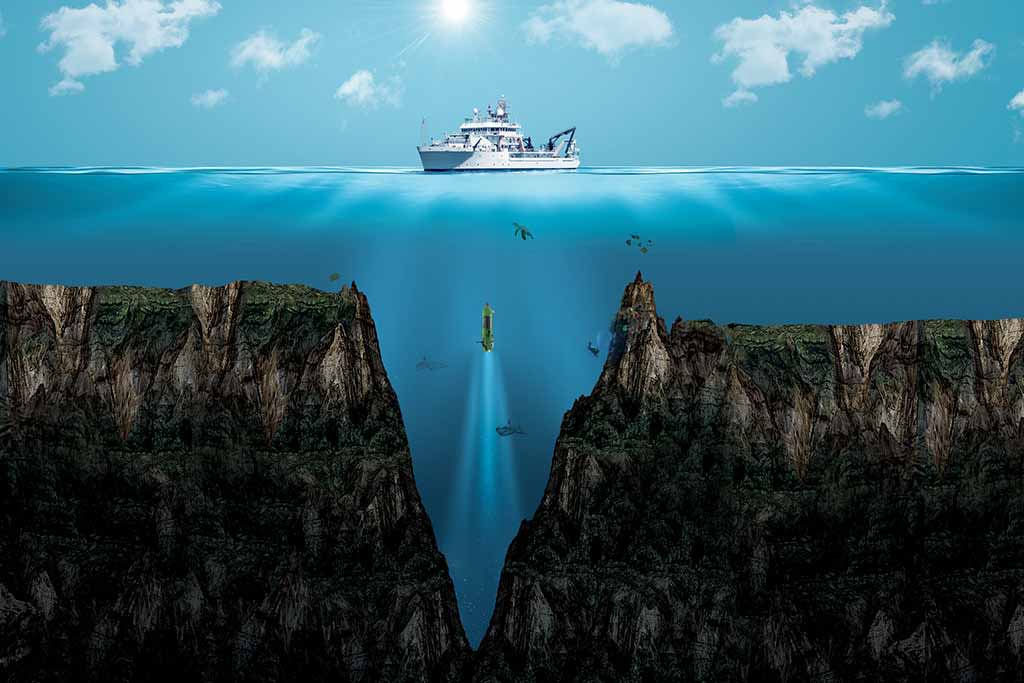
The Mariana Trench, a chasm in the western Pacific Ocean, stands as a testament to the extraordinary depths and enigmatic nature of our planet. With its staggering depths reaching 36,070 feet (10,994 meters), this trench holds secrets that have captivated explorers and scientists for decades. In this exploration, we embark on a journey to uncover the mysteries concealed within the deepest place on Earth, shedding light on its fascinating geology, unique inhabitants, and the scientific significance it holds.
The Geographical Wonder
Located in the Pacific Ocean near the Mariana Islands, the trench stretches over 1,580 miles (2,550 kilometers) long and 43 miles (69 kilometers) wide. Its depth exceeds the height of Mount Everest, the highest peak on land, by more than 6,000 feet (1,800 meters). This trench remains an exceptional geological marvel formed by the collision of tectonic plates, where the Pacific Plate subducts beneath the Mariana Plate.
The Abyssal Depths
Descending into the Mariana Trench is a feat reserved for the most advanced submersibles and daring explorers. The immense pressure at these depths, reaching over 1,000 times the pressure at the sea level, challenges the limits of human exploration. Only a few manned expeditions, such as Jacques Piccard and Don Walsh's 1960 voyage in the Trieste, have ventured to its deepest point, the Challenger Deep.
Life in the Depths
Contrary to initial beliefs of a lifeless abyss, the Mariana Trench teems with extraordinary life adapted to extreme conditions. Unique species such as amphipods, snailfish, and microbial organisms have adapted to survive in total darkness and withstand immense pressure. Studying these creatures unveils new insights into the adaptability of life forms and their potential implications for astrobiology.
Scientific Significance
Beyond its biological wonders, the trench serves as a living laboratory for scientific exploration. Its unique conditions offer a glimpse into Earth's geological processes, helping scientists understand plate tectonics, seismic activities, and the composition of Earth's crust. Furthermore, exploring the trench may provide insights into the potential for life in other extreme environments, including icy moons like Europa and Enceladus.
Geological Significance:
Tectonic Activity: The trench is a result of tectonic plate activity. The Pacific Plate subducts beneath the Mariana Plate, causing a deep trench. It's a prime location for studying subduction zones, helping scientists understand how plates move and interact.
Geological Processes: Investigating the trench provides insights into the Earth's geological history. The rock formations, sediment layers, and mineral compositions found in its depths offer clues about the Earth's past and ongoing geological processes.
Exploratory Significance:
Human Exploration: Despite its challenges, explorations into the Mariana Trench have pushed the boundaries of human knowledge and technological capabilities. The few manned missions have provided valuable data and expanded our understanding of the deep sea.
Technological Development: Developing vehicles and instruments capable of withstanding the extreme pressure and darkness of the trench has spurred advancements in marine technology and robotics.
Mysteries:
Life in Extreme Conditions: The trench hosts a variety of unique and poorly understood life forms. These organisms have adapted to extreme pressure, darkness, and limited food sources, offering insights into the adaptability and resilience of life.
Unexplored Territory: Most of the trench remains unexplored. The deepest point, Challenger Deep, remains largely unknown, leaving many questions unanswered about its geological formations, potential undiscovered life, and undiscovered phenomena.
Scientific Unknowns: The Mariana Trench holds secrets about Earth's geology, the origins of life, and the limits of adaptation. Exploring these unknowns could yield discoveries with implications not only for understanding our planet but also for astrobiology and our understanding of life in the cosmos.
Conclusion
The Mariana Trench stands as a testament to the uncharted territories and mysteries that still exist on our planet. Its depths not only hold scientific significance but also provoke philosophical contemplation about the resilience and diversity of life. As technology advances and our understanding grows, this enigmatic abyss continues to beckon scientists and adventurers alike, inviting us to uncover its secrets and broaden our understanding of Earth's most profound depths.
About the Creator
Siva N
Whenever I write a story, I will bite these things
1.Research Prowess
2.Scientific Acumen
3.Storytelling Mastery
4.Attention to Detail
5.Inquisitive Mindset
6.Adaptability and Creativity
7.Structure and Clarity
8.Empathy and Engagement
Taher Saifuddin: Transforming Toronto’s Classrooms with Inclusive and Future-Focused Education
In the heart of Canada’s most diverse city, Toronto educator Taher Saifuddin is quietly leading a transformation in the way learning is delivered, measured, and experienced. With over two decades of experience, Taher is recognized for his dynamic role in teaching, academic leadership, and digital innovation across Toronto’s private and independent schools.
By Dena Falken Esq6 days ago in Education
What People Get Wrong About Consulting
Many people talk about consulting, but few understand what it truly involves. Movies, social media, and word of mouth often shape a narrow view. This creates confusion for students, business owners, and even new consultants. The topic of common misconceptions about consulting matters because these beliefs affect career choices and business decisions. When ideas are wrong, expectations break down fast.
By Nicole Metz6 days ago in Education
Silver Screen Magic with Mae West
American actress and singer Mae West became a popular film actress during the Great Depression. She started entertaining in vaudeville, then performed on Broadway, and finally went to Hollywood. She signed up with Paramount Pictures and made her debut in the 1932 film “Night After Night.” She also starred in musicals, comedies, and crime dramas. The American Film Institute named her one of the best classic Hollywood actresses.
By Rasma Raisters6 days ago in Geeks


Comments (1)
Imagine these implications: "adapted to survive in total darkness and withstand immense pressure."