
Eukaryotic Organisms
Nucleus, Golgi complex, mitochondria and chloroplast
Eukaryotic organisms
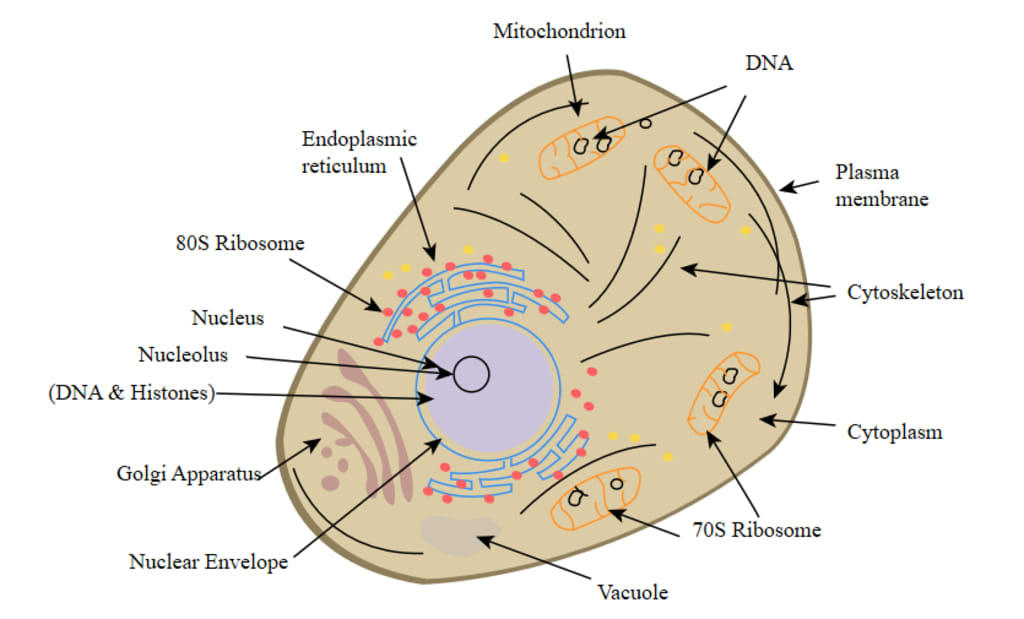
Eukaryote creatures consist of one or more cells, each of which has a membrane-enclosed nucleus and other organelles. Eukaryotic cells differ from prokaryotic cells in that they have organelles that are membrane-bound, particularly the nucleus, which is surrounded by the nuclear envelope and houses the genetic material. Other membrane-bound organelles like the Golgi apparatus and mitochondria are also present in eukaryotic cells. Chloroplasts are also found in plants and algae. Eukaryotic organisms might have one cell or many. Only eukaryotes possess a wide variety of tissues composed of several cell types.
• Anatomy of Eukaryotic Cells
The simplest form of life is the cell. All living cells can be classified into two categories: prokaryotic and eukaryotic (sometimes spelt procaryotic and eucaryotic), based on the arrangement of their cellular structures. Eukaryotic cell types can be found in algae, animals, fungus, plants, protozoans, and fungi. Only prokaryotic cell types are found in bacteria.
Cytoplasmic Membrane
The cytoplasmic membrane of eukaryotic cells is a fluid phospholipid bilayer containing proteins and glycoproteins. It is also known as the plasma or cell membrane. It includes sterols, a class of complex lipids, as well as glycolipids. The cytoplasmic membrane controls what enters and exits the cell since it is a semipermeable membrane. . Simple diffusion, osmosis, passive transport, active transport, endocytosis, and exocytosis are a few of the methods by which substances can travel through the cytoplasmic membrane of eukaryotic cells.
• Cellular Wall
Animal and protozoan cells lack cell walls, while those of algae, fungus, and plants do. The cell wall's hard, close-knit polysaccharide molecular structure aids in the cell's resistance to osmotic lysis.
Endomembrane System
The endomembrane system is made up of a number of components, such as the nucleus, endoplasmic reticulum, and the Golgi complex.
The Nucleus
A fluid termed nucleoplasm, a nucleolus, and linear chromosomes made of negatively charged DNA linked to positively charged basic proteins called histones to create structures known as nucleosomes are all found inside the nucleus. The DNA and proteins that build up the chromosomes are collectively referred to as chromatin and include the nucleosomes. The ribosomal subunits are put together in the nucleolus, a region of the nucleus. The production of ribosomal RNA (rRNA), which joins with ribosomal proteins to generate immature ribosomal subunits that mature after they exit the nucleus through holes in the nuclear envelope and mature in the cytoplasm, is directed by a region of DNA known as the nucleolar organizer.
1. Compared to bacteria, eukaryotic cells have far more DNA, which is arranged into numerous chromosomes that are housed inside a nucleus.
2. In eukaryotic cells, a nuclear envelope separates the nucleus from the cytoplasm.
3. The nucleolus, a component of the nucleus, is where the ribosomal subunits are put together.
4. RNA molecules, primarily messenger RNA (mRNA), transfer RNA (tRNA), and ribosomal RNA (rRNA), are produced from genes that are situated throughout the DNA. At the ribosomes, messenger RNA is subsequently translated into protein.
5. Therefore, in general, DNA controls which proteins and enzymes an organism can produce and, consequently, which chemical reactions it is able to perform.
Endoplasmic reticulum
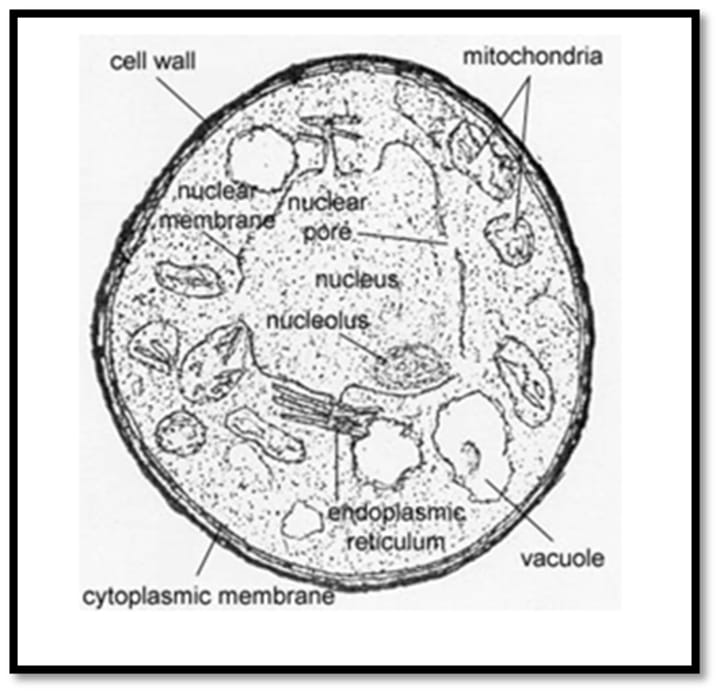
The endoplasmic reticulum, also known as the ER, is a network of flattened sacs and parallel membranous tubules that surrounds the nucleus, connects to the nuclear membrane, and permeates the cytoplasm. The ER has three purposes: 1. it provides a surface area for the production of proteins and lipids; 2. it creates a pathway for the movement of molecules inside the cell; and 3. it serves as a repository for molecules the cell has produced.
The pores of the nuclear envelope are connected to the endoplasmic reticulum. Ribosomal subunits and mRNA produced from genes in DNA can exit the nucleus, enter the cytoplasm, and take part in protein synthesis thanks to pores in the nuclear membrane. The ER is divided into two sections: the rough ER and the smooth ER.
The Golgi Complex (iii)
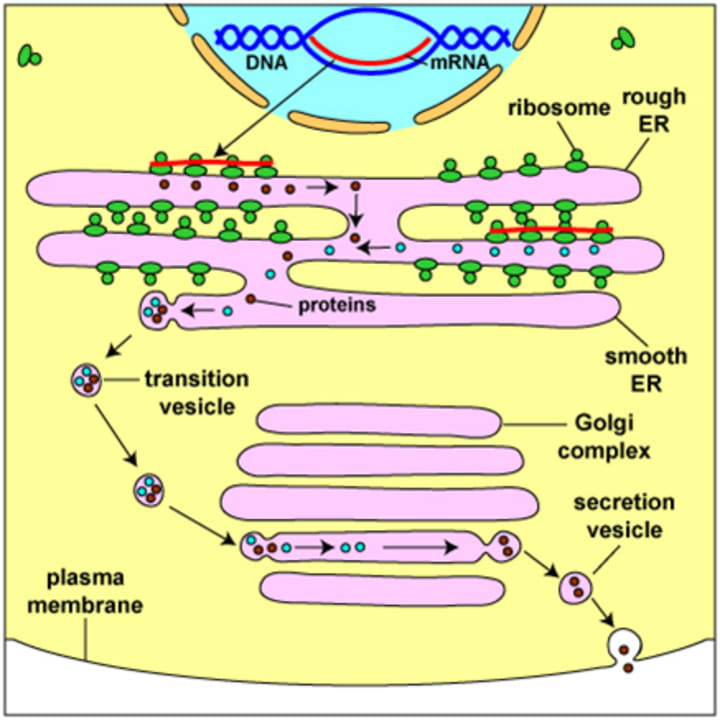
The Golgi complex, also known as the Golgi apparatus, is made up of 3–20 flattened saclike structures, or cisternae. At the borders of the cisternae, there is an intricate network of tubules and vesicles. Proteins and lipids from the ER are sorted at the Golgi complex, certain proteins and glycoproteins are modified, and then these molecules are sorted and packaged into vesicles for transport to other sections of the cell or secretion from the cell.
As was already established, the smooth ER places proteins made in the rough ER into transition vesicles. As the transition vesicles fuse with the Golgi complex membrane, the proteins and glycoproteins inside are then transferred to the Golgi complex.
• Different internal organelles (not endomembranous)
Eukaryotic cells need a variety of specialised internal membrane-bound organelles because of their increased size in order to carry out metabolism and generate energy. The following are some of these: vacuoles, vesicles, lysosomes, peroxisomes, mitochondria, and chloroplasts. We'll now examine the many organelles that are bound to membranes.
i. Mitochondria
1. Mitochondria are rod-shaped organelles with two membranes surrounding them and measuring 2 to 8 micrometres in length.
3. During aerobic respiration, mitochondria work to make ATP through oxidative phosphorylation.
The matrix is where the citric acid cycle's (Krebs cycle) enzymes are found.
5. As mitochondria expand and divide, they replicate, producing new mitochondria. They also possess their own ribosomes and DNA.

ii. Chloroplasts
Chloroplasts are disk-shaped organelles that have a length of 5 to 10 micrometres. Chloroplasts are encased in an inner and an outer membrane, just like mitochondria. The stroma, a fluid-filled area that is enclosed by the inner membrane and includes enzymes for the photosynthesis's light-independent processes, is filled with fluid. The infolding of this inner membrane results in the formation of grana, which are stacks of interconnected thylakoids, or disk-shaped sacs. Chlorophyll and other photosynthetic pigments, as well as electron transport chains, are found in the thylakoid membrane, which encloses a fluid-filled thylakoid interior space. The thylakoids are where photosynthesis' light-dependent reactions take place. The intermembrane area between the inner and outer chloroplast membranes is enclosed by the chloroplast's outer membrane.
About the Creator
Keep reading
More stories from Zainab Amjad and writers in Education and other communities.
Biosensors
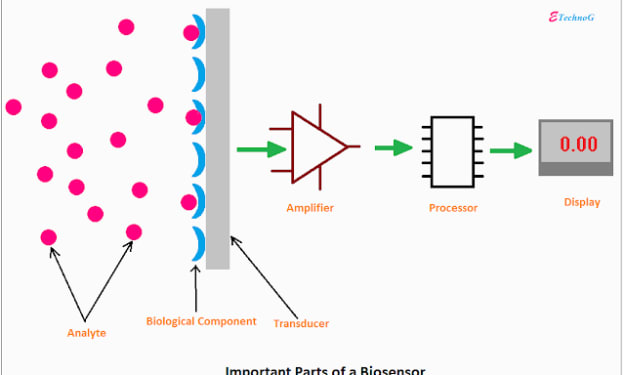
Biosensors Introduction: Innovative tools called biosensors combine biological elements with transducers to find and quantify different biological or chemical analytes. By offering quick and sensitive detection capabilities, these analytical tools have revolutionized a number of industries, including medicine, environmental monitoring, food safety, and many others.
By Zainab Amjad 3 years ago in Education


Comments
There are no comments for this story
Be the first to respond and start the conversation.