

Biosensors
Introduction:
Innovative tools called biosensors combine biological elements with transducers to find and quantify different biological or chemical analytes. By offering quick and sensitive detection capabilities, these analytical tools have revolutionized a number of industries, including medicine, environmental monitoring, food safety, and many others.
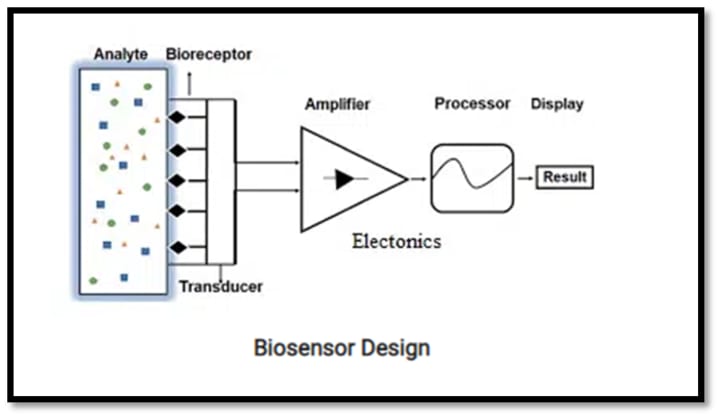
The five different types of biosensors are as follows:
Calorimetric biosensors:
Exothermic reactions are frequently catalysed by enzymes. Following enzyme action, calorimetric biosensors assess the temperature change of the analyte-containing solution and translate it into the concentration of the analyte in the solution. The temperature of the analyte solution is measured shortly before entering the column and just as it exits the column using different thermistors. The analyte solution is passed through a tiny packed bed column containing immobilised enzyme.
This form of biosensor is the most widely applicable and can be utilised with turbid and brightly coloured liquids. The biggest drawback is having to keep the sample stream's temperature within, say, 0.01° C. For the majority of applications, these biosensors' sensitivity and range are rather modest. By connecting numerous processes to boost the heat production, two or more enzymes from the biosensor's pathway can increase sensitivity. Alternatives include multipurpose enzymes. One illustration is the measurement of glucose using glucose oxidaze.
Potentiometric Biosensors:
These biosensors transform a biological reaction into an electrical signal using ion-selective electrodes. The most often used electrodes are solid state electrodes, glass pH electrodes coated with a gas selective membrane, or pH metre glass electrodes (for cations). Many reactions produce or utilise H+, which the biosensor can detect and analyse. In these situations, very weak buffered solutions are employed. Gas production is detected and quantified by gas detecting electrodes. The following reactions are catalysed by urease, which serves as an example of one of these electrodes:
CO (NH2)2 + 2H2O + H+→ 2NH4+ + HCO–3
A pH sensitive, ammonium ion sensitive, NH3 sensitive, or CO2 sensitive electrode can be used.
It is now possible to create incredibly tiny biosensors by attaching enzyme-coated membranes to the ion-selective gates of field effect transistors.
Wave, Acoustic Biosensors:
They can also be referred to as piezoelectric devices. Typically, they have antibodies on their surface that attach to the complementary antigen in the sample solution. The amount of antigen in the sample solution can be estimated using this shift in vibrational frequency, which results in increased mass and lower vibrational frequency.
Amperometric biosensors
It produces a current when a voltage is applied between two electrodes, with the size of the current being proportional to the concentration of the substrate. The Clark oxygen electrode, which determines the decrease of O2 present in the sample (analyte) solution, is used in the simplest amperometric biosensors. These biosensors are from the first generation. These biosensors are employed to track redox reactions, with the measurement of glucose using glucose oxidase serving as a representative example.
The dependence of such biosensors on the amount of dissolved oxygen present in the analyte solution is a significant issue. This can be avoided by utilising mediators, which do not reduce the O2 dissolved in the analyte solution but instead transmit the electrons produced by the reaction directly to the electrode. Additionally known as second-generation biosensors. The electrodes of today, however, are covered with electrically conducting organic salts and remove the electrons from the reduced enzymes directly without the need of mediators.
Optical biosensors
These biosensors track affinities as well as catalytic processes. They gauge an alteration in fluorescence or absorbance brought on by the byproducts of catalytic processes. As an alternative, they track changes in the biosensor surface's intrinsic optical characteristics brought on by the loading of dielectric molecules like proteins (in the case of affinities processes). Firefly enzyme luciferase is a highly promising biosensor that uses light to identify microorganisms in clinical samples or food. In order to liberate ATP, which luciferase uses in the presence of 02 to produce light that is detected by the biosensor, the bacteria are specially lysed.
About the Creator
Keep reading
More stories from Zainab Amjad and writers in Education and other communities.
Creating a Higher Education Legacy in Monterey
Not Known for Colleges Picturesque Monterey, California is not known as a college town. Instead, its recent fame was that of being the old stomping grounds for John Steinbeck and the current location of a world-class marine aquarium.
By Dean Traylora day ago in Education



Comments
There are no comments for this story
Be the first to respond and start the conversation.