
Elon Musk - Major AI Projects
Known for Tesla, SpaceX and even Twitter!
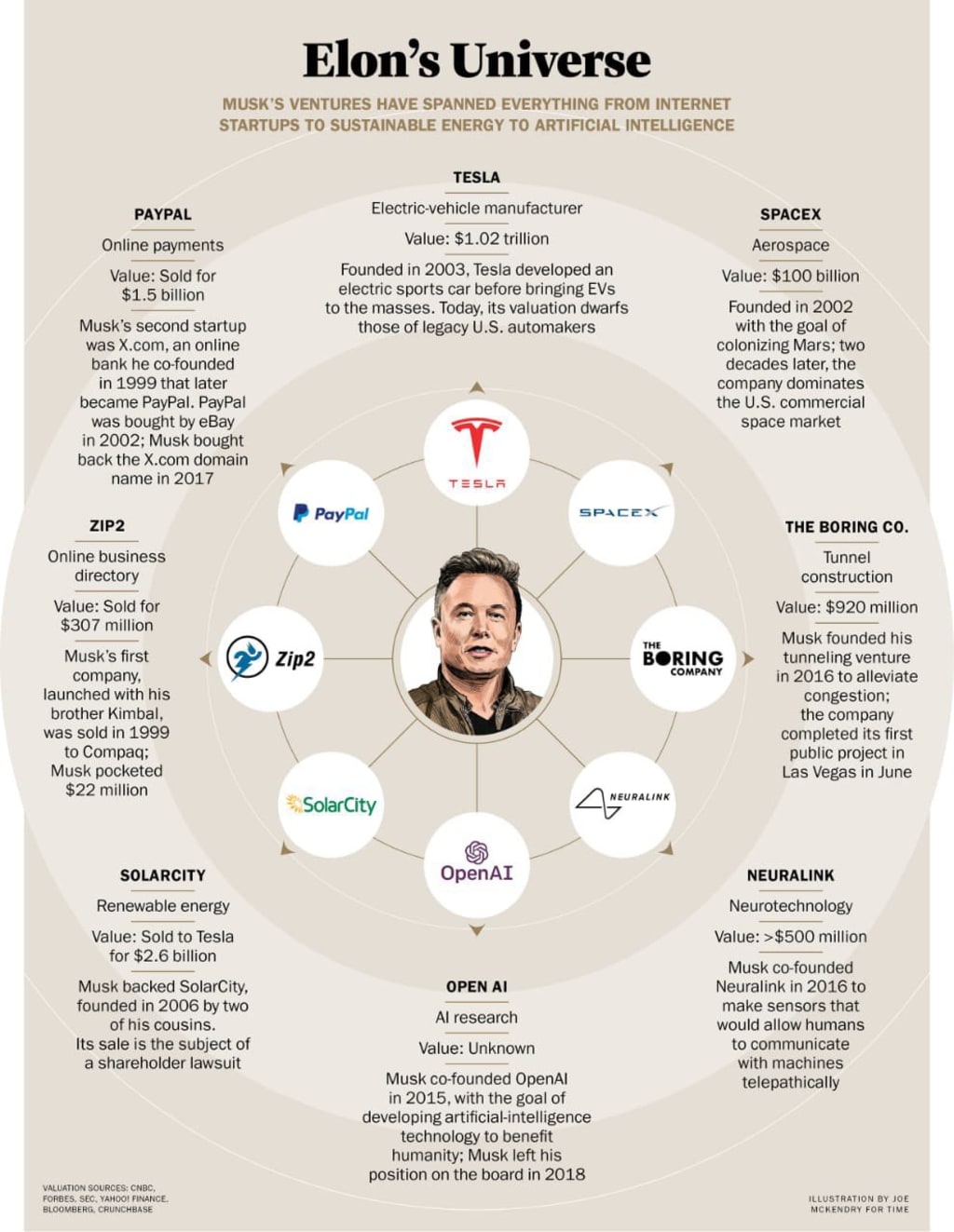
Elon Musk has been involved in several projects related to artificial intelligence (AI). Some notable projects include:
1.Neuralink:
- Developing implantable brain-machine interfaces (BMIs)
- The goal of Neuralink is to use these BMIs to treat a variety of brain and nervous system disorders, such as Parkinson's disease and Alzheimer's disease, as well as to enhance human cognitive abilities.
- One of the main technologies being developed by Neuralink is called the "neural lace," which refers to a mesh of electrodes that can be implanted in the brain. These electrodes can be used to monitor brain activity and stimulate specific brain regions, which could potentially be used to treat disorders or enhance cognitive functions.
2.OpenAI :
- Research laboratory focused on advancing artificial intelligence (AI)
- It was founded in 2015 by Elon Musk, Sam Altman, Greg Brockman, Ilya Sutskever, and Wojciech Zaremba, with the goal of advancing and promoting AI in a way that is safe for humanity.
- Conducts research in a wide range of areas related to AI, including machine learning, robotics, and economics
- Goal is to promote the development of AI technologies that are beneficial to humanity
- Established principles and guidelines for the development of AI and conducts research on the ethical, social, and economic implications of AI
- Influential player in the field of AI known for its research on a wide range of topics related to the development and deployment of AI technologies.
- One of OpenAI's most well-known projects is the development of GPT (Generative Pre-training Transformer), a natural language processing model that has achieved state-of-the-art results on a number of language tasks.
- It includes Computer vision, OpenAI has also conducted research on using AI and machine learning to enable computers to see and understand images and video. This includes work on object recognition, image segmentation, and image generation.
3.DeepMind :
- Company focused on developing advanced AI technologies, particularly in the areas of machine learning by Neural Networks and reinforcement learning
- In Reinforcement learning, DeepMind has made significant contributions to the field of reinforcement learning, which involves training agents to take actions in an environment in order to maximize a reward. This includes the development of the AlphaGo and AlphaZero systems, which have achieved superhuman performance in the games of Go and chess, respectively.
- Neural networks: DeepMind is known for its work on neural networks, which are a type of machine learning model inspired by the structure and function of the human brain. DeepMind has developed a number of neural network architectures, including convolutional neural networks (CNNs) and long short-term memory (LSTM) networks, that have achieved state-of-the-art results on a variety of tasks.
- Founded in 2010 and later acquired by Google in 2014
- Developed a number of breakthrough AI systems, including AlphaGo, which was the first computer program to defeat a world champion at the game of Go
- Conducts research on a wide range of topics related to AI, including natural language processing, computer vision, and robotics
- Collaborates with a number of partners in the public and private sectors to develop and apply AI technologies in a variety of fields, including healthcare, energy, and finance.
4.Tesla Autopilot:
- Suite of advanced driver assistance systems (ADAS) available on some Tesla electric vehicles
- The technology is designed to assist drivers in navigating and controlling their vehicles, and is intended to eventually enable fully autonomous driving.
- Designed to assist drivers in navigating and controlling their vehicles
- Intended to eventually enable fully autonomous driving
- Uses a combination of sensors, cameras, and radar to gather data about the vehicle's surroundings
- Utilizes machine learning and other artificial intelligence (AI) techniques to interpret this data and make driving decisions
- Can perform a variety of functions, including lane keeping, adaptive cruise control, and automatic lane changes
- Still requires the driver to be attentive and ready to take control of the vehicle at any time.
About the Creator
Keep reading
More stories from Divyadarshini N and writers in Education and other communities.
How to get started with deep learning?
Deep learning is a branch of machine learning that deals with algorithms inspired by the structure and function of the brain. Also known as neural networks, deep learning models are able to learn complex patterns in data.
By Divyadarshini N3 years ago in Education
How to Gain Real Work Experience in Wealth Management
Breaking into wealth management can feel confusing at first. Many roles ask for experience, but it is not always clear how to get it. The good news is that real wealth management work experience comes from action, not just titles. With the right approach, you can build skills, credibility, and confidence before landing a full-time role.
By John Lennox Cummings7 days ago in Education
Common Online Money
Introduction: The Dark Side of Online Earning The internet has created countless opportunities to earn money online. From freelancing and blogging to online teaching and affiliate marketing, many people now make a living from the digital world. However, along with real opportunities, the internet is also full of scams. Every year, millions of people lose money, time, and personal information because of online money-making frauds. Understanding these scams is the first step to staying safe. This article explains the most common online money-making scams and how you can avoid them.
By Bilal Mohammadi6 days ago in Education


Comments
There are no comments for this story
Be the first to respond and start the conversation.