
Education in Asia: A Tapestry of Tradition, Innovation, and Ambition
Harmony and Progress: Asia's Evolving Educational Vision for a Just and Technologically Advanced World

Introduction
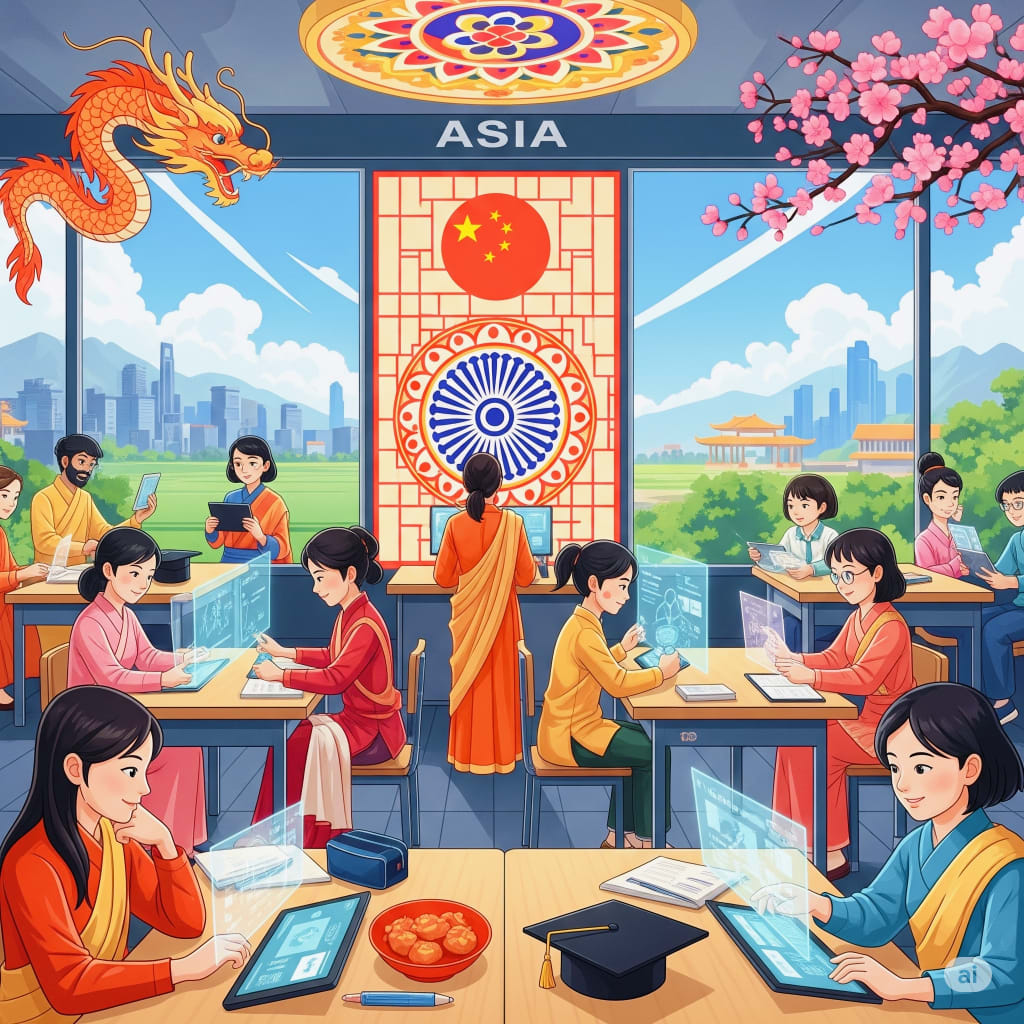
Asia, home to over 4.7 billion people, boasts some of the world’s most dynamic education systems, shaping global leaders in technology, science, and culture. From the ancient gurukuls of India to South Korea’s high-tech classrooms, education in Asia reflects a blend of deep-rooted traditions and cutting-edge innovation. Serving millions of students across diverse economies, Asia’s education landscape is a powerhouse of potential. This post explores its diversity, strengths, challenges, and future, highlighting why Asia is a global education trailblazer.
The Diverse Educational Landscape
Asia’s education systems vary widely, shaped by cultural, economic, and historical contexts. China and South Korea lead with rigorous, centralized systems, achieving top PISA rankings (Shanghai: 1st, South Korea: 7th in 2018). Their focus on STEM produces millions of graduates annually—China alone graduates 4.7 million STEM students yearly. Japan emphasizes holistic education, balancing academics with moral development, while India’s sprawling system serves 250 million students, bolstered by the Right to Education Act (2009). Southeast Asian nations like Singapore excel in outcome-based learning, with Singapore topping global rankings for math and science.
In contrast, developing nations like Cambodia and Myanmar face resource constraints, with literacy rates around 80% and 86%, respectively (UNESCO, 2022). Yet, initiatives like ASEAN’s education integration programs are bridging gaps, promoting regional collaboration. Across Asia, Confucian values in East Asia and collectivist traditions elsewhere drive a cultural emphasis on education as a path to social mobility.
Achievements and Innovations
Asia’s education systems have fueled economic miracles. South Korea’s 98.8% literacy rate and India’s IITs have produced global tech leaders. China’s “Double First-Class” initiative aims to create 42 world-class universities by 2030, while Japan’s research output ranks among the world’s highest. EdTech is transforming learning—India’s EdTech market hit $5 billion in 2024, and China’s platforms like Yuanfudao serve millions. Singapore’s AI-driven adaptive learning and South Korea’s smart classrooms showcase Asia’s technological edge, with 90% of East Asian schools internet-connected.
Challenges Across the Continent
Despite successes, challenges persist. High-stakes exams like China’s Gaokao and South Korea’s Suneung create intense pressure, contributing to mental health issues—25% of Chinese students report anxiety (2023 survey). Socioeconomic disparities are stark: urban students in Shanghai access world-class facilities, while rural schools in India and Laos lack basic infrastructure. India’s ASER 2023 found 48% of rural Class 5 students struggle with basic reading. Overemphasis on rote learning in countries like China and India hampers creativity, with Asia’s R&D spending (1.7% of GDP) trailing Western nations (2.8%, World Bank, 2022). Gender gaps and access for marginalized groups remain issues in countries like Afghanistan, where female education faces restrictions.
The Path Forward: Reforms and Vision
Asia is embracing transformative reforms. China’s Education Modernization 2035 and India’s National Education Policy (2020) prioritize holistic learning, vocational training, and digital integration. South Korea is reducing hagwon reliance, while Singapore’s “Teach Less, Learn More” initiative fosters critical thinking. ASEAN’s focus on inclusive education aims to uplift underserved regions, with programs like Malaysia’s digital literacy push reaching 95% of schools. AI, coding, and green skills are being integrated across curricula, preparing students for a tech-driven future. Public-private partnerships and increased funding—Asia spends 4.1% of GDP on education—are key to addressing inequities.
Conclusion
Education in Asia is a vibrant mosaic, blending tradition with innovation to shape a globalized future. While challenges like pressure, inequality, and outdated methods persist, reforms signal a shift toward inclusivity and creativity. As Asia continues to lead in academic excellence and technological advancement, its education systems will empower billions to drive global progress.
Call to Action
What can Asia’s education systems teach the world? Share your thoughts in the comments and join the conversation on shaping the future of learning!
About the Creator
Arjun. S. Gaikwad
Truth Writing unveils reality beyond illusion, power, and propaganda words that awaken conscience and challenge comfort. Fearless, honest, and thought-provoking, it explores politics, humanity, and spirit to inspire awareness and change.
Keep reading
More stories from Arjun. S. Gaikwad and writers in Education and other communities.
Education in China: A Powerhouse of Scale, Ambition, and Transformation
Introduction China’s education system, one of the largest in the world, serves over 250 million students and reflects the nation’s drive for global leadership. Rooted in a millennia-old reverence for learning, China has modernized its education to fuel economic growth and innovation. With a literacy rate of 99.8% (UNESCO, 2022) and top PISA rankings, China’s system is a blend of tradition and ambition. This post explores its structure, achievements, challenges, and future trajectory, offering a glimpse into a dynamic educational landscape.
By Arjun. S. Gaikwad7 months ago in Education
Common Online Money
Introduction: The Dark Side of Online Earning The internet has created countless opportunities to earn money online. From freelancing and blogging to online teaching and affiliate marketing, many people now make a living from the digital world. However, along with real opportunities, the internet is also full of scams. Every year, millions of people lose money, time, and personal information because of online money-making frauds. Understanding these scams is the first step to staying safe. This article explains the most common online money-making scams and how you can avoid them.
By Bilal Mohammadi2 days ago in Education
Connected Wealth: Why Strong Networks Are Essential to Smarter Financial Planning
Financial planning is often associated with spreadsheets, forecasts, and long-term projections. While these technical elements are essential, they represent only one side of the process. Relationships, shared knowledge, and access to broader communities strengthen a truly effective financial plan. Networks—both personal and professional—play a critical role in shaping smarter, more resilient financial strategies.
By Lee Generous5 days ago in Education


Comments
There are no comments for this story
Be the first to respond and start the conversation.