
"Demystifying Naïve Bayes: Log Probability and Laplace Smoothing"
"Mastering Naïve Bayes: Advancements and Techniques"
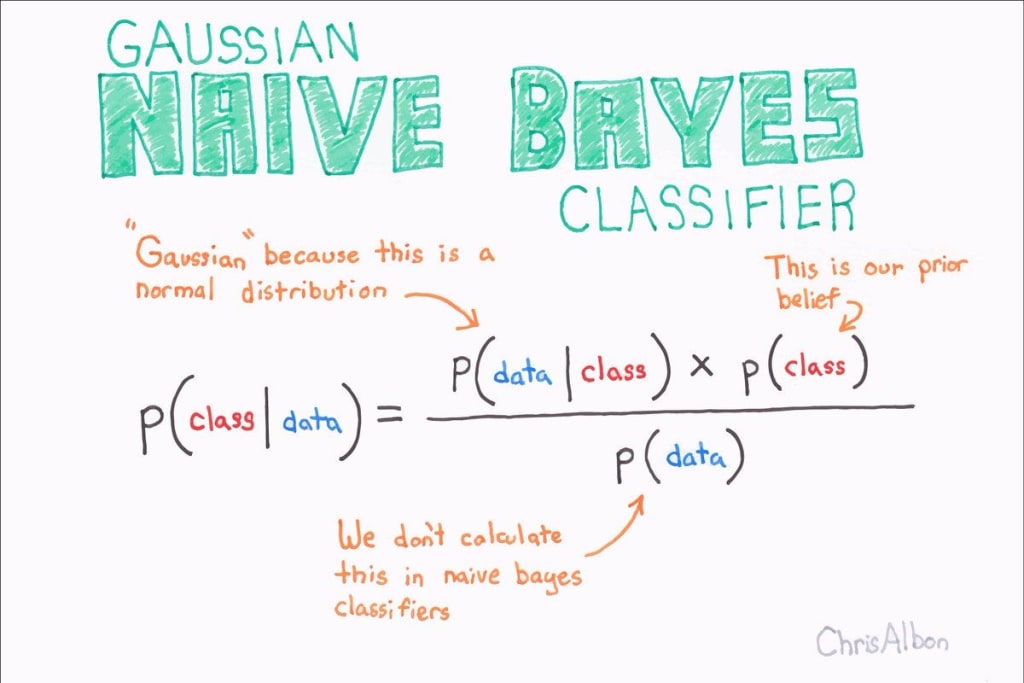
Before moving forward pls read this article first then you can understand further ….
Agenda:
Advancing Naive Bayes
. Types of Naive Bayes
- The Concept of Log Probability
- The Concept of Laplace Smoothing
Numerical stability
In the earliest days of programming, developers often encountered difficulties when it came to storing decimal or floating-point values in computer memory. While they could easily represent whole numbers, representing decimal values posed a challenge.
The reason behind this challenge is that computers use binary representation, using only 0s and 1s, to represent any number. Consequently, it becomes challenging to accurately represent decimal values in binary form. For instance, when representing extremely small numbers like 0.000001, precision can be lost, and the value may be treated as 0.
Let's consider an example in the field of biology. Suppose you are measuring the radius of a cell. In some cases, your measurements might be extremely small, such as 0.00000001. Now, let's say you want to compare this radius to another cell's radius, which is 0.0000003. Due to the limitations of computer representation, the computer will treat both values as zero, leading to the incorrect conclusion that both cells have equal radii. This condition is referred to as underflow.
Underflow refers to a situation in which values smaller than the smallest representable value in a computer's numeric system are rounded down to zero.
Let's explore underflow in the context of a simple example. Suppose you are trying to predict whether a student will get a placement based on their CGPA (Cumulative Grade Point Average) and IQ (Intelligence Quotient). Let's say the student has a CGPA of 8.1 and an IQ of 81. To calculate the probability of placement, you need to evaluate the following:
p(y|8.1, 81) = p(y) * p(8.1|y) * p(81|y)
p(n|8.1, 81) = p(n) * p(8.1|n) * p(81|n)
Since probabilities range from 0 to 1, when you multiply these probabilities together (especially if you have multiple features), the result tends to move closer to zero. This leads to the underflow problem, where the computed probability becomes extremely small, approaching zero, and can cause inaccuracies in the prediction model.
To address the underflow problem, one solution is to work with
logarithmic probabilities
logarithmic probabilities. By taking the logarithm of the probabilities, you can avoid the issue of extremely small values.
The logarithmic property you mentioned, log(A * B) = log(A) + log(B), is indeed a useful property. It allows us to rewrite the expression.
log(p(y) * p(8.1|y) * p(81|y)) as the sum of logarithms:
log(p(y)) + log(p(8.1|y)) + log(p(81|y)).
In the context of implementing this solution, you can utilize the predict_log_proba(X) function available in the scikit-learn library's Naive Bayes implementation. This function computes the logarithm of the probabilities for each class given input features X.
After calculating the logarithmic probabilities, you can compare them and choose the class with the highest log probability. For example, if you obtain a log probability of 53 for one class and 25 for another, you would select the class with the higher log probability.
By using logarithmic probabilities, you can overcome the underflow problem and make more accurate predictions.
Laplace additive smoothing
To understand why we need Laplace additive smoothing,
let's consider a sentiment analysis task. We have two features: movie reviews and corresponding sentiments (positive or negative).
Our goal is to predict the sentiment based on the movie review.
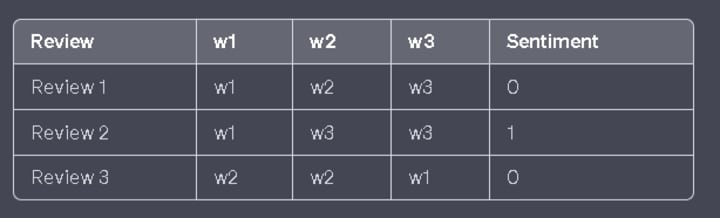
To convert this data into a binary bag-of-words table, we need to represent each word with a binary value (0 or 1).
The table would look like this:
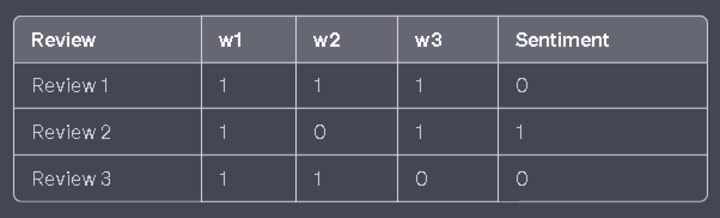
In the binary bag-of-words table, each word corresponds to a column, and its presence is denoted by a 1, while its absence is denoted by a 0. The sentiment is represented by the "Sentiment" column.
To create the binary bag-of-words representation table, considering the additional query point "r4" with the words "w1, w1, w1," we can convert it to a table as follows
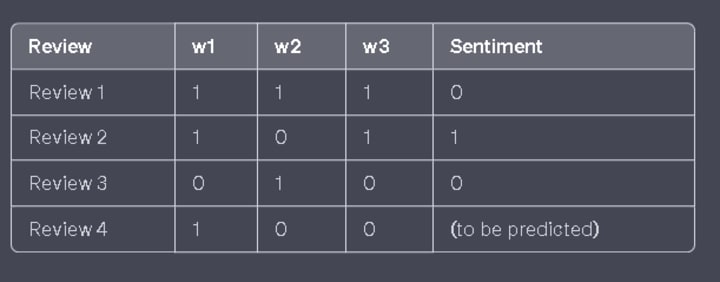
:
In this table, "r4" represents the additional query point, where "w1" appears twice and "w2" and "w3" are absent. The sentiment for Review 4 is yet to be predicted.
Now, let's calculate the probabilities for positive and negative sentiments based on the given data table:
p(+ve|r4) = p(+ve) * p(w1=1|+ve) * p(w2=0|+ve) * p(w3=0|+ve) = (2/3) * (1/1) * (1/1) * (0/1) = 0
p(-ve|r4) = p(-ve) * p(w1=1|-ve) * p(w2=0|-ve) * p(w3=0|-ve) = (1/3) * (1/2) * (0/2) * (1/2) = 1/12
As you can see, both probabilities become 0, which is an issue when certain features do not exist in a particular class, resulting in zero probabilities. This is where Laplace additive smoothing comes in.
Laplace additive smoothing helps avoid zero probabilities by adding a small constant (alpha) to the numerator and n * alpha to the denominator of each probability estimate. By applying Laplace additive smoothing, the probabilities will never be zero.
The value of alpha is usually 1 (default), but you can choose a different value based on your preference. The value of n depends on the type of Naive Bayes algorithm you are using, which we can discuss further if needed.
Let's understand the bias-variance tradeoff in the case of Naive Bayes.
The question arises: why do we add alpha in the numerator and n * alpha in the denominator?
Why don't we add a very small constant value like 0.000001 instead?
The reason we add alpha in the numerator and n * alpha in the denominator is to have flexibility in controlling the bias and variance of the model. By tuning the value of alpha, we can adjust the bias and variance accordingly.
When a model has high bias, it means it has simplified assumptions or constraints that may lead to underfitting, resulting in poor performance. In such cases, we can set a lower value of alpha to reduce bias and allow the model to capture more complex patterns.
On the other hand, when a model has high variance, it means it is too sensitive to the training data and may overfit, resulting in poor generalization to unseen data. To address high variance, we can set a higher value of alpha to smoothen the probability estimates and reduce the impact of individual features, thus reducing variance.
Alpha serves as a hyperparameter that allows us to strike a balance between bias and variance. By choosing different values of alpha, we can fine-tune the model's behavior and find the optimal tradeoff between bias and variance for a specific problem.
There are two reasons why we use Laplace additive smoothing:
- To ensure that probabilities will not become zero.
- By tuning the value of alpha and n * alpha, we can reduce overfitting and strike a balance between bias and variance trade-off.
Types of Naive Bayes
Let's discuss the five types of Naive Bayes classifiers:
- Gaussian Naive Bayes: This type of Naive Bayes is used when the dataset consists of numerical features. It assumes that the features follow a Gaussian (normal) distribution. Gaussian Naive Bayes is suitable for continuous data.
- Categorical Naive Bayes: When the dataset contains categorical features, such as colors or types of objects, we use Categorical Naive Bayes. It assumes that each feature follows a categorical distribution.
- Bernoulli Naive Bayes: Bernoulli Naive Bayes is applied when the features are binary or follow a Bernoulli distribution. This type of Naive Bayes is suitable for datasets with binary features like presence or absence of certain attributes.
- Multinomial Naive Bayes: Multinomial Naive Bayes is commonly used for text classification tasks. It assumes that features represent the frequencies or occurrences of different words in the text. It is suitable for datasets with discrete features and follows a multinomial distribution.
- Complement Naive Bayes: Complement Naive Bayes is a variation of Naive Bayes that is designed to address imbalanced datasets. It is particularly useful when the majority class overwhelms the minority class in the dataset. It aims to correct the imbalance by considering the complement of each class when making predictions.
Each type of Naive Bayes classifier is suitable for different types of datasets based on the nature of the features and their distribution. By selecting the appropriate Naive Bayes algorithm, we can effectively model and classify data based on the given features.
let start with
Gaussian Naive Bayes
when to use naive bayes which form of dataset
Data → when we have data like where all the features are numerical at that time, we use gaussian naive bayes.
Let's say we have a dataset containing age and marital status information, where we want to predict whether a person is married or not. For example, we have 5 data points in the dataset.
Now, let's consider a scenario where we want to calculate the probability of a person being married at the age of 55. We predict "yes" for married and "no" for not married. So, we want to calculate
P(yes|55) = (P(55|yes) * P(yes)) / P(w)
P(no|55) =(P(55|no) * P(no)) / P(w)
However, what if we don't have any data points with an age of 55 in our dataset? In that case, both probabilities will be zero because we won't be able to calculate the probability of P(55/yes) or P(55/no).
To handle numerical data in Naive Bayes, we use a different approach. We assume that the particular age column follows a normal distribution (Gaussian distribution) and calculate the mean (μ) and standard deviation (σ) of the age column.
Now, we can assume that the age values follow a Gaussian distribution. We use the formula
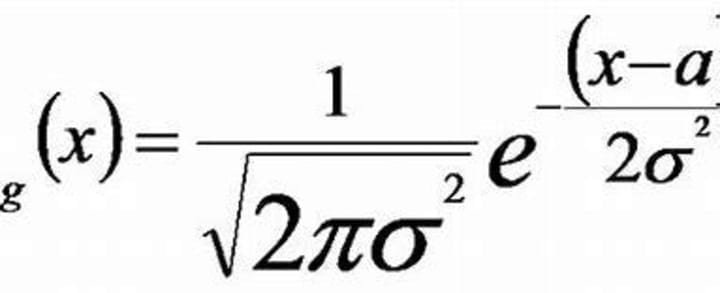
f(x) = 1 / (σ * √(2π)) * e^(-((x - μ)²) / (2 * σ²)).
This formula gives us the probability density.
To calculate the probability, we take the query point (in this case, 55) and plot it on our Gaussian distribution. We calculate the probability density at that point, let's say we get 0.62. This means the probability density to get the age of 55 is 0.62 (not exactly the probability, but the probability density).
It's important to note that for both classes (married and not married), we have two different Gaussian distributions, one for "yes" and another for "no". We calculate the probability density using the respective distribution.
After performing the calculation, we replace P(55/yes) with 0.62. Even though we don't have the exact data point in our dataset, we can calculate the probability using the distribution.
It's worth mentioning that this approach assumes the particular column or feature follows a Gaussian distribution. If the data follows a different distribution, such as a chi-square distribution, we would apply the corresponding formulation for that distribution. If the data doesn't follow any well-known distribution, we would need to explore alternative techniques to handle such cases.
Question on Gaussian NB
why Laplace Additive smoothing does not apply on gaussian Naive Bayes?
Laplace additive smoothing is not applied to Gaussian Naive Bayes because it assumes that the features in the dataset follow a Gaussian (normal) distribution. In Gaussian Naive Bayes, the probability estimation is based on calculating the mean and standard deviation of each feature within each class.
Since Gaussian distributions are continuous, there is no issue of zero probabilities or missing feature values. Laplace smoothing is typically used when dealing with categorical or discrete features, where the presence of zero probabilities can occur when a feature does not appear in a particular class.
Therefore, in the case of Gaussian Naive Bayes, Laplace additive smoothing is not necessary as the Gaussian distribution handles the continuous nature of the features without encountering the problem of zero probabilities.
Categorical Naïve Bayes:
When the dataset contains categorical features, such as colors or types of objects, we use Categorical Naive Bayes. It assumes that each feature follows a categorical distribution.
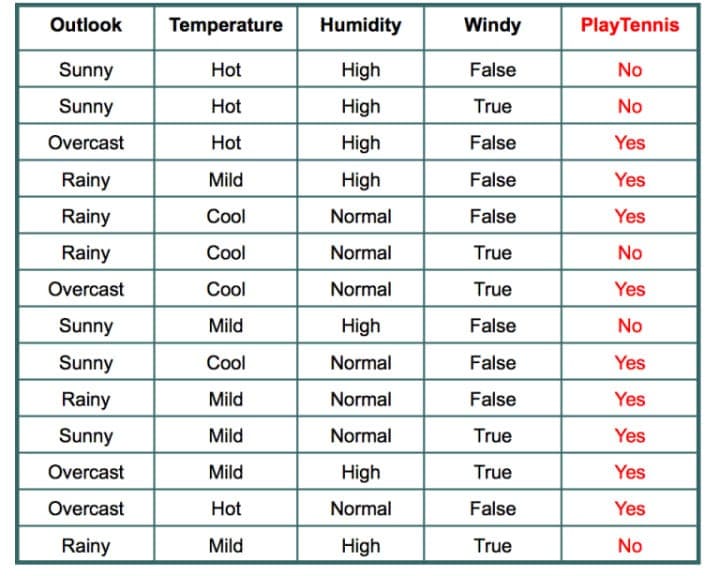
So, over here, what we are going to do is use this simple dataset to understand Naive Bayes. Our goal is to predict whether a student will go to play tennis given these weather conditions.
Let's say we have a query point:
w = {sunny, cool, normal, true}
We need to predict whether the student will go to play tennis (yes or no). We will use Bayes' theorem for this purpose.
The formula is: P(A|B) = (P(B|A) * P(A)) / P(B)
note laplace smoothing is not apply on P(A)
So, our problem formulation is P(yes|w) and P(no|w). Here is the equation:
P(yes|w) = (P(w|yes) * P(yes)) / P(w)
P(no|w) =(P(w|no) * P(no)) / P(w)
By simplifying and removing the denominator from both equations, we can see that they are the same.
The final equation for both probabilities is:
P(yes|w) = (P(w|yes) * P(yes))
note LaPlace smoothing is not apply on P(yes),P(no))
P(no|w) =(P(w|no) * P(no))
P(yes|w) = P(sunny|yes) * P(cool|yes) * P(normal|yes) * P(true|yes) * P(yes) = (2/9) * (3/9) * (6/9) * (3/9) * (9/14)
Applying Laplace smoothing alpha=1,
note LaPlace smoothing is not apply on P(yes)
n=no.of category present in feature or column
for Outlook (n=3), Temperature (n=3), Humidity(n=2), windy(n=2)
=(2+1/9+3*1) * (3+1/9+3*1) * (6+1/9+2*1) * (3+1/9+2*1) * (9/14)
= 3/12*4/13*7/11*4/11*9/14
=0.01144
(Try calculating it yourself using the given data table.)
P(no|w) = P(sunny|no) * P(cool|no) * P(normal|no) * P(true|no) * P(no)
for more info must read…..
Multinomial Naive Bayes:
Multinomial Naïve Bayes is commonly used for text classification tasks. It assumes that features represent the frequencies or occurrences of different words in the text. It is suitable for datasets with discrete features and follows a multinomial distribution.
Email- spam classification and sentiment analysis are good example
let's we discuss how Multinomial Naive Bayes actually work.

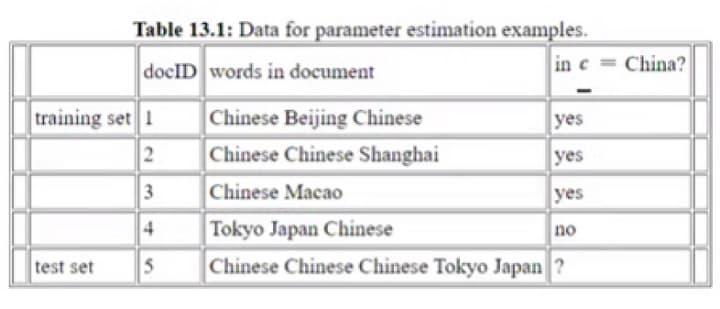
dataset we are going to be use.
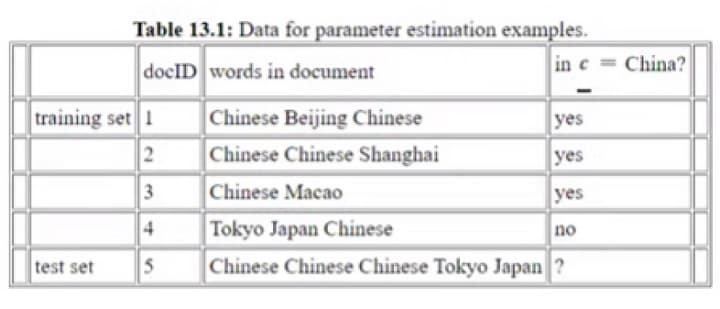
d5 →{Chinese , Chinese, Chinese, Tokyo, Japan}
bag of words →{3,0,0,0,1,1}
we need to predict whether it is China or not.
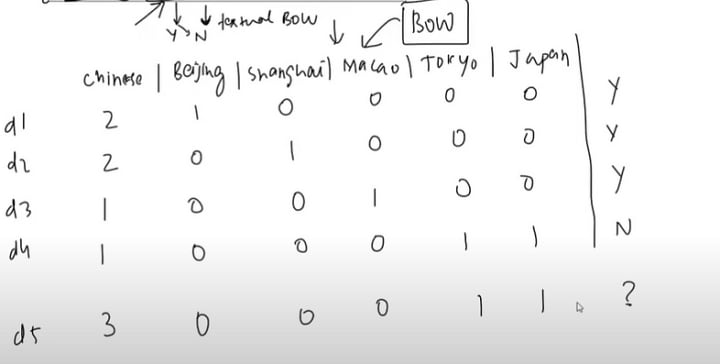
d5 →{Chinese , Chinese, Chinese, Tokyo, Japan}
bag of words →{3,0,0,0,1,1}
P(yes|d5)
P(Chinese|Yes) * P(Beijing|Yes) * P(Shanghai|Yes) * P(Macao|Yes) * P(Tokyo|Yes) * P(Japan|Yes) * P(Yes)
Now, let's calculate the probabilities
P(Chinese|Yes) = 5/ 8
P(Beijing|Yes) = 1 / 8
P(Shanghai|Yes) = 1 / 8
P(Macao|Yes) = 1 / 8
P(Tokyo|Yes) = 0 / 8= 0
P(Japan|Yes) = 0 / 8= 0
P(Yes) = 3 / 4
After Laplace smoothing, the probabilities for "Tokyo" and "Japan" become non-zero. This is because Laplace smoothing adds a count of alpha=1 in numerator and n*alpha in denominator =6*1
here n is : size of vocabulary of unique words you have
Now, let's calculate the probabilities:
P(Chinese|Yes) = (5 + 1) / (8 + 6) = 6 / 14 = 3 / 7
P(Beijing|Yes) = (1 + 1) / (8 + 6) = 2 / 14 = 1 / 7
P(Shanghai|Yes) = (1 + 1) / (8 + 6) = 2 / 14 = 1 / 7
P(Macao|Yes) = (1 + 1) / (8 + 6) = 2 / 14 = 1 / 7
P(Tokyo|Yes) = (0 + 1) / (8 + 6) = 1 / 14
P(Japan|Yes) = (0 + 1) / (8 + 6) = 1 / 14
P(Yes) = 3/ 4
Now let's recalculate the expression:
d5 →{Chinese , Chinese, Chinese, Tokyo, Japan}
bag of words →{3,0,0,0,1,1}
P(Chinese=3|yes) * P(Beijing=0|yes) * P(shanghai=0|yes) * P(Macao=0|yes) * P(Tokyo=1|yes) * P(Japan=1|yes) * P(yes)
Raising each probability with power, given number of occurrences in d5 like chines occurrence is 3.
P(Chinese|Yes)³ * P(Beijing|Yes)⁰ * P(Shanghai|Yes)⁰ * P(Macao|Yes)⁰ * P(Tokyo|Yes)¹ * P(Japan|Yes)¹ * P(Yes)
= (3/7)³ * (1/7)⁰ * (1/7)⁰ * (1/7)⁰ * (1/14)¹ * (1/14)¹ * (3/4)
Simplifying the expression:
= 27/343 * 1 * 1 * 1 * 1/2744 * 1/2744 * 3/4
= 81/32687648
Therefore, the corrected value of the expression is 81/32687648
Do the same calculation for below:
- d5 →{Chinese , Chinese, Chinese, Tokyo, Japan}
- bag of words →{3,0,0,0,1,1}
P(no|d5) =
= P(Chinese=3|no) * P(Beijing=0|no) * P(shanghai=0|no) * P(Macao=0|no) * P(Tokyo=1|no) * P(Japan=1|no) * P(no)
.......
At the end you will find:
P(Yes|d5) > P(No|d5)
d5 -->Chinese, Chinese, Chinese, Tokyo, Japan} - -> Yes
we will discuss. in our Next Post Saty tunned
- Bernoulli Naive Bayes
- Complement Naive Bayes:
Also check out our 1st and 3rd post on it
link is given in the comment section.
About the Creator
Keep reading
More stories from ajay mehta and writers in Education and other communities.
"Demystifying Naïve Bayes: Simple yet Powerful for Text Classification"
Naïve Bayes Naïve Bayes is, first of all, a classification algorithm that helps us solve classification-related problems. Not only does it assist in classification, but it particularly excels in analyzing textual data. If you are working with text or need to perform tasks like spam filtering or sentiment analysis, applying Naïve Bayes as a baseline model is highly recommended before exploring other algorithms, such as deep learning.
By ajay mehta3 years ago in Education
How Hot-Dip Galvanizing Saves Maintenance Costs Over Time for Steel Infrastructure
Steel is a key material in modern infrastructure. It is used in bridges, buildings, towers, fences, and many industrial systems. Steel offers strength and reliability, but it can rust when exposed to air and water. Rust slowly weakens steel and creates serious maintenance challenges. To prevent this damage, many industries rely on hot-dip galvanizing.
By Frontier Galvanizinga day ago in Education
5 AI Tools That Can Help You Make Money Online in 2026
5 AI Tools That Can Help You Make Money Online in 2026 Artificial Intelligence is no longer just a futuristic concept. It has quickly become one of the most powerful technologies shaping the modern digital economy. Businesses, creators, and freelancers are now using AI tools to save time, increase productivity, and generate new income streams. Just a few years ago, creating content, designing images, or editing videos required advanced technical skills and expensive software. Today, AI tools allow almost anyone with an internet connection to do these tasks faster and more efficiently. For people looking to earn money online, learning how to use AI tools can be a major advantage. Instead of spending hours on repetitive work, these tools can help you produce professional-level results in minutes. Here are five AI tools that are helping people around the world build online income opportunities. 1. ChatGPT – AI Writing and Content Creation One of the most powerful AI tools available today is ChatGPT. It helps users generate high-quality written content quickly and efficiently. People use ChatGPT for many different online tasks, including writing blog posts, creating social media content, generating marketing copy, and even producing scripts for videos. Freelancers are using it to complete writing projects faster, while bloggers use it to brainstorm ideas and structure their articles. Content creators can also use it to write YouTube scripts, product descriptions, and email newsletters. While AI can assist with writing, successful creators still add their own creativity and editing to make the content unique and engaging. Because online businesses constantly need fresh content, this tool has become extremely valuable for writers and marketers. 2. Midjourney – AI Image Generation Visual content plays a huge role in the digital world. Social media posts, website designs, advertisements, and digital products all rely heavily on high-quality images. Midjourney is an AI image generator that can turn simple text prompts into stunning digital artwork. Designers and entrepreneurs use it to create: Book covers Social media graphics Website images Digital art prints Many creators even sell AI-generated artwork online through digital marketplaces. With the right prompts and creativity, people can build entire design portfolios using AI-generated images. 3. Runway ML – AI Video Creation and Editing Video content continues to dominate the internet. Platforms like YouTube, social media apps, and online courses all rely heavily on video. Runway ML is an AI-powered tool that helps creators generate and edit videos quickly. It allows users to create visual effects, remove backgrounds, and even generate video clips using artificial intelligence. Video editors and content creators use this tool to speed up their workflow and produce high-quality videos without expensive equipment. As the demand for video continues to grow, people who understand AI video tools will have a strong advantage in the online content industry. 4. Canva – AI Design for Everyone Canva has become one of the most popular design tools on the internet, especially for beginners. With its AI-powered features, users can create professional graphics, presentations, posters, and marketing materials with very little design experience. Freelancers often use Canva to provide design services for clients, including social media posts, brand kits, and promotional graphics. Small businesses also rely on Canva to maintain a consistent online presence without hiring expensive designers. Because of its simplicity and versatility, Canva remains one of the easiest tools for beginners who want to start offering digital design services. 5. Pictory – AI Video From Text Pictory is a powerful AI tool that can transform written content into engaging videos. Creators can simply paste an article or script into the platform, and Pictory automatically generates a video using stock footage, captions, and background music. This tool is especially useful for content creators who want to produce videos for YouTube or social media without filming themselves. Many people use Pictory to turn blog posts into videos, create educational content, or produce short clips for social platforms. Because video consumption continues to increase worldwide, tools like Pictory are becoming essential for digital creators. Final Thoughts Artificial Intelligence is changing the way people work online. Instead of replacing human creativity, AI tools are helping people work faster and more efficiently. For beginners who want to earn money online, learning how to use AI tools can open the door to many new opportunities. Writing, designing, video editing, and digital marketing are all becoming easier with the help of technology. The most important step is to start experimenting and learning. Even mastering just one of these tools can create new income possibilities. The future of online work is increasingly connected to AI. Those who learn to use these tools today will likely have a strong advantage in the digital economy of tomorrow.
By Baseer Shaheen 6 days ago in Education
Early March 2026: 4 Goals Accomplished
It's early March and I've now accomplished my 4th writing goal for the year of 2026. Before diving into the behind-the-scenes of it... why not tell you up front what that accomplishment was? I was published in a 2nd publication for this year. Published in Helix Literary Magazine out of Central Connecticut State University. You can read it for free right now!
By Stephen Kramer Avitabile7 days ago in Writers




Comments (1)
post 1- https://shopping-feedback.today/education/demystifying-naive-bayes-simple-yet-powerful-for-text-classification%3C/span%3E%3C/span%3E%3C/span%3E%3C/a%3E post2 https://shopping-feedback.today/education/demystifying-naive-bayes-log-probability-and-laplace-smoothing%3C/span%3E%3C/span%3E%3C/span%3E%3C/a%3E post3 https://shopping-feedback.today/education/exploring-bernoulli-naive-bayes-and-unveiling-the-power-of-out-of-core-learning%3C/span%3E%3C/span%3E%3C/span%3E%3C/a%3E%3C/p%3E%3C/div%3E%3C/div%3E%3C/div%3E%3Cstyle data-emotion-css="w4qknv-Replies">.css-w4qknv-Replies{display:grid;gap:1.5rem;}