
Democracy vs Shura: Power from People or Power under God?
Two Systems. Two Civilizations. One Truth.

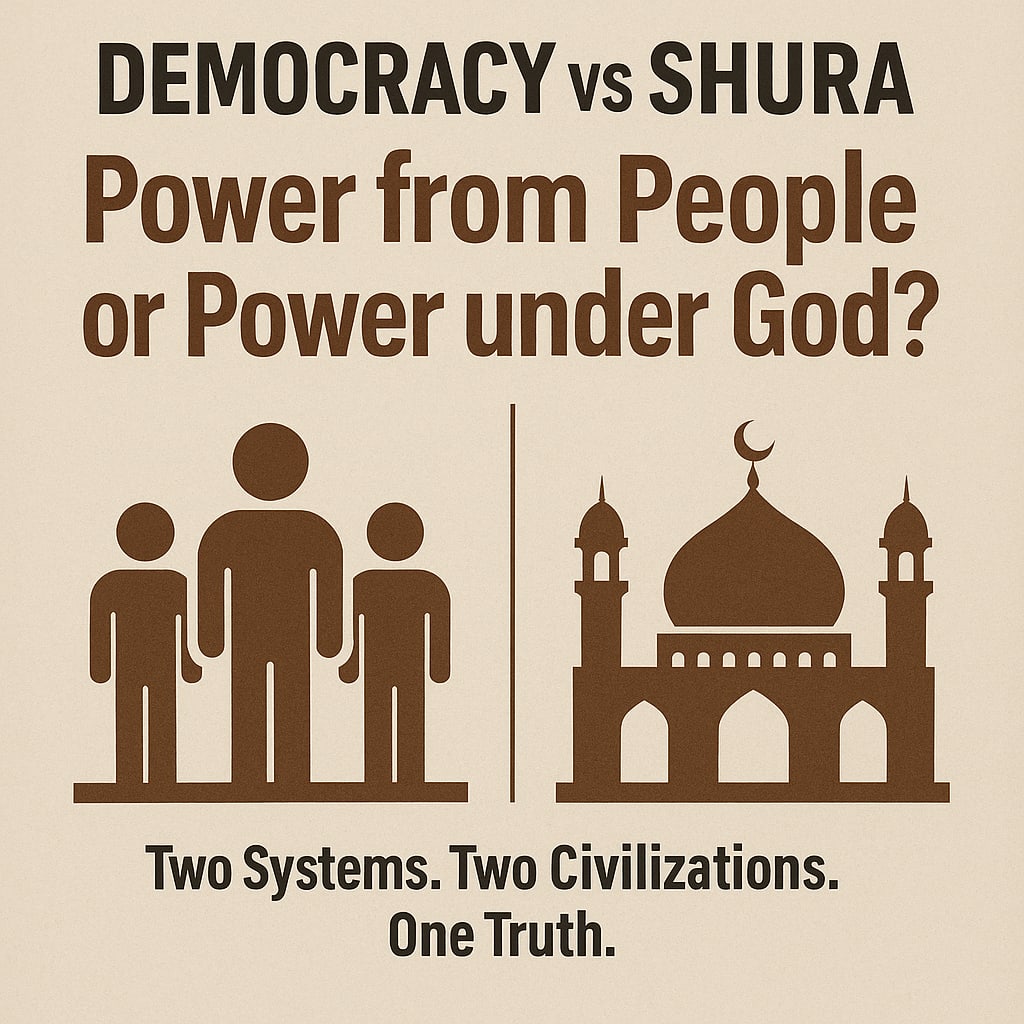
Democracy, as the modern world understands it, is essentially a system of government where the people are the source of government. The basis of this philosophy is that people are the supreme authority, they make the laws, and they are the ultimate owners of the state. Western democracy is essentially the result of European secularism, where religion and state are separate, and individual freedom is the highest value.
On the other hand, Islamic Shura is a completely different outline. In the Shura system, the supreme authority is Allah. The source of law or governance is not man, but the provisions of Allah, that is, the Quran and Hadith. Here, the main task of the state is to implement the laws of Allah, establish justice, and build a believing society for the benefit of people.
In a democracy, the majority determines the truth. If something is accepted by the will of the majority of people, it becomes legal—even if it contradicts the law of Allah. For example, in a democratic country, same-sex marriage can be declared legal because the majority of people have consented to it. But in the Islamic Shura system, such a thing can never be legal, because it is a clear violation of Allah's guidance.
Consultation (shura) is important in the Islamic system of governance, but it is within the limits of Sharia. During the rule of the Rightly Guided Caliphs, we see that before every major decision, there was a shura or exchange of views among the companions, but no decision ever went against the Quran and Hadith. The responsibility of the head of state was to implement Sharia, lead the Muslim Ummah, and establish justice in the world.
On the other hand, in a democratic system of governance, the main purpose of leadership is to fulfill the will of the people, protect the interests of political parties, and maintain power under the influence of financial and military power. In this system, morality or fear of Allah is not mandatory. Rather, political strategy, control of public opinion, and media influence are the main tools here. Therefore, in a democracy, we often see that before the vote, one thing is said, and then a completely opposite policy is implemented.
To be a leader in an Islamic system, personal character, piety, knowledge, and the trust of society are necessary. When Abu Bakr (RA) was elected Caliph, he said, “I am not the best among you, but I have been given a responsibility; if I am right, follow me, and if I go astray, correct me.” This statement reveals the core philosophy of Islamic leadership—power means accountability, not arrogance.
Furthermore, in democratic systems, continuity of governance is often disrupted by changes in leadership, but in the Islamic Shura structure, the continuity of Sharia is maintained even when leadership changes. The character, policies, and direction of the Islamic state never change depending on public opinion—rather, they remain eternal and fixed.
When Islamic governance is presented in the modern world as the opposite of Western democracy, a baseless comparison is made. Democracy itself can take many forms—the presidential system of the United States, the parliamentary system of the United Kingdom, or the so-called democracy of China. But the basic structure of the Islamic Shura system is one and unchangeable, because it is based on the Quran and the Sunnah of the Prophet (peace be upon him).
The political philosophy of Islam does not only talk about power, but also thinks about the hearts of people, principles, the responsibility of leadership, and accountability in the Hereafter. In this system, the ruler is not so much a dictator as a servant. The Prophet (peace be upon him) used to say, “The ruler is responsible for his people, and responsibility has been entrusted to him.” While in democracy the goal is “gaining power”, in Islamic governance the goal is “protecting the trust”.
Many Muslim countries in the world today are following the so-called “democracy”, but there are no Islamic values, no justice, and no curbs on corruption. On the other hand, the Islamic governance system is a ‘threat’ to the Western masters, because it is an obstacle to their colonialist structures. As a result, Islamic Shura-based leadership may not yet be established in reality, but it is deeply entrenched in the thoughts, consciousness, and aspirations of Muslim youth.
About the Creator
Keep reading
More stories from Abdul Barik and writers in Education and other communities.
Why Do They Fear Political Islam?
Start writing...Islam is not just a religious doctrine from the beginning - but a complete way of life. It offers people not only spiritual liberation, but also social justice, political leadership and a picture of a society without discrimination. When the Prophet (peace be upon him) called for religion in Mecca, it was not just a message of self-purification for a single individual - but a call for change at all levels of Arab society. Islam establishes a state, formulates laws, reforms society, and lays the foundation for an exceptional system of governance in the world. Therefore, Islam has never been just a 'religion of individual worship'.
By Abdul Barik9 months ago in History
How Neuroscience Is Changing the Way We Learn
In recent decades, advances in neuroscience have reshaped our understanding of human learning. Rather than viewing learning as merely memorizing facts, researchers now see it as a biological process that physically and functionally changes the brain. This shift in perspective — from teaching content to understanding how the brain learns — is transforming educational theory, classroom practice, and lifelong learning strategies across the globe.
By Games Mode Onabout 18 hours ago in Education



Comments
There are no comments for this story
Be the first to respond and start the conversation.