
Dark Matter: The Invisible Skeleton of the Universe
The universe is full of wonders—stars, galaxies, planets, glowing nebulae, and black holes. But hidden behind all these visible objects lies something even more mysterious: dark matter. It cannot be seen, touched, or directly detected, yet it shapes the entire structure of the cosmos. Scientists often describe it as the “invisible skeleton” of the universe because it provides the framework around which galaxies and galaxy clusters form. In this article, we will explore what dark matter is, why scientists believe it exists, how it influences the universe, and what mysteries still surround it. The language is kept simple so anyone can understand this deep and fascinating topic.

What Is Dark Matter?
Dark matter is a mysterious form of matter that does not emit light, absorb light, or interact with electromagnetic radiation. This means we cannot see it with telescopes. It is completely invisible.
Yet scientists estimate that dark matter makes up:
• 27% of the entire universe
• Ordinary matter (everything we see) makes up only 5%
• The remaining 68% is dark energy
This means almost everything we see—stars, galaxies, planets, atoms—is only a tiny fraction of what actually exists.
Dark matter is called “dark” not because it is black or shadowy, but because it does not interact with light. It passes through space silently, without revealing its presence. The only way we know it exists is through its gravity.
________________________________________
Why Do Scientists Believe Dark Matter Exists?
Even though dark matter cannot be seen, its gravitational effects are strong. Scientists discovered something strange while studying galaxies: the stars near the outer edges were moving much faster than expected. If only visible matter existed, these galaxies should fly apart.
But they don’t.
Why?
Because something invisible is adding gravity and holding them together.
Let’s explore the key evidence for dark matter.
________________________________________
1. Galaxy Rotation Curves
In the 1970s, astronomer Vera Rubin observed how stars move around the centers of galaxies. According to Newtonian physics, stars farther from the center should move more slowly—just like planets far from the Sun move slower than those close to it.
But Rubin found that stars on the outer edges of galaxies were moving just as fast as stars near the center.
This should be impossible unless there is unseen mass providing extra gravity.
This hidden mass is now known as dark matter.
________________________________________
2. Gravitational Lensing
Einstein predicted that gravity can bend light. When astronomers look at distant galaxies, they sometimes see strange distortions or arcs of light, as if light is bending around something massive.
Often, the amount of bending is too strong to be caused by visible matter alone.
Something invisible—but extremely massive—is doing the bending.
That “something” is dark matter.
________________________________________
3. Cosmic Structure Formation
Computer simulations of the early universe show that galaxies could not have formed without dark matter. After the Big Bang, matter was spread out almost evenly. But small clumps of dark matter acted as gravitational “seeds.” They pulled gas and dust toward them, eventually forming stars and galaxies.
Without dark matter, the universe would be a thin, smooth cloud of gas—not the rich cosmic structure we see today.
________________________________________
4. Cosmic Microwave Background (CMB)
The CMB is the faint afterglow of the Big Bang. Tiny temperature variations in the CMB reveal how matter was distributed in the early universe.
The patterns match perfectly with models that include dark matter—and do not match models without it.
________________________________________
What Could Dark Matter Be?
Scientists still don’t know what dark matter is made of. But there are several strong possibilities.
1. WIMPs (Weakly Interacting Massive Particles)
WIMPs are hypothetical particles that:
• Have mass
• Rarely interact with normal matter
• Do not emit or absorb light
For decades, WIMPs were the leading candidate. Huge underground detectors have been built to find them, but none have been detected yet.
________________________________________
2. Axions
Axions are extremely light particles that might fill the universe like a smooth field. They interact very weakly with normal matter and could be produced in massive quantities.
Scientists are actively searching for axions using special radio antennas and microwave experiments.
________________________________________
3. Sterile Neutrinos
Neutrinos are tiny particles produced in nuclear reactions. They pass through matter almost effortlessly. Sterile neutrinos would interact even less and could be a component of dark matter.
________________________________________
4. MACHOs (Massive Compact Halo Objects)
These include:
• brown dwarfs
• faint stars
• black holes
• rogue planets
MACHOs were once considered a strong possibility, but observations show they cannot account for enough mass to explain dark matter.
________________________________________
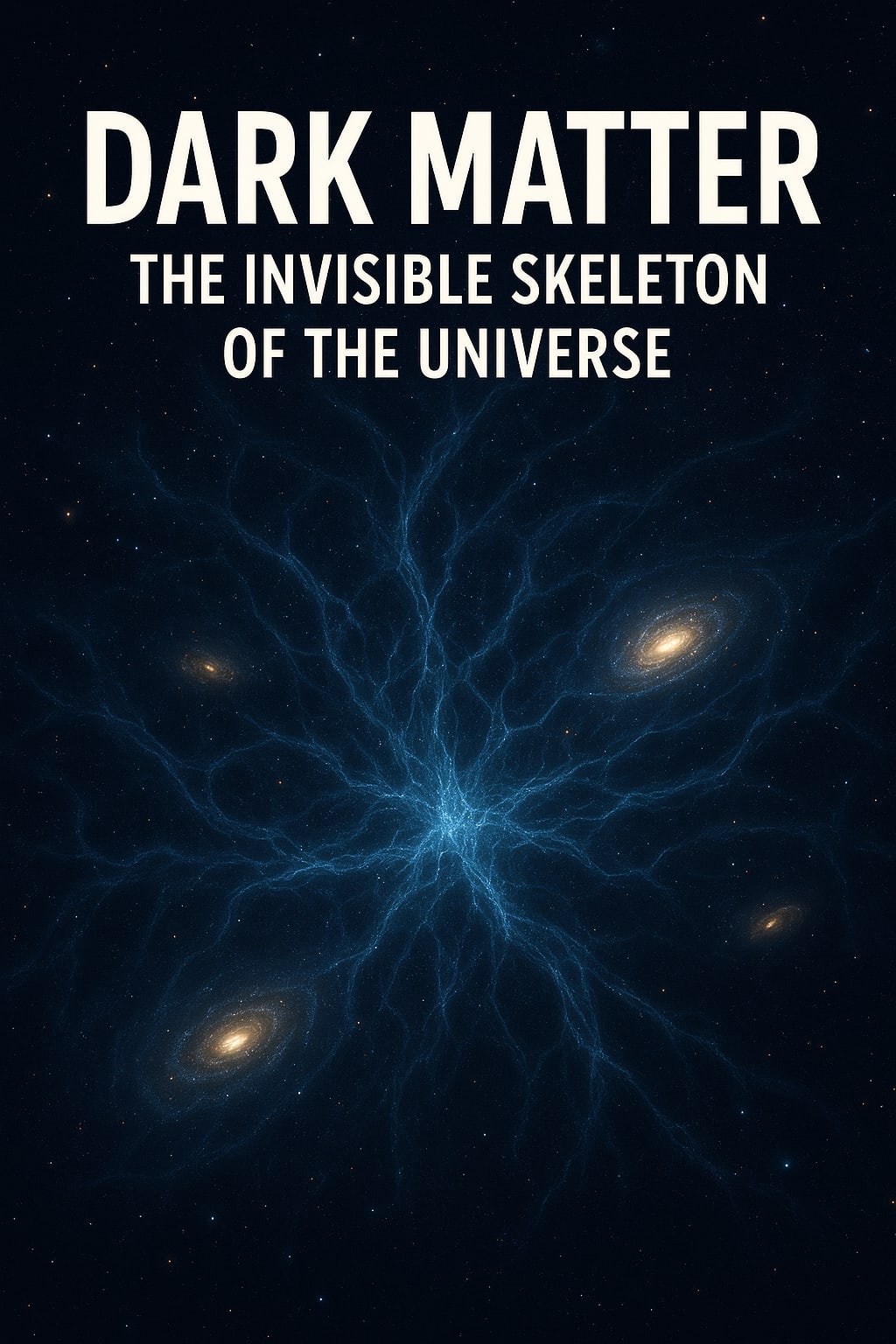
Dark Matter as the “Invisible Skeleton” of the Universe
The structure of the universe resembles a giant cosmic web made of:
• Filaments
• Clusters
• Voids
These structures formed because dark matter clumped together first. Imagine pouring flour into water—chunks form and attract more flour. Dark matter behaved in a similar way after the Big Bang.
How the cosmic skeleton formed:
1. After the Big Bang, dark matter began to clump due to gravity.
2. These clumps formed large halos, like invisible bubbles.
3. Gas from the early universe fell into these halos.
4. Gas cooled, collapsed, and created stars and galaxies.
Every galaxy—including the Milky Way—sits inside a dark matter halo. This halo extends far beyond the visible stars and provides the gravitational glue that keeps the galaxy stable.
Without dark matter, galaxies would not exist.
________________________________________
How Do Scientists Search for Dark Matter Today?
Understanding dark matter is one of the greatest challenges in physics. Scientists are exploring many approaches.
1. Underground Detectors
Facilities like the LUX-ZEPLIN and XENONnT experiments are deep underground to avoid cosmic radiation. They use large tanks of liquid xenon to detect rare collisions between dark matter particles and atoms.
________________________________________
2. Particle Accelerators
The Large Hadron Collider (LHC) tries to produce dark matter particles by smashing protons at high energy. If dark matter is created, it would escape undetected, leaving missing energy in the experiments.
________________________________________
3. Space Telescopes
Telescopes like the James Webb and Fermi Gamma-Ray Telescope search for signals possibly caused by dark matter interactions.
________________________________________
4. Mapping Dark Matter Through Gravity
Even if dark matter cannot be seen, its gravity can be. Astronomers map gravitational lensing to observe dark matter distribution in galaxy clusters.
________________________________________
Mysteries That Still Remain
Despite decades of research, dark matter remains unknown. Here are some major questions:
1. What is the true identity of dark matter?
We still don’t know if it’s a particle, a field, or something completely new.
2. Why does dark matter not interact with light?
This makes it extremely difficult to detect.
3. Does dark matter interact with itself?
Some theories suggest dark matter might have its own forces.
4. Could modified gravity explain dark matter?
A few scientists propose that gravity behaves differently on large scales, which could eliminate the need for dark matter. But most evidence strongly supports dark matter’s existence.
________________________________________
Why Dark Matter Matters to Us
Dark matter may sound exotic, but it plays a crucial role in our existence.
• Without dark matter, galaxies would not form.
• Without galaxies, stars would not form.
• Without stars, planets would not form.
• Without planets, life would not exist.
Dark matter created the cosmic scaffolding that allowed the universe to develop structure. In a sense, we owe our very existence to this invisible substance.
________________________________________
The Future of Dark Matter Research
In the next few decades, new experiments may finally reveal the nature of dark matter. Some scientists believe:
• A new particle could be discovered
• A new force of nature might be revealed
• Our understanding of spacetime could change
• Dark matter may open the door to a deeper theory beyond the Standard Model of physics
Dark matter is not just a scientific puzzle—it may be the key to the next revolution in physics.
________________________________________
Conclusion
Dark matter is one of the greatest mysteries of the universe. It is invisible, untouchable, and silent, yet it shapes everything around us. It serves as the invisible skeleton of the cosmos, giving structure to galaxies and guiding the formation of cosmic webs.
Although scientists cannot see dark matter directly, its gravity tells a powerful story. Every star that shines, every galaxy that spins, and every cluster that forms owes its existence to the hidden mass that binds the universe together.
As technology advances, we may soon unlock the secrets of this cosmic mystery. But until then, dark matter remains a silent shadow—an unseen architect shaping the universe on the grandest scales.
About the Creator
Keep reading
More stories from shahkar jalal and writers in Education and other communities.
The Higgs Boson: How It Gives Mass to Everything
What Is the Higgs Boson? The Higgs boson is a fundamental particle linked to a field that spreads across the entire universe, known as the Higgs field. It was predicted by physicists Peter Higgs and others in the 1960s as part of the Standard Model of particle physics, the framework that describes how particles interact.
By shahkar jalalabout a month ago in Education
Top 10 Essential Skills for Success in 2026
By 2026, the job market is no longer driven only by degrees or titles. Technology, especially Artificial Intelligence (AI), automation, and remote work, has changed how companies operate and how people work. Many routine tasks are now handled by machines, while humans are expected to do work that requires thinking, judgment, creativity, and emotional understanding. This shift means that skills — not just education — determine success. The following 10 skills are considered essential for 2026 because they combine technology awareness with human intelligence. Let’s understand them one by one, step by step.
By Talha khan4 days ago in Education



Comments
There are no comments for this story
Be the first to respond and start the conversation.