
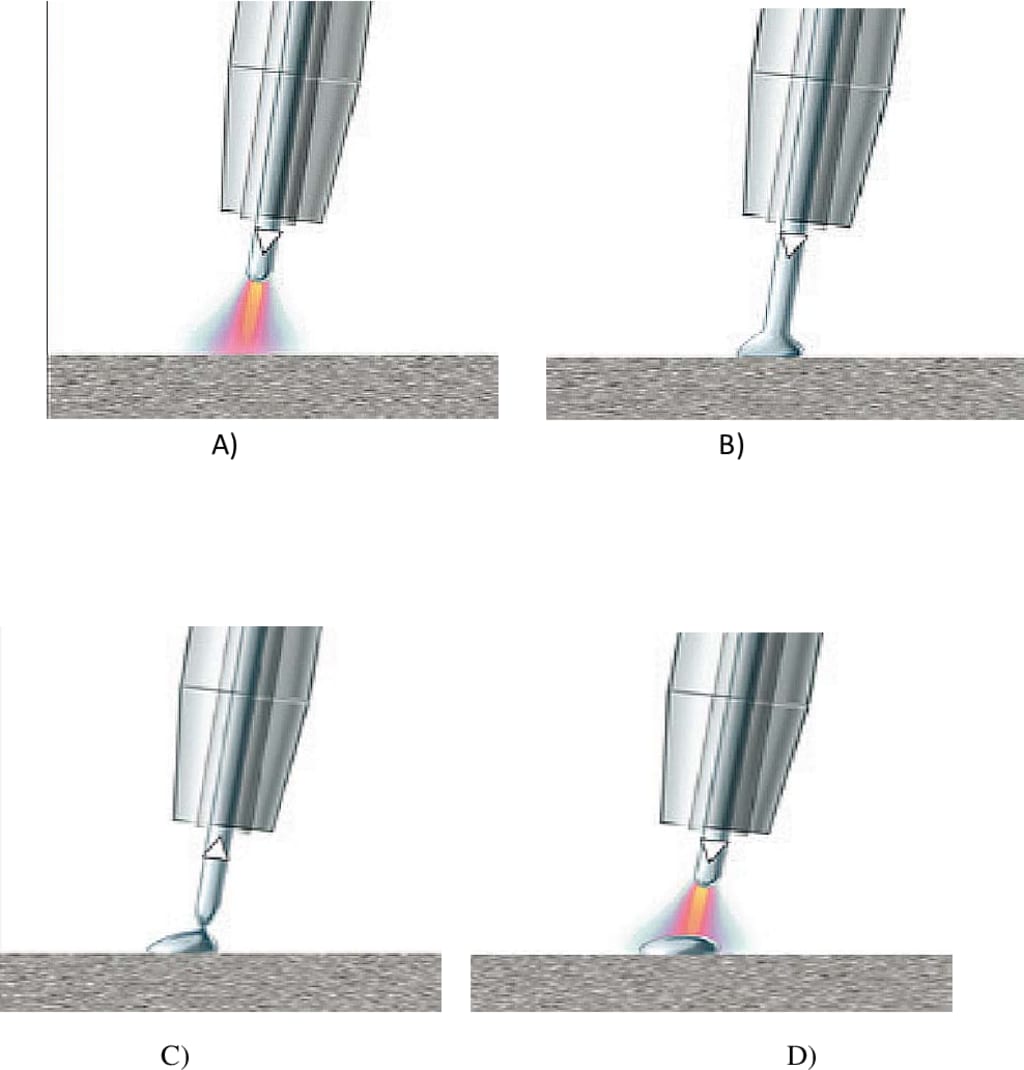
The CMT process physically resembles MIG welding. However, the main difference is the wire feed rather than continuously moving forward in the weld pool with CMT, the wire is retracted and the instant current flows. The weld wire and shielding gas are fed through a welding torch. The electricity arcs between the weld wire and the welding surface.
This causes the tip of the weld wire to liquefy to be applied to welding surface. The CMT uses automatic activation and deactivation of the heating air to systematically heat and cool the weld wire while bringing the wire in and out of contact with the weld pool many times per second. The reduction in heat is cold metal transfer technology’s greatest benefit.
The welding droplets are detached in a target manner via a precisely closed current pulse. Due to this process, the arc only introduces heat for a very brief period during the arc burning phase. Thus, the arc length is detached and adjusted mechanically. The arc remains stable no matter what the surface of the work piece and how fast the welding speeds were. This means CMT can be used everywhere and in every position. A CMT based metal printer is an additive manufacturing technique where 3D objects and parts are made by the addition of multiple layers of material. It is a mechanized method where 3D objects are quickly made as per the required size machine connected to a computer containing blueprints of any object.
The additive method may differ with the subtractive process, where the material is removed from a block by sculpting or drilling. The main reason to use 3d printer is for 90% of material utilization, increase product life, lighter and stronger. 3D printing is efficiently utilized in various fields such as aerospace, automobile, medical, construction and in manufacturing of many household products.
Metal 3D printing is considered the apex of all 3D printing. When it comes to strength and durability, there’s nothing quite like metal. The first patent for metal 3D printing was DMLS (direct metal laser sintering) and it was filed in the 1990s by the German company EOS.
Every metal 3D printer will generally fall into one of these four categories (with a few exceptions that will be covered at the end): powder bed fusion, binder jetting, direct energy deposition, and material extrusion.
Additive manufacturing techniques (AM) are widely used today in order to builds up products by the deposition of materials layer-by-layer, instead of using traditional processing techniques based on the machining of the raw material. AM is a promising alternative for fabricating components made of expensive materials such as titanium or aluminum alloys, because of the high value of the buy-to-fly ratio. Many techniques have been developed for manufacturing metal structures in AM, such as selective laser sintering , direct metal deposition, electron beam melting , shape deposition manufacturing , and wire and arc additive manufacturing (WAAM) . According to the different energy sources used for the deposition of the metal, wire-feed AM is classified into three groups: laser based, arc welding based, and electron beam based [8]. Arc welding based AM has the advantages of a lower cost and higher deposition rate, achieved at the cost of lower feature resolution.
This is not a problem for most of the products since a following machining operation is often due.
Usually, the deposition rate of laser or electron beam deposition is about 2–10 g/min, while for the arc welding technology the deposition rate is about 50–130 g/min .
In WAAM, the building strategy consists in the deposition of a series of single weld beads, one on the other, alternating pauses of cooling with deposition steps
About the Creator
Keep reading
More stories from Dhanya sree V and writers in Education and other communities.
GRAPHENE
GRAPHENE Understanding Graphene Carbon atoms are usually arranged in one layer (monolayer) in graphene, which seems subtly bonded in a hexagonal honeycomb structure. Through a bond length of 0.142 nanometers molecular, it is a carbon in the shape allotrope of plane atoms of sp2-bonded, which is generally considered rather important. With 0.335 nanometers of interplanar spacing, graphite remains created when graphene layers are piled especially on one another top. Contrary toward the common perception forces van der Waals, the very distinct layers that hold together graphene in graphite, usually remain somewhat overcome through the graphene exfoliation from graphite.
By Dhanya sree V3 years ago in Journal
Most Sales Deals Fail Because Sellers Talk to the Wrong People
There is a quiet reason many sales conversations feel productive but go nowhere. Everyone leaves the call optimistic. Emails move back and forth. Documents get shared. Then momentum fades. Weeks pass. The deal stalls without a clear explanation.
By Armi Ponsica6 days ago in Education
The Energy Pivot The State of Russia’s Oil and Gas in 2026
For decades, this was the "world's gas station": Russia's pipeline network to Europe was the veins of the world economy. By 2026, that aura is dull and those veins are rerouted out of Europe. Since the collapse of the Soviet Union, the Russian oil and gas sector is facing the largest structural change.
By Neeraj kumar5 days ago in Education
A Dart at Dusk
Seconds ago, the sullen sun set on the two of us… my exuberant furry companion and me. A fresh breeze embraces us, delivering welcome relief from the day’s oppressive heat. His typical stumbling and staggering along — apace with a sloth — has turned into trip-trapping, high-stepping, almost skipping along.
By Angie the Archivist 📚🪶6 days ago in Petlife


Comments
There are no comments for this story
Be the first to respond and start the conversation.