
Can Spacetime Tear or Break? Exploring the Limits of the Universe
Space and time form the very fabric of our universe. According to Einstein’s theory of general relativity, spacetime is not just an abstract concept—it is a dynamic structure that can bend, stretch, ripple, and curve under the influence of mass and energy. We know it can warp around black holes and vibrate as gravitational waves. But this raises a deeper and more dramatic question: Can spacetime actually tear or break? Could the universe rip apart like fabric under stress? Or are the laws of physics structured in such a way that spacetime remains fundamentally unbreakable? In this article, we explore what spacetime really is, how it behaves under extreme conditions, whether modern physics allows for "tears" in spacetime, and what such a phenomenon would mean for our understanding of reality.

What Is Spacetime?
Before asking whether spacetime can break, we need to understand what it is.
In classical physics, space and time were treated as separate entities. Space was a three-dimensional stage where events occurred, and time flowed independently. Einstein changed this picture in 1915 with general relativity.
According to Einstein:
• Space and time are fused into a single four-dimensional structure.
• Mass and energy curve this structure.
• Objects move along the curves created by gravity.
Instead of thinking of gravity as a force pulling objects together, general relativity describes gravity as the bending of spacetime itself.
________________________________________
Can Spacetime Bend and Stretch?
Yes. Spacetime is not rigid.
We observe its flexibility in several ways:
• Light bends near massive objects.
• Time runs slower in strong gravitational fields.
• Gravitational waves ripple across the cosmos when massive objects collide.
These phenomena demonstrate that spacetime can stretch, compress, and vibrate. But bending is not the same as breaking.
________________________________________
What Would It Mean for Spacetime to Tear?
If spacetime were to "tear," it would imply a discontinuity—a place where the smooth geometry described by general relativity no longer applies.
A tear might mean:
• A sudden break in the continuity of space
• A region where physics behaves unpredictably
• A boundary separating disconnected regions of the universe
However, whether such a tear is physically possible remains uncertain.
________________________________________
Singularities: The Closest Thing to a Break
Black holes provide the strongest known distortions of spacetime.
At the center of a black hole lies a singularity, a point where density becomes infinite and spacetime curvature becomes extreme. According to general relativity, the laws of physics break down at this point.
But does spacetime tear there?
Not exactly.
A singularity is better described as a breakdown in our mathematical description rather than a literal rip in spacetime. It signals that our current theories are incomplete.
________________________________________
The Big Rip Scenario
One theoretical possibility of spacetime tearing comes from cosmology.
If dark energy—the mysterious force driving cosmic expansion—were to grow stronger over time, it could eventually overwhelm gravity entirely. In a scenario known as the Big Rip:
• Galaxies would separate.
• Stars would be torn from galaxies.
• Planets would be stripped from stars.
• Eventually, atoms themselves would be pulled apart.
In this extreme case, spacetime would expand so rapidly that all structure dissolves. While this resembles a “tearing,” it is more accurately an extreme stretching rather than a literal break.
Current observations suggest this outcome is unlikely, but it remains theoretically possible.
________________________________________
Quantum Gravity and Spacetime Foam
At incredibly small scales—far smaller than atoms—spacetime may not be smooth at all.
Quantum theories suggest that at the Planck scale:
• Spacetime could fluctuate violently.
• Tiny wormholes might appear and disappear.
• Geometry may become probabilistic.
This concept is sometimes called spacetime foam.
If spacetime has a granular or discrete structure at microscopic levels, the idea of tearing may not even apply in the traditional sense. Instead of fabric, spacetime might behave more like a quantum network.
________________________________________
Cosmic Strings and Topological Defects
Some theoretical models predict the existence of topological defects formed in the early universe.
Cosmic strings, for example, would not represent tears in spacetime but rather stable irregularities—similar to creases or seams.
These structures would distort spacetime without breaking it.
________________________________________
Wormholes: Bridges, Not Tears
Wormholes are hypothetical tunnels connecting distant regions of spacetime.
While they might appear to represent holes or tears, wormholes are solutions to Einstein’s equations that preserve continuity. They do not rip spacetime apart but instead connect two regions through curved geometry.
However, maintaining a stable wormhole would require exotic matter with negative energy density—something not yet observed.
________________________________________
Could Extreme Energy Tear Spacetime?
In particle accelerators, scientists collide particles at tremendous energies. Yet even these energies are tiny compared to those of the early universe.
Some speculative theories suggest that if energy densities approached Planck-scale levels, spacetime itself might undergo dramatic transitions.
But current physics does not provide evidence that spacetime can tear under achievable conditions.
________________________________________
The Role of Quantum Gravity
One of the biggest open questions in physics is how to unify general relativity with quantum mechanics.
A successful theory of quantum gravity may reveal whether spacetime is continuous or composed of discrete units.
If spacetime has an atomic structure, tearing might correspond to rearrangements rather than ruptures.
Until such a theory is confirmed, the true limits of spacetime remain unknown.
________________________________________
Observational Evidence
So far, all astronomical observations suggest spacetime behaves as a smooth and continuous entity.
We have detected:
• Gravitational waves from black hole mergers
• Light bending around galaxies
• Time dilation near massive objects
None of these observations indicate any tearing or discontinuity.
________________________________________
What If Spacetime Could Break?
If spacetime were capable of tearing, the consequences would be profound:
• Regions of the universe could become disconnected.
• Physical laws might vary across boundaries.
• Causality could break down.
Such possibilities remain speculative and are not supported by current evidence.
________________________________________
Why the Fabric Analogy Can Be Misleading
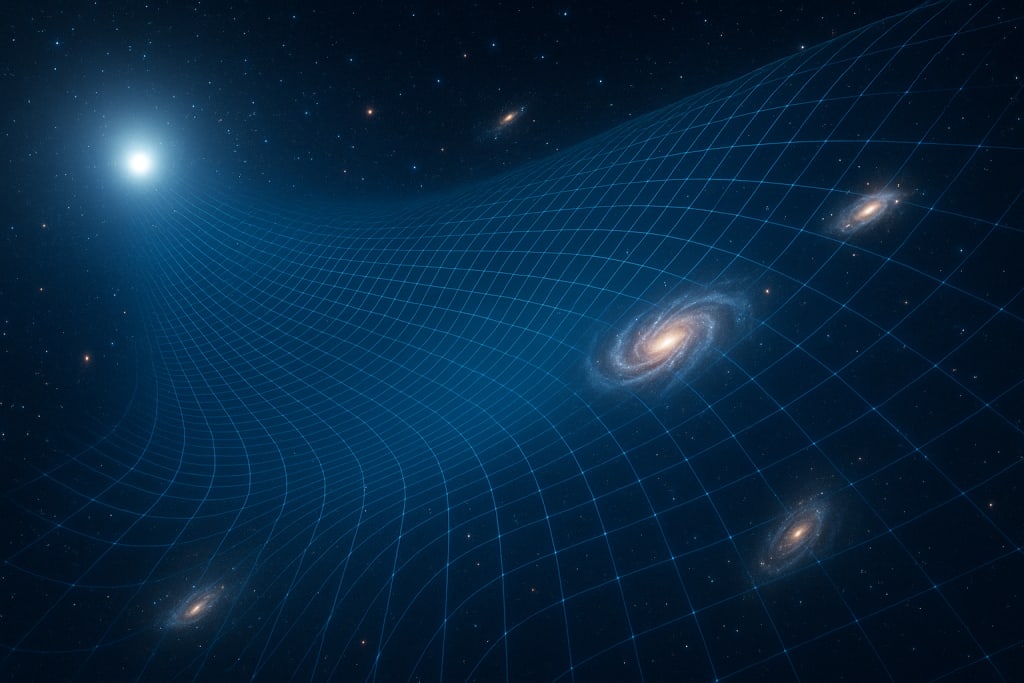
Spacetime is often compared to a stretched rubber sheet. While useful for visualization, this analogy has limits.
Spacetime is not a material object embedded in something else. It does not sit inside a larger container where it could rip.
Instead, spacetime is the framework within which physical events occur. Asking whether it can tear is partly a question about the limits of our theoretical descriptions.
________________________________________
The Most Likely Answer
Based on current knowledge:
• Spacetime can bend and stretch.
• It can ripple as gravitational waves.
• It can curve extremely near black holes.
But there is no confirmed evidence that it can tear or break in a literal sense.
If breakdowns occur, they likely signal the need for deeper physical laws rather than actual ruptures.
________________________________________
Conclusion: The Limits of the Cosmic Fabric
Spacetime is remarkably flexible, capable of bending around stars, vibrating across galaxies, and expanding with the universe itself. Yet despite these dramatic behaviors, modern physics provides no clear evidence that spacetime can tear or break like fabric.
Extreme phenomena such as black hole singularities and the hypothetical Big Rip push spacetime to its limits. But even there, what appears to be a “tear” may simply be a gap in our understanding.
The question of whether spacetime can truly break ultimately points to one of the deepest mysteries in science: the nature of reality at its most fundamental level.
Until we develop a complete theory of quantum gravity, spacetime remains both resilient and mysterious—capable of extraordinary distortions, yet seemingly unbroken.
About the Creator
Keep reading
More stories from shahkar jalal and writers in Education and other communities.
What Are Cosmic Strings? The Universe’s Most Mysterious Threads
What Are Cosmic Strings? Cosmic strings are theoretical one-dimensional defects in spacetime that may have formed in the early universe. They are not related to string theory’s vibrating strings, although the names are similar.
By shahkar jalalabout 16 hours ago in Education
Sulfonic Acid: Uses, Structure & Synthesis
Sulfonic Acid: Uses, Structure & Synthesis Sulfonic acid is one of the most important classes of organic acids in industrial and applied chemistry. From detergents and dyes to pharmaceuticals and catalysts, sulfonic acid derivatives play a critical role in modern chemical manufacturing. This article explains what sulfonic acid is, its chemical structure, methods of synthesis, and its real-world applications, using only validated and authoritative sources.
By Shraddha Mahajanabout 14 hours ago in Education
Losing Track of Expenses?Bookkeeping Services Explained
Receipts tucked into wallets, spreadsheets half-updated, and bank statements opened with a sigh, expense tracking slips through the cracks faster than most owners expect. The problem usually isn’t effort; it’s the lack of a clean system that works quietly in the background. When finances feel scattered, clarity becomes the most valuable asset a business can regain. That’s where bookkeeping services step in, not as a luxury, but as a stabilizing force that brings order, insight, and confidence back into financial decision-making.
By Lily Noblet7 days ago in Education
Self Help: Grifters' Gospel
On Self-Help, Snake Oil, and the Illusion of Change Psychology professionals and students can be imagined on two opposite sides of a line called self-help books: likely a larger group opposes pop-science and step-by-step manuals filled with talk of success, journaling, and not giving a f**k; others love them, but they aren’t many.
By Avocado Nunzella BSc (Psych) -- M.A.P 6 days ago in BookClub



Comments
There are no comments for this story
Be the first to respond and start the conversation.