
What Are Cosmic Strings? The Universe’s Most Mysterious Threads
Imagine cracks forming in ice as water freezes. Now imagine something similar happening to the universe itself—moments after the Big Bang. Instead of cracks in ice, picture ultra-thin, incredibly dense “threads” stretching across vast cosmic distances. These hypothetical structures are known as cosmic strings, and they may be among the most extraordinary objects ever predicted by theoretical physics. But what are cosmic strings? Do they really exist? And what would they mean for our understanding of space, time, and the early universe? In this in-depth guide, we explore the science behind cosmic strings, how they might have formed, how scientists search for them, and why they could revolutionize modern cosmology.

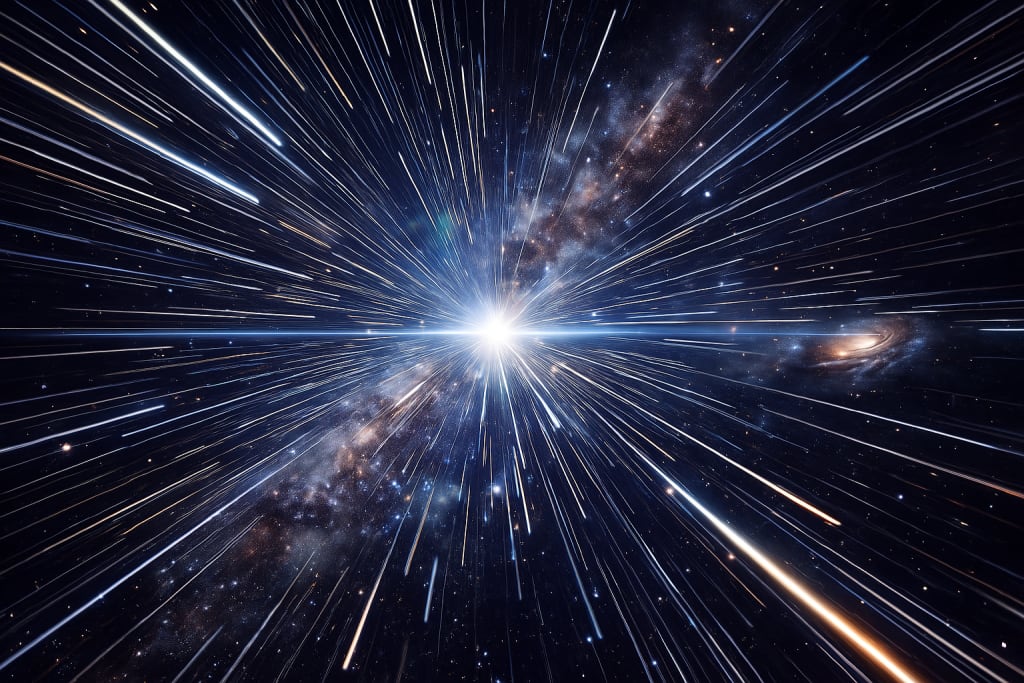
What Are Cosmic Strings?
Cosmic strings are theoretical one-dimensional defects in spacetime that may have formed in the early universe. They are not related to string theory’s vibrating strings, although the names are similar.
If they exist, cosmic strings would be:
• Extremely thin (possibly thinner than a proton)
• Incredibly dense
• Capable of stretching across galaxies
• Left over from the earliest moments after the Big Bang
Unlike ordinary strings made of matter, cosmic strings would be defects in the structure of spacetime itself.
________________________________________
How Did Cosmic Strings Form?
To understand cosmic strings, we need to travel back to the first fractions of a second after the Big Bang.
In the early universe:
• Temperatures were unimaginably high
• Forces of nature may have been unified
• Symmetry governed physical laws
As the universe expanded and cooled, these symmetries broke in a process called symmetry breaking. Similar to how ice crystals form patterns as water freezes, the cooling universe may have developed structural imperfections.
Cosmic strings are thought to be one possible type of imperfection—known as a topological defect.
________________________________________
What Is a Topological Defect?
A topological defect forms when regions of space settle into slightly different states during a phase transition.
Think of a field of arrows pointing in different directions. If neighboring regions choose different orientations, boundaries can form between them. In cosmology, such boundaries could create stable, thread-like energy concentrations.
Cosmic strings would be these boundaries—thin lines where energy remains trapped.
________________________________________
How Dense Are Cosmic Strings?
Cosmic strings would not be heavy in the conventional sense, but their energy density would be enormous.
A single kilometer of cosmic string could weigh more than Mount Everest. Yet its width might be smaller than a subatomic particle.
Their immense density means they would generate powerful gravitational effects despite their thin shape.
________________________________________
How Do Cosmic Strings Affect Spacetime?
Unlike stars or planets, cosmic strings would not pull objects toward them in the usual way. Instead, they would distort spacetime around them.
One predicted effect is called a conical spacetime geometry.
If you traveled around a cosmic string, you would not complete a full 360-degree circle in normal space. Instead, spacetime itself would be slightly “missing” a wedge, creating unusual gravitational lensing effects.
________________________________________
Gravitational Lensing and Cosmic Strings
Because cosmic strings would bend spacetime, they could affect light traveling nearby.
If a distant galaxy were positioned behind a cosmic string, its light could split into duplicate images. Unlike typical gravitational lensing caused by massive galaxies, cosmic string lensing would create:
• Identical, undistorted twin images
• Sharp alignment patterns
Astronomers search for these signatures when scanning deep space.
________________________________________
Are Cosmic Strings Related to String Theory?
Although the names sound similar, cosmic strings and string theory strings are not the same.
However, some modern versions of string theory predict the existence of cosmic superstrings, which are similar to cosmic strings but arise from fundamental string vibrations.
If detected, such structures would provide rare observational evidence for high-energy physics beyond current experiments.
________________________________________
Do Cosmic Strings Still Exist Today?
If cosmic strings formed during the early universe, some might still exist today.
Over billions of years, they would:
• Stretch with cosmic expansion
• Form loops
• Intersect and reconnect
• Gradually lose energy
These processes could produce detectable signals.
________________________________________
Gravitational Waves from Cosmic Strings
One of the most promising ways to detect cosmic strings is through gravitational waves.
When cosmic string loops vibrate or snap, they could release bursts of gravitational radiation—ripples in spacetime predicted by Einstein.
Modern observatories such as LIGO and Virgo search for unusual gravitational wave patterns that could match cosmic string predictions.
A confirmed detection would be groundbreaking.
________________________________________
Why Haven’t We Found Them Yet?
Despite decades of searching, no confirmed cosmic string has been observed.
Possible explanations include:
• They never formed
• They are too rare
• Their energy scale is lower than expected
• Current instruments lack sensitivity
However, the absence of detection also helps scientists narrow theoretical models.
________________________________________
Cosmic Strings and the Early Universe
If cosmic strings exist, they would provide a window into conditions just moments after the Big Bang.
They could reveal:
• How fundamental forces separated
• The energy scale of early phase transitions
• Clues about grand unified theories
Studying cosmic strings would help bridge the gap between cosmology and particle physics.
________________________________________
Could Cosmic Strings Destroy Earth?
This idea often appears in science fiction, but there is no evidence suggesting cosmic strings pose any threat.
Even if one passed near Earth, it would likely have minimal direct interaction with matter. Its primary effect would be gravitational distortion rather than physical collision.
The probability of such an event is extremely small.
________________________________________
How Would We Confirm Their Existence?
Scientists are looking for multiple possible signals:
• Unique gravitational lensing patterns
• Background gravitational wave noise
• Sudden bursts of gravitational radiation
• Subtle imprints in the cosmic microwave background
Combining observational evidence from different methods increases the chance of detection.
________________________________________
What Would Discovery Mean?
The discovery of cosmic strings would be revolutionary.
It would:
• Confirm predictions of early universe phase transitions
• Provide evidence for new high-energy physics
• Offer insight into symmetry breaking
• Possibly support aspects of string theory
Such a finding would rank among the most important discoveries in modern physics.
________________________________________
Cosmic Strings vs. Black Holes
While both cosmic strings and black holes warp spacetime, they differ significantly:
• Black holes are spherical and trap light.
• Cosmic strings are thread-like and do not trap matter.
• Black holes result from stellar collapse.
• Cosmic strings would be relics of the Big Bang.
Their gravitational effects are fundamentally different.
________________________________________
The Future of Cosmic String Research
Next-generation observatories may finally answer whether cosmic strings exist.
Projects monitoring gravitational waves and mapping the cosmic microwave background are becoming increasingly sensitive.
As technology advances, the search continues.
________________________________________
Conclusion: Threads from the Dawn of Time
Cosmic strings are among the most intriguing predictions of theoretical cosmology. These ultra-thin, immensely dense structures may have formed during the universe’s earliest moments, when fundamental forces separated and symmetry broke.
Though none have yet been confirmed, their possible existence offers profound insight into the physics of the Big Bang. From gravitational lensing to gravitational waves, cosmic strings provide testable predictions that guide modern astronomical research.
If discovered, cosmic strings would not just be cosmic curiosities—they would be relics of creation itself, stretching across space as silent witnesses to the birth of the universe.
About the Creator
Keep reading
More stories from shahkar jalal and writers in Education and other communities.
Can Stars Collapse Without Exploding? The Silent Death of Massive Stars
How Stars Normally Die Stars are powered by nuclear fusion. For most of their lives, they fuse hydrogen into helium, releasing energy that pushes outward against gravity. This balance between outward pressure and inward gravitational pull keeps a star stable.
By shahkar jalalabout 18 hours ago in Education
Battery-As-A-Service Models Driving Innovation in Electric Transportation
The global shift toward electrification and clean energy has placed batteries at the center of modern technological progress. Batteries power electric vehicles, support renewable energy systems, enable mobile devices, and ensure backup power for critical infrastructure. Despite their importance, batteries remain expensive, complex to maintain, and challenging to manage throughout their lifecycle. To address these challenges, a new business model known as Battery-As-A-Service (BaaS) is gaining global attention.
By Bobby Yadav3 days ago in Education
Hidden Milestones of Success: The Powerful Impact of Private and Public Venture Accomplishments
In the business world, success is not always loud or publicly celebrated. Many of the most influential achievements happen quietly—inside private ventures, within corporate boardrooms, or through strategic decisions that remain undisclosed to protect competitive advantage. These confidential accomplishments often shape industries, transform organizations, and generate enormous long-term value. Whether in private enterprises or publicly traded companies, behind-the-scenes achievements drive growth, innovation, and resilience in ways the public rarely sees.
By Matthew J Smith3 days ago in Education


Comments
There are no comments for this story
Be the first to respond and start the conversation.