
Brain wave tracker
China's Establishment as a global artificial intelligence
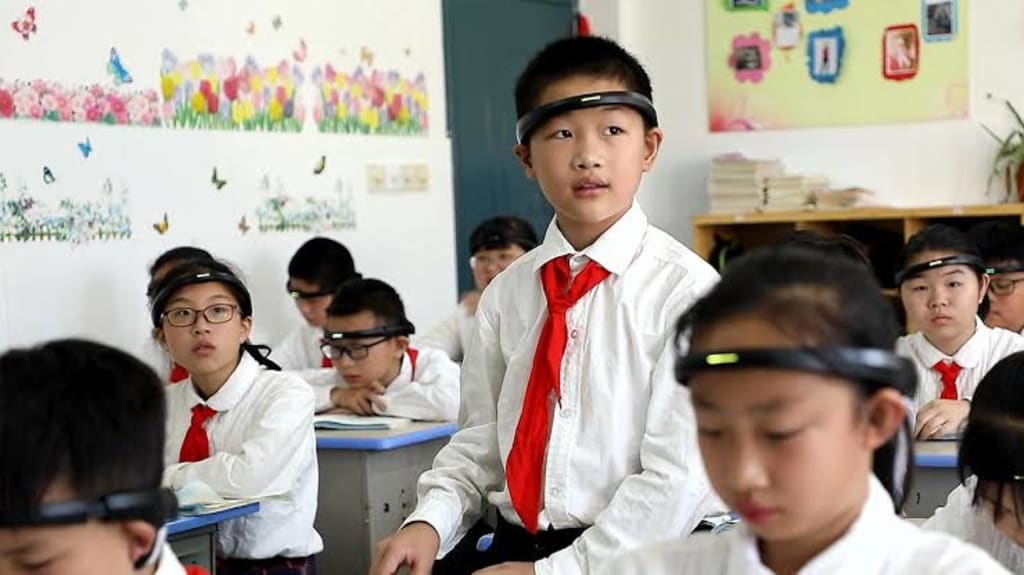
Teachers at this primary school in China possess the ability to accurately identify when a student is not paying attention. They achieve this through the use of headbands that measure each student's concentration level. This information is then transmitted directly to the teacher's computer and to the parents.
China has ambitious plans to establish itself as a global leader in artificial intelligence. The country has implemented a cashless economy, where facial recognition technology enables people to make purchases.
Surveillance cameras equipped with facial recognition assist law enforcement in monitoring the population. Meanwhile, certain schools offer a glimpse into the future of high-tech education in China. Classrooms are equipped with robots that assess students' health and engagement levels. Students wear uniforms embedded with chips that track their whereabouts. There are even surveillance cameras that monitor how frequently students check their phones or exhibit signs of drowsiness during class. These gadgets have raised concerns among Chinese citizens. Nevertheless, schools claim that obtaining parental consent to enroll their children in one of the world's largest AI education experiments was not difficult. The program aims to enhance students' academic performance while also providing valuable data for powerful algorithms. The government has invested billions of dollars into this project, fostering collaboration between tech giants, startups, and educational institutions. Our team was granted exclusive access to a primary school located a few hours outside of Shanghai to observe firsthand how AI technology is utilized in the classroom. For the fifth-grade students, the day commences with the usage of a brain wave sensing device. Following this, the students engage in meditation exercises. This Chinese-made device consists of three electrodes, two placed behind the ears and one on the forehead. These sensors detect electrical signals emitted by neurons in the brain. The neural data is then promptly transmitted to the teacher's computer, allowing the teacher to quickly discern which students are paying attention and which are not while they work on math problems.
A report is generated, providing a detailed account of the class's level of attentiveness, including each student's concentration level at 10-minute intervals. This report is then shared with parents via a group chat. Although the reports are comprehensive, the actual effectiveness and specific metrics measured by these devices remain somewhat uncertain. In order to investigate whether the headbands can genuinely gauge concentration, one of our reporters tested the device.
This technology is relatively new, with limited research to support its efficacy. Theodore Zanto, a neural scientist at the University of California San Francisco, expressed surprise at the utilization of electroencephalography (EEG) in classrooms, as it is typically employed by doctors in medical facilities and laboratories. Zanto explains that EEG is highly susceptible to artifacts, meaning that factors such as itchiness or slight restlessness, as well as improper setup leading to poor electrode contact, can affect the accuracy of the signals. Despite the potential for false readings, teachers claim that the headbands have instilled discipline in students. They assert that students now exhibit improved attentiveness, leading to increased studying and higher academic scores. However, not all students share the same level of enthusiasm. One fifth-grade student, caught dozing off in class, revealed that his parents punish him for receiving low attention scores. This type of data adds a new dimension of pressure for students. The companies we interviewed mentioned that the data collected may be used for government-funded research projects. Some parents we spoke to were uncertain about where the data ends up, although they appeared to be unconcerned. Zanto suggests that there is likely a lack of privacy protection in place. The classroom environment, where individual student assessments are conducted, does not lend itself to a nuanced analysis. Experts and citizens alike are issuing warnings regarding various aspects of China's extensive push into artificial intelligence. These classrooms serve as laboratories for future generations, and while these new tools may potentially aid the academic performance of around 200 million students, the true outcomes of this endeavor will only become apparent once they reach adulthood.
About the Creator
Keep reading
More stories from writers in Education and other communities.
Professors Are Being Watched: ‘We’ve Never Seen This Much Surveillance’
University professors across several countries are reporting an unprecedented rise in monitoring of their teaching, research, and public speech, raising concerns about academic freedom and the future of open inquiry. From recorded lectures and classroom informants to digital tracking and social media scrutiny, faculty members say the level of surveillance they now face is unlike anything seen in modern higher education. Civil liberties groups warn that the trend reflects a broader climate of political polarization, national security anxiety, and ideological conflict that is reshaping universities into contested spaces where professors are increasingly treated as potential risks rather than independent scholars. “We’ve never seen this much surveillance of faculty,” said a senior researcher at an academic freedom watchdog organization. “What used to be isolated incidents are now becoming systematic.” Monitoring Inside the Classroom In several recent cases, students have recorded lectures without professors’ knowledge and submitted clips to outside advocacy groups or government agencies, accusing instructors of political bias or inappropriate speech. Some professors say administrators have quietly installed additional classroom recording systems or requested access to lecture content in advance. At a large public university in the United States, a history professor described receiving an email from administrators informing him that his lectures would be reviewed after complaints from anonymous sources. “It felt like I was being interrogated rather than evaluated,” he said. “My course is about political movements. That alone seems to make it suspicious now.” Universities defend some monitoring as part of quality control or compliance with harassment and discrimination policies. But faculty unions argue that the line between oversight and surveillance is being crossed. Digital Surveillance and Social Media Scrutiny Beyond the classroom, professors say their online lives are increasingly under watch. Academic tweets, blog posts, and even private comments in virtual classrooms have been flagged and forwarded to employers or politicians. In one case, a professor specializing in Middle Eastern politics faced an internal investigation after screenshots of a social media post criticizing a foreign government were circulated by a political group. Although no formal wrongdoing was found, the professor said the experience was chilling. “You start thinking twice before speaking,” she said. “That’s the point of surveillance—it creates fear.” Cybersecurity experts note that universities now use software that can track email communications, monitor internal messaging platforms, and analyze lecture recordings for “compliance risks.” While such tools were initially designed for data protection and campus safety, they are increasingly applied to content and behavior. Political Pressure and National Security Concerns Governments in several countries have expanded scrutiny of academic institutions in the name of national security. Laws requiring disclosure of foreign research funding, collaborations, and travel have grown stricter, particularly for scientists and political scholars working on China, Russia, the Middle East, and emerging technologies. In some regions, faculty members must report contacts with overseas colleagues or face penalties. Critics argue these measures blur the line between legitimate security concerns and ideological policing. “Universities are becoming extensions of the security state,” said a legal scholar who studies higher education policy. “That fundamentally changes what universities are supposed to be.” The pressure is not limited to authoritarian countries. Democratic nations have also seen increased political involvement in curriculum decisions and research agendas, especially on topics such as race, gender, war, and foreign policy. Impact on Teaching and Research Many professors report self-censorship as a result of constant scrutiny. Sensitive topics are avoided, controversial authors removed from syllabi, and classroom debates tightly controlled to prevent misunderstandings. A sociology professor said she now records every lecture herself for legal protection. “I need proof of what I actually said,” she explained. “It’s defensive teaching.” Graduate students and junior faculty are especially vulnerable. Without tenure protections, they risk losing jobs or funding if accused of violating vague conduct rules. Some universities have also introduced anonymous reporting systems that allow students or staff to flag instructors for “concerning behavior.” While intended to promote inclusion, faculty groups warn these systems can be weaponized for political or personal grievances. Universities Defend Policies University administrators insist that surveillance measures are not meant to suppress ideas but to ensure safety and accountability. Many point to rising threats, online harassment, and campus tensions as reasons for stronger monitoring systems. “We are responsible for protecting students and staff,” said a university spokesperson. “That includes responding to complaints and maintaining respectful learning environments.” However, transparency remains a key concern. Faculty members often do not know when they are being monitored, how data is used, or who has access to recordings and reports. A Global Trend International academic organizations say the problem is growing worldwide. In Europe, new laws regulating “political neutrality” in classrooms have raised alarms. In parts of Asia and the Middle East, surveillance of professors has long been common, but digital tools have made it far more pervasive. “What’s new is the scale and technology,” said an official from a global education group. “Surveillance used to be physical. Now it’s constant and invisible.” The Future of Academic Freedom Legal challenges are beginning to emerge. Faculty unions and civil rights groups are pushing for clearer boundaries between legitimate oversight and intrusive monitoring. Some courts have ruled that academic speech deserves strong protection, but enforcement remains uneven. For many professors, the fear is not just disciplinary action but the erosion of trust between teachers and students. “The classroom should be a place of curiosity and disagreement,” one professor said. “If everyone is watching everyone else, that disappears.” As universities balance safety, politics, and technology, the question remains whether higher education can preserve its core mission: fostering independent thought in an age of constant observation. The answer may determine not only the future of academia, but the health of democratic debate itself.
By Fiaz Ahmed 6 days ago in Education
The Overlooked Intersections of Education, Cultural Heritage, and Public Service in Society
Education, cultural heritage, and public service often appear as separate fields. Schools focus on learning. Heritage focuses on history and tradition. Public service focuses on helping people. Yet these areas are deeply connected. They shape values, guide behavior, and support communities. When viewed together, their shared purpose becomes clear. At the center of this connection is education, cultural heritage, and public service, a relationship that quietly shapes how societies grow, remember, and care for people. These intersections are often overlooked because they work in subtle ways. They appear in classrooms, museums, libraries, and community programs. They influence how people learn about the past, understand the present, and act for the future. When combined, they create stronger and more informed communities.
By Carmen Reid7 days ago in Education
Should We Not Try to Get Too Political?
Here's something you often hear people say, "I try not to get too political." I understand the sentiment and I sympathize with it... while at the same exact time, I completely disagree with the notion. Whether it's referring to social media or wherever, it's kind of unavoidable. You can attempt to sidestep it, not engage, leave the less important things for actual politicians to discuss... you can want it to not take over your life, your conversations, your relationships, and that makes perfect sense.
By Stephen Kramer Avitabile6 days ago in Writers



Comments
There are no comments for this story
Be the first to respond and start the conversation.