
Blood, Sweat, and Sneakers: The Extraordinary Rivalry Between Adidas and Puma.
In the quiet Bavarian town of Herzogenaurach, Germany, a small river named the Aurach carves a path through the community.

Blood, Sweat, and Sneakers: The Extraordinary Rivalry Between Adidas and Puma.
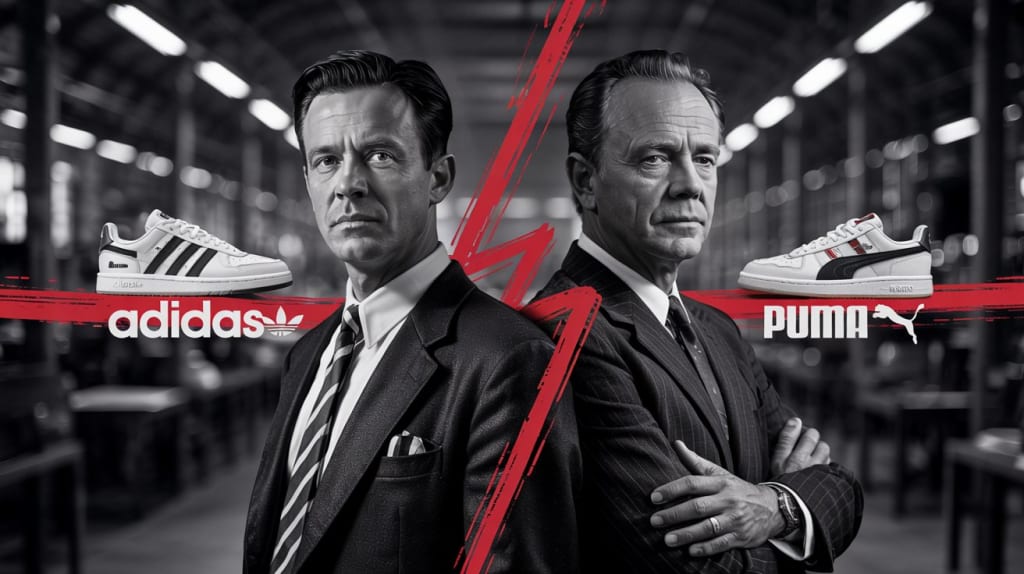
In the picturesque Bavarian town of Herzogenaurach, Germany, a river cuts through the center like a scar—a fitting metaphor for the bitter divide that has defined this community for generations. On one side stands the global headquarters of Adidas, on the other, the worldwide base of operations for Puma. These two sportswear giants, recognized in every corner of the globe, emerged not as friendly competitors but as the manifestation of one of the most acrimonious family feuds in business history.
The story of Adidas and Puma is not merely a tale of corporate rivalry; it's a saga of betrayal, sabotage, and a sibling relationship fractured beyond repair. Adolf and Rudolf Dassler, brothers born at the turn of the 20th century, began their journey sharing a dream and a small workshop in their mother's laundry shed. Together, they built a pioneering shoe company that would revolutionize athletic footwear. Yet, what started as a harmonious partnership disintegrated into a lifelong chess match where each brother maneuvered relentlessly to destroy the other.
Even today, the shadow of their conflict looms large over Herzogenaurach, a town once known as the "town of bent necks" because residents would look down to see which brand of shoes a person was wearing before deciding whether to speak to them. One half of the town aligned with Adidas, the other with Puma—a division that permeated schools, social circles, and even romantic relationships.
This extraordinary rivalry spans two world wars, intertwines with the rise and fall of Nazi Germany, and features some of the most iconic moments in sports marketing history. From Jesse Owens' gold medals at the 1936 Berlin Olympics to Pelé's calculated shoelace-tying moment at the 1970 World Cup, the Dassler brothers' competition shaped not just their companies but the entire landscape of global sports business.
What makes this story particularly compelling is its profound irony: in their obsessive quest to outdo each other, the brothers ultimately prevented their shared vision from reaching its full potential. While they were consumed by mutual hatred, an upstart American company called Nike eventually surpassed them both to become the world's dominant sports brand.
The saga of Adidas and Puma reveals the double-edged nature of competition—how personal conflict can simultaneously drive remarkable innovation and extract a devastating human cost. It demonstrates how the bonds of blood can be both our greatest strength and, when broken, our most destructive weakness. This is the story of two brothers bound by birth but driven apart by ambition, whose bitter feud created two global empires that continue to shape athletic culture around the world today.
Humble Beginnings: From Laundry Shed to Shoe Factory
In the small Bavarian town of Herzogenaurach at the turn of the 20th century, few could have predicted that two of the world's most influential sports brands would emerge from such modest origins. Rudolf Dassler, known as Rudi, was born in 1898 into a working-class family struggling to make ends meet. Just two years later, in 1900, his younger brother Adolf, who would come to be known as Adi, joined the family. Their childhood was far from privileged—their father worked in one of the local shoe factories that dotted the region, but his meager earnings were insufficient to support the family.
To supplement their father's income, the Dassler matriarch established a small laundry business from their home. Young Rudi and Adi would spend their afternoons after school delivering freshly washed clothes throughout Herzogenaurach. As they traversed the cobblestone streets with bundles of laundry, the townspeople began affectionately referring to them as the "laundry boys." This early experience of hard work and responsibility would shape both brothers' character and work ethic in the years to come.
The relatively stable rhythm of their childhood was abruptly disrupted when World War I erupted across Europe. Both Dassler brothers were eventually drafted into the German Army, forcing them to abandon their education and family responsibilities. The war years were formative for the young men, exposing them to a world beyond their small town and instilling in them a sense of national identity that would later influence their business decisions.
When they finally returned home after the war, they found Germany in economic ruins. The Treaty of Versailles had imposed crushing reparations on the defeated nation, triggering hyperinflation and widespread unemployment. The Dassler family's situation was particularly dire—their mother's laundry business had lost all its customers during the brothers' absence, and opportunities for steady employment were scarce.
It was in this environment of post-war desperation that Adi Dassler's entrepreneurial spirit emerged. Unlike his more outgoing and business-minded brother Rudi, Adi had always been introspective and technically inclined. He had also harbored a lifelong passion for athletics, and during his time in the army, he had observed how proper footwear could significantly impact a soldier's performance and comfort.
Adi recognized a gap in the market: at that time, athletes typically competed in the same shoes they wore for everyday use. There were no specialized shoes designed for specific sports or activities. With his background knowledge from his father's profession and his own athletic interests, Adi envisioned creating specialized spiked shoes that would give runners better traction and improved performance.
With no capital, no materials, and unreliable electricity in post-war Germany, most would have abandoned such an ambitious idea. But Adi's determination and resourcefulness prevailed. He converted his mother's laundry shed into a makeshift workshop and began his quest to create the perfect athletic shoe. Rather than purchasing new materials—which would have been both expensive and scarce—Adi scoured old battlefields and military surplus stores, collecting whatever he could repurpose: leather from discarded helmets, canvas from military tents, and even strings from broken parachutes.
The electricity shortage presented another challenge. In a stroke of ingenuity, Adi attached a leather trimmer to a stationary bicycle and enlisted friends to pedal, generating the power needed to operate his equipment. This creative solution allowed him to continue working even during the frequent power outages that plagued post-war Germany.
Despite these obstacles, Adi's first shoes were surprisingly well-crafted. He obsessed over every detail, experimenting with different materials and designs to create footwear that was both durable and performance-enhancing. Word of his quality handmade athletic shoes began to spread throughout Herzogenaurach and neighboring towns. Local athletes who tried his spiked running shoes reported improved times and better stability, validating Adi's vision.
As demand for his shoes grew, Adi found himself overwhelmed with orders. It was at this critical juncture that Rudi, who had been working at a porcelain factory since returning from the war, decided to join his brother's venture. The partnership made perfect sense: Adi was the quiet innovator, constantly tinkering with designs and production techniques, while Rudi was charismatic and business-savvy, with a natural talent for sales and promotion.
Rudi's contribution to the fledgling business was immediate and significant. He began visiting sports clubs throughout the region, often giving away free pairs of their shoes to influential coaches and star athletes. This early form of athletic sponsorship proved remarkably effective—once team leaders experienced the quality and performance advantages of Dassler shoes, they would typically order pairs for their entire team.
In 1924, the brothers formalized their partnership by registering the "Dassler Brothers Sport Shoe Factory." Their first official workshop, though still modest, was a significant upgrade from the laundry shed where it all began. They hired their first employees and established a more systematic production process, allowing them to increase output while maintaining the quality that had become their hallmark.
The timing of their business venture coincided with a growing interest in sports across Germany. After the humiliation of World War I, many Germans viewed athletic achievement as a way to restore national pride. Sports clubs proliferated, and participation in track and field, football, and other competitive activities surged. The Dassler brothers were perfectly positioned to capitalize on this trend with their specialized athletic footwear.
By the late 1920s, the Dassler brothers' reputation had spread beyond Herzogenaurach. Athletes wearing their shoes began winning competitions at regional and national levels, providing the best possible advertisement for their products. The brothers reinvested their profits into better equipment and materials, constantly refining their designs based on feedback from the athletes who wore them.
On the surface, the partnership appeared ideal—Adi's technical brilliance complemented by Rudi's business acumen. They were not just brothers but best friends and business partners, working side by side to build something meaningful from nothing. Their shared vision and complementary skills had transformed a desperate post-war idea into a thriving business with growing national recognition.
Yet beneath this harmonious exterior, the seeds of what would become one of the most bitter business rivalries in history were already being sown. The brothers' different personalities and approaches to business would eventually create friction. Adi's perfectionism and constant desire to improve their products sometimes clashed with Rudi's more aggressive sales tactics and expansion plans. These tensions, though manageable in the company's early years, would later explode into open conflict, forever changing the landscape of sports manufacturing and marketing.
For now, though, the Dassler brothers stood united, their small shoe factory in Herzogenaurach poised on the cusp of international recognition. Neither could have imagined that within two decades, they would be sworn enemies, or that their family feud would give birth to two of the most recognizable brands in the world.
## Rise to Prominence: The Nazi Era and Olympic Glory
As the 1930s dawned, the Dassler brothers' shoe business was steadily growing, but it was about to experience an unprecedented boom due to political changes that would reshape Germany—and eventually the world. The rise of Adolf Hitler and the Nazi Party in 1933 marked the beginning of a new era for German society, including its approach to sports and athletics.
The Nazi regime viewed sports not merely as recreation but as a powerful tool for propaganda. Physical fitness was promoted as a national duty, preparing German youth for military service while demonstrating the supposed superiority of the "Aryan race." This ideological emphasis on athletics created an explosive demand for sporting equipment, particularly specialized footwear. For the Dassler brothers, this political shift presented a significant business opportunity, albeit one entangled with moral compromises.
Both Rudolf and Adolf Dassler joined the Nazi Party in the 1930s. While some historians argue that party membership was practically mandatory for business owners who wished to continue operating, evidence suggests that the brothers' involvement went beyond mere pragmatism. Rudolf, the more politically outspoken of the two, reportedly embraced Nazi ideology with considerable enthusiasm. He was known to express strong support for Hitler's policies and vision for Germany. Adolf, though less vocal about his political views, became actively involved with the Hitler Youth organization, helping to equip young Germans for athletic competitions that were increasingly framed as demonstrations of national strength.
The brothers' association with the Nazi Party undoubtedly facilitated their business growth during this period. They received government contracts and benefited from the regime's emphasis on sports. Their factory expanded, and they hired more workers to meet the growing demand. By the mid-1930s, the Dassler brothers had established themselves as Germany's premier athletic shoe manufacturers, with their products being worn by most German athletes in major competitions.
However, it was the 1936 Berlin Olympics that would truly transform their business and set the stage for their global recognition. These Games were unlike any that had come before. Hitler had envisioned them as a spectacular showcase for Nazi Germany—a chance to present his regime to the world as modern, efficient, and powerful. The Olympics would be the first to be televised, reaching an unprecedented international audience. For businesses associated with the Games, this represented an extraordinary marketing opportunity.
The Dassler brothers recognized this potential and made a bold decision that would forever change their company's trajectory. They decided to pursue international athletes to wear their shoes, focusing particularly on track and field stars who would command the spotlight. Among these athletes was Jesse Owens, an African American runner who had already established himself as one of the world's fastest men.
The decision to approach Owens was fraught with risk. Hitler's racial ideology positioned Black people as inferior, and the Nazi propaganda machine was preparing to use the Olympics to demonstrate "Aryan superiority." For German businessmen to actively support a Black athlete was to potentially invite scrutiny from the regime. Nevertheless, Adolf Dassler was determined to have the best athletes wearing his shoes, regardless of their nationality or race.
Dassler made his way to the Olympic Village where international athletes were staying. Finding Jesse Owens, he introduced himself and presented the American with a pair of handcrafted track spikes specifically designed for sprinting and jumping events. Unlike today's elaborate sponsorship deals, this arrangement was remarkably simple: Owens received the shoes as a gift and agreed to wear them in competition. No contracts were signed, no money changed hands—just a handshake agreement between an athlete and a shoemaker.
What followed would become one of the most iconic moments in Olympic history. Jesse Owens, wearing Dassler spikes, won four gold medals in the 100 meters, 200 meters, long jump, and 4×100 meter relay. His dominant performance directly contradicted Nazi propaganda about racial superiority and reportedly infuriated Hitler, who had hoped to see German athletes triumph as proof of his ideological claims.
For the Dassler brothers, however, Owens' victories represented a marketing coup of unprecedented proportions. Millions around the world watched as a Black American athlete wearing German-made shoes defeated the best competitors from every nation. Photographs of Owens on the podium, his Dassler spikes clearly visible, circulated in newspapers globally. The brothers could not have asked for more effective advertising.
In the aftermath of the Berlin Olympics, orders for Dassler shoes began pouring in from around the world. Athletes and teams from various countries, impressed by what they had seen, wanted the same equipment that had carried Jesse Owens to glory. The small factory in Herzogenaurach suddenly found itself with an international clientele, and the brothers worked feverishly to expand production to meet this new demand.
The Olympic success also enhanced the brothers' reputation within Germany. Despite the regime's disappointment with Owens' victories, the fact that he had won wearing German-made shoes allowed the Dasslers to frame the outcome as a triumph of German craftsmanship. Their business continued to grow throughout the late 1930s, with their shoes becoming the standard for serious athletes across Europe.
On the surface, this period represented the pinnacle of the brothers' partnership. Their shared vision had elevated them from a small-town workshop to international recognition. Their complementary skills—Adolf's technical innovation and Rudolf's business acumen—seemed perfectly balanced. Yet beneath this success, tensions were beginning to simmer.
As the business grew more complex and the stakes higher, differences in the brothers' personalities and priorities became more pronounced. Rudolf, always the more ambitious and outgoing of the two, began to chafe at what he perceived as Adolf's excessive focus on technical details at the expense of business expansion. Adolf, meanwhile, grew frustrated with Rudolf's emphasis on sales over product quality. These professional disagreements were exacerbated by the brothers' close living arrangements—they had invested in a duplex house where both families lived side by side, meaning they could never truly escape each other.
The outbreak of World War II in 1939 would further strain their relationship and ultimately set the stage for their dramatic split. As Germany mobilized for total war, civilian industries were increasingly required to contribute to the military effort. The Dassler factory, with its expertise in leather working and shoe production, was partially converted to manufacture boots for German soldiers and, later, weapons components.
This wartime conversion shifted the power dynamic between the brothers. Adolf's technical knowledge became more valuable than Rudolf's sales abilities in a market now dominated by government contracts rather than consumer choice. Rudolf grew increasingly paranoid that his brother was using the war as an opportunity to sideline him and take control of the company.
These suspicions would soon explode into open hostility, transforming a successful partnership into one of the most bitter rivalries in business history. The seeds planted during the Nazi era and Olympic triumph would bear fruit in the form of two competing global brands, each fueled by the brothers' determination to outdo the other. But that dramatic split still lay in the future, as Germany and the world plunged deeper into the darkness of World War II.
## War and Division: The Bitter Split
As World War II engulfed Europe, the tensions that had been simmering between the Dassler brothers reached a boiling point. What had once been minor disagreements about business strategy evolved into deep-seated animosity that would permanently fracture their relationship and ultimately give birth to two competing global brands.
The war years brought unprecedented stress to the Dassler shoe factory. Like most German businesses, they were required to contribute to the war effort. Their production lines, once dedicated to crafting athletic footwear, were partially converted to manufacture military boots for German soldiers. As the conflict intensified, they were even tasked with producing weapons components, including bazookas and parts for tank mines—a far cry from the specialized sports shoes that had built their reputation.
This wartime conversion created a significant shift in the power dynamics between the brothers. Adolf's technical expertise in manufacturing became more valuable than Rudolf's sales abilities in an economy now dominated by government contracts rather than consumer choice. Rudolf, who had always prided himself on being the business mastermind behind their success, found his role diminished as Adolf took greater control of day-to-day operations.
The most infamous incident—one that would become central to the brothers' mythology—occurred during an Allied bombing raid on Herzogenaurach. As air raid sirens wailed, Adolf and his wife hurried to a bomb shelter where Rudolf and his family had already taken refuge. Upon entering, Adolf reportedly uttered the fateful words: "The bastards are back again."
This seemingly innocuous comment would become the subject of bitter dispute for decades. Adolf would later insist he had been referring to the Allied bombers overhead. Rudolf, however, became convinced the remark was directed at him and his family. In the heightened tension of wartime Germany, with both brothers already harboring resentments, this misunderstanding—if indeed it was one—proved catastrophic to their relationship.
Shortly after this incident, Rudolf was called up for military service, while Adolf was permitted to remain in Herzogenaurach to continue operating the factory. This separation only deepened Rudolf's suspicions that his brother was maneuvering to take complete control of their business. From the front lines, Rudolf sent a letter expressing his concerns about Adolf's character and demanding that his wife be installed as his representative in company matters during his absence. Adolf refused this request, further convincing Rudolf that his brother was plotting against him.
The paranoia and mistrust between the brothers reached new heights when Rudolf reported Adolf to Nazi authorities, accusing him of hoarding leather that should have been contributed to the war effort. As a result, Adolf was briefly detained and interrogated—an experience he would never forgive his brother for instigating.
As Germany's fortunes in the war declined, the brothers' relationship deteriorated in parallel. By the time the conflict ended in 1945, with Germany defeated and occupied by Allied forces, the Dasslers' partnership existed in name only. Their personal animosity had become so intense that reconciliation seemed impossible.
The post-war period brought new challenges that further strained their fractured relationship. The process of denazification—whereby German citizens were investigated for their involvement with the Nazi regime—placed both brothers under scrutiny. Rudolf was imprisoned in an American POW camp for nearly a year due to suspicions about his enthusiastic support for the Nazi Party. During this time, he grew increasingly bitter that Adolf made no apparent effort to secure his release.
When Rudolf was finally freed, he became convinced that his imprisonment had been the result of a deliberate betrayal. American authorities had indeed received a tip about Rudolf's Nazi sympathies, and Rudolf was certain the information had come from Adolf—another accusation that would never be definitively proven or disproven.
The tables turned when Adolf himself faced investigation for war profiteering. During these proceedings, Rudolf did not hesitate to testify against his brother, seizing the opportunity for revenge. Though Adolf was eventually cleared of wrongdoing, the public spectacle of the brothers' mutual accusations destroyed any remaining possibility of reconciliation.
Rumors and allegations continued to swirl around the brothers, further poisoning their relationship. Perhaps most damaging was the suggestion of an affair between Rudolf and Adolf's wife—a claim that, whether true or not, added a deeply personal dimension to their business rivalry. The brothers, once inseparable partners who had built a successful company from nothing, now could not bear to be in the same room.
By 1948, it became clear that the Dassler Brothers Sport Shoe Factory could not continue with both siblings at the helm. After months of bitter negotiations, facilitated by lawyers and town officials, they agreed to divide the company's assets. The split was not merely professional but geographical—Rudolf established his new company on the north side of the Aurach River that ran through Herzogenaurach, while Adolf remained on the south side.
Adolf combined his nickname "Adi" with the first syllable of his surname to create "Adidas." Rudolf initially named his company "Ruda," following a similar pattern, but soon changed it to "Puma," believing the name of the sleek, powerful cat would better appeal to athletes.
The division of assets was as contentious as everything else between the brothers. They split their equipment, materials, and even their workforce. Employees were forced to choose sides, with most technical staff following Adolf to Adidas and sales personnel joining Rudolf at Puma. This division extended beyond the factory walls, effectively splitting the town of Herzogenaurach itself.
The river that had always run through the center of town now became a symbolic border between two hostile camps. Residents aligned themselves with either Adidas or Puma, creating parallel communities that rarely interacted. Local businesses, sports clubs, and even schools became associated with one company or the other. Marriages between employees of rival companies were strongly discouraged, and children were taught from an early age which side of town—and which brand of shoes—was "theirs."
This division was so pronounced that Herzogenaurach became known as "the town of bent necks" because people would look down at others' feet to see which brand of shoes they were wearing before deciding whether to engage with them. The only person who refused to take sides was the town's mayor, who in a diplomatic gesture would wear one Adidas shoe and one Puma shoe to official functions.
In the immediate aftermath of the split, the brothers faced the challenge of distinguishing their products from each other. Initially, Adidas and Puma shoes looked remarkably similar, reflecting their common origin. Adolf's solution was to emphasize the three leather support stripes that had been a functional element of his designs. By painting these stripes white, he created a distinctive visual trademark that would eventually become one of the most recognizable logos in the world.
Rudolf, meanwhile, focused on creating his own distinctive identity for Puma, developing the leaping cat logo and emphasizing speed and agility in his marketing. Both brothers were determined to prove they could succeed without the other—and more importantly, that they could outdo their sibling rival.
What had begun as a family partnership born of post-war necessity had transformed into two separate companies fueled by an almost pathological hatred. The brothers, who once shared a dream and a workshop in their mother's laundry shed, would never speak to each other again. Their mutual animosity would drive them to extraordinary lengths to outcompete, outmaneuver, and ultimately outlast each other in the global sportswear market.
The stage was now set for a decades-long rivalry that would shape not just the brothers' lives but the entire sports industry. Adidas and Puma would battle for supremacy in every arena, from the football pitch to the Olympic track, each victory or defeat in this corporate war carrying the weight of personal vendetta. The brothers' split had created not just two companies but two opposing philosophies, two competing visions, and two bitter enemies bound by blood but divided by everything else.
## A Town Divided: Rivalry and Global Growth
With the official split of their company in 1948, Adolf and Rudolf Dassler transformed from brothers into sworn enemies. Their newly formed companies—Adidas and Puma—became the physical manifestations of their bitter feud, and both men were determined to prove they could outdo the other. What followed was a decades-long corporate chess match where business decisions were often motivated more by spite than strategy.
The division of Herzogenaurach along company lines was immediate and profound. The Aurach River that ran through the center of town became more than a geographical feature; it was a border between two hostile territories. On the south side stood Adidas, on the north side Puma, and crossing this boundary required a certain courage—especially if you were wearing the wrong brand of shoes.
As the largest employers in the area, the two companies shaped every aspect of local life. Children of Adidas employees attended different schools than children of Puma workers. Local businesses, restaurants, and bakeries became known as either "Adidas establishments" or "Puma establishments." Dating someone from the "other side" was strongly discouraged, and marriages between employees of rival companies were rare enough to cause scandal when they occurred.
The town became known throughout Germany as "the town of bent necks" because residents would instinctively look down at a stranger's feet to check their shoes before deciding whether to engage with them. Wearing Puma shoes on the Adidas side of town (or vice versa) could result in refused service at shops or hostile stares from passersby. The only person who maintained neutrality was the town's mayor, who diplomatically wore one shoe from each company to official functions—a visual compromise that satisfied neither of the feuding brothers.
Beyond Herzogenaurach, the brothers raced to distinguish their products from each other and establish unique brand identities. Adolf's strategy centered on product innovation and technical excellence. He had always been the craftsman of the partnership, obsessed with creating the perfect athletic shoe, and he continued this focus with Adidas. His most distinctive innovation was emphasizing the three support stripes that had been a functional element of his designs. By painting these stripes white, he created an instantly recognizable visual trademark that would eventually become one of the most iconic logos in sports history.
Rudolf, meanwhile, positioned Puma as the more rebellious, cutting-edge alternative. He focused on speed and agility in his marketing, developing the leaping cat logo that suggested power and dynamism. While Adolf was methodical and detail-oriented, Rudolf was bold and willing to take risks—characteristics that were reflected in their respective companies' approaches to business.
The first major battleground for the newly separated companies was the 1950 FIFA World Cup in Brazil. Rudolf, leveraging his sales expertise and personal connections, attempted to secure a deal with the German national team's coach to have the players wear Puma boots during the tournament. However, negotiations stalled over payment terms. Rudolf, confident in his negotiating position, refused to compromise, believing the coach would eventually accept his terms.
This proved to be a critical miscalculation. While Rudolf held firm, Adolf swooped in and struck a deal with the German team. When the tournament began, the German players took to the field wearing Adidas boots—a very public victory for Adolf in the brothers' ongoing feud.
Initially, this seemed like a minor triumph, as expectations for the German team were low. Germany was still recovering from the devastation of World War II, and its national football program had been in disarray. Few expected them to advance far in the tournament. However, against all odds, the German team fought their way to the final match against the heavily favored Hungarian team, which hadn't lost a game in four years.
What happened next would become legendary in both football history and the annals of sports marketing. On the day of the final, it began to rain heavily, turning the pitch into a muddy quagmire. This would typically favor the more technically skilled Hungarian team, but Adolf Dassler had prepared for this possibility. The boots he had designed for the German players featured an innovation he called "adjustable cleats"—screw-in studs that could be changed based on field conditions.
As the match progressed and the field became increasingly waterlogged, the Hungarian players began to slip and lose their footing. The German players, however, maintained perfect traction thanks to their Adidas boots. After falling behind 2-0 early in the match, Germany staged a remarkable comeback, scoring three goals to win 3-2 in what became known as "The Miracle of Bern."
This victory was transformative for post-war Germany, representing the country's return to the international stage and giving its citizens something to celebrate after years of defeat and shame. And at the center of this national moment of pride were Adolf Dassler's shoes. Overnight, Adidas became a symbol of German ingenuity and quality. Orders flooded in from around the world, and Adolf was elevated to the status of national hero.
For Rudolf, watching his brother receive acclaim for what he considered a stroke of luck was unbearable. His bitterness intensified when, two years later at the 1956 Melbourne Olympics, Puma's shipment of shoes mysteriously failed to clear customs while Adidas' shipment passed through without issue. Rudolf became convinced that Adolf had bribed officials to block his products, ensuring that the majority of athletes would wear Adidas shoes by default. Whether this accusation was true or merely another manifestation of the brothers' paranoia remains unclear, but it further poisoned their relationship.
As the 1950s gave way to the 1960s, both companies expanded aggressively. They diversified their product lines beyond specialized athletic shoes to include sneakers, sports clothing, and accessories. They also began to establish international operations, recognizing that the global market for sporting goods was growing rapidly. Whatever strategy one brother adopted, the other quickly followed, determined not to cede any advantage.
The intensity of their competition led both companies to pioneer what would become standard practice in the sports industry: athlete endorsements. Both Adidas and Puma began paying top athletes to wear their products, recognizing the marketing value of having champions associated with their brands. This approach, revolutionary at the time, would eventually transform sports marketing worldwide.
As the brothers aged, they enlisted their sons to help manage their expanding businesses. Adolf's son Horst (often called "Adi") took on increasing responsibility at Adidas, while Rudolf's son Armin assumed a leadership role at Puma. Far from cooling the family feud, this new generation inherited and sometimes intensified the rivalry. The sons had grown up in the shadow of their fathers' hatred and viewed the competition between the companies as their birthright.
By the late 1960s, the cost of this rivalry was becoming apparent. Both companies were spending enormous sums to outbid each other for athlete endorsements, significantly cutting into their profits. Before the 1968 Olympics, Horst and Armin recognized that their bidding wars were mutually destructive and secretly agreed to a truce of sorts. They would refrain from competing for certain athletes, particularly the most expensive stars, to avoid driving up costs for both companies.
This fragile peace would be dramatically shattered during the 1970 World Cup in Mexico. Pelé was not just another football player; he was widely regarded as the greatest player in the world, a global superstar whose endorsement would be invaluable. According to their agreement, neither Adidas nor Puma would attempt to sign him, as the resulting bidding war would be ruinously expensive.
Imagine Horst Dassler's shock, then, when he turned on his television to watch Brazil's quarterfinal match and saw Pelé wearing unmistakable Puma boots. Just before the opening whistle, Pelé asked the referee for a moment to tie his shoelaces. As he knelt down, cameras from around the world focused on him—and by extension, on his Puma shoes. For those few seconds, Puma dominated television screens across the globe in what may have been the most effective ambush marketing in sports history.
Armin had secretly negotiated a deal worth approximately $125,000 for Pelé to wear Puma boots—an astronomical sum for athlete endorsement at that time. The calculated shoelace-tying moment ensured maximum visibility for the brand. When Pelé led Brazil to victory in the tournament, Puma's global standing soared, and their football boots became bestsellers worldwide.
Horst was furious at what he saw as a betrayal of their agreement. The truce between the cousins was over, and the Dassler feud entered a new, even more aggressive phase. Both companies now pursued athlete endorsements with renewed vigor, spending ever-larger sums to secure the most visible stars.
Meanwhile, the original brothers were entering the twilight of their lives, their hatred for each other undiminished by time. When Rudolf was diagnosed with lung cancer in the early 1970s, Adolf refused all suggestions of reconciliation. Rudolf died in 1974, and Adolf declined to attend his funeral. When Adolf himself died in 1978, he was buried at the opposite end of the town cemetery from his brother—their physical separation maintained even in death.
The brothers' passing marked the end of an era for both companies. They had built global brands from nothing, driven by a combination of innovation, determination, and an almost pathological desire to outdo each other. Their rivalry had pushed them to achievements neither might have accomplished alone, but it had also consumed them personally and, increasingly, threatened the financial health of their respective companies.
With the founders gone, leadership passed fully to their sons, who faced the challenge of navigating an increasingly competitive global market without the driving force of their fathers' vision—and vendetta. The stage was set for a new chapter in the Adidas-Puma saga, one that would test whether these companies could survive without the bitter personal rivalry that had defined them for so long.
## Decline and Rebirth: The Modern Era
The deaths of Adolf and Rudolf Dassler in the 1970s marked the end of an era for both Adidas and Puma. The fierce personal rivalry that had driven the companies' growth for decades was gone, leaving their sons to navigate an increasingly competitive global market without the founding fathers' vision—and vendetta.
Under Horst Dassler's leadership, Adidas initially maintained its dominant position in the sports industry. Horst had inherited his father's technical knowledge but combined it with a more aggressive approach to marketing and global expansion. He focused heavily on securing high-profile sponsorship deals, believing that visibility at major sporting events was the key to maintaining Adidas's market leadership.
Meanwhile, at Puma, Armin Dassler struggled to emerge from his father's shadow. While he shared Rudolf's sales-oriented approach, he lacked the personal charisma and ruthless determination that had defined the elder Dassler. Puma began to lose ground to Adidas in many markets, though it maintained strong positions in certain sports and regions.
The late 1970s and early 1980s proved challenging for both companies. The sportswear industry was evolving rapidly, with new competitors entering the market and consumer preferences shifting toward casual athletic wear rather than specialized sports equipment. Most significantly, an upstart American company called Nike was gaining momentum with innovative designs and revolutionary marketing approaches.
Both Adidas and Puma found themselves caught in a strategic trap of their own making. For decades, they had been so focused on outdoing each other that they failed to notice the changing landscape around them. Their product development and marketing strategies remained rooted in the mid-20th century, while Nike was pioneering new approaches that resonated with younger consumers.
Horst Dassler's Adidas continued to pour resources into traditional sponsorship deals, securing official partnerships with major sporting events and federations. This approach had served the company well in previous decades but was becoming increasingly expensive as the commercialization of sports accelerated. Adidas was spending enormous sums to maintain its visibility without adapting its core products to changing consumer tastes.
At Puma, Armin Dassler attempted to match Adidas's sponsorship strategy but lacked the financial resources to compete effectively. The company began to focus on expanding its product range to include more casual footwear and apparel, but these efforts often seemed reactive rather than innovative. Puma's identity became increasingly diluted as it tried to be all things to all consumers.
The situation deteriorated further when Horst Dassler died unexpectedly in 1987 at the age of 51. His death created a leadership vacuum at Adidas that the company struggled to fill. Without a clear successor from the Dassler family, Adidas entered a period of management turmoil and strategic drift. The company that had once defined sports innovation now seemed increasingly out of touch with the market it had helped create.
By 1989, both Adidas and Puma were approaching financial crisis. Decades of fierce competition had left them vulnerable to external challengers, and neither company had successfully adapted to the changing sportswear landscape. The bitter irony was that while the Dassler brothers had been consumed with defeating each other, they had created an opening for Nike to surpass them both and become the dominant global sports brand.
Facing bankruptcy, both companies were forced to sell to outside investors, ending the era of family ownership. The Dassler dynasty, which had created two global brands from a small-town workshop, no longer controlled either company. It seemed a sad end to a remarkable story of entrepreneurship and innovation, albeit one marred by personal animosity.
However, this transition to professional management would ultimately prove to be the salvation of both brands. In 1993, Adidas was acquired by Robert Louis-Dreyfus, a French businessman with a reputation for turning around struggling companies. Louis-Dreyfus recognized that Adidas's heritage was its greatest asset but that the company needed to modernize its approach to product development, marketing, and distribution.
Under Louis-Dreyfus's leadership, Adidas refocused on its core identity as the brand for serious athletes while simultaneously making itself relevant to a new generation of consumers. The company invested heavily in research and development, creating innovative products like the Predator football boot, which revolutionized the game with its unique design features that enhanced ball control and shooting power.
Louis-Dreyfus also recognized the growing importance of celebrity endorsements beyond traditional athletes. Adidas began partnering with cultural icons like David Beckham, who transcended sports to become global celebrities. This strategy helped the brand regain its cool factor while maintaining its authentic sports credentials.
By the early 2000s, Adidas had regained much of its former glory. The company solidified its position as the clear number two in the global sports market behind Nike. In 2006, Adidas made a bold move by acquiring Reebok for $3.8 billion, significantly expanding its market share, particularly in North America where it had historically struggled against Nike.
Perhaps the most significant partnership in Adidas's modern era came in 2013 when the company signed a deal with rapper Kanye West to create the Yeezy line of shoes and apparel. This collaboration transcended traditional athletic wear, positioning Adidas at the intersection of sports, fashion, and popular culture. The Yeezy brand would eventually grow into a billion-dollar business in its own right, attracting consumers who might never have considered purchasing Adidas products otherwise.
Puma, meanwhile, followed a different path to revival. In 1993, the same year Louis-Dreyfus took over Adidas, Puma was acquired by Jochen Zeitz, a young German executive who would transform the struggling company. At just 30 years old when he became CEO, Zeitz was the youngest person ever to lead a public German company.
Zeitz recognized that Puma could not compete directly with Adidas and Nike in traditional sports categories, so he pursued a different strategy. Rather than trying to be everything to everyone, he positioned Puma as a more focused, design-oriented brand that blended sports and lifestyle. The company entered niche markets like motorsport, partnering with Formula 1 teams and drivers to create distinctive products that faced less direct competition from the industry giants.
Most crucially, Zeitz transformed Puma from a pure sports company into a fashion-forward lifestyle brand. He collaborated with high-profile designers like Jil Sander and Alexander McQueen, creating limited-edition collections that appealed to fashion-conscious consumers. This approach culminated in 2014 when Puma appointed Rihanna as its women's creative director, a move that signaled the brand's commitment to being at the cutting edge of culture rather than just sports.
Zeitz's strategy paid off. By the mid-2000s, Puma had reclaimed its status as a billion-dollar brand and established itself as the world's third-largest sportswear company behind Nike and Adidas. While smaller than its historic rival, Puma had found a distinctive identity that allowed it to thrive in the modern market.
The transformation of both companies under professional management demonstrated that the Dassler brothers' creations had value beyond their founders' personal vendetta. Freed from the burden of family rivalry, Adidas and Puma were able to evolve into modern global brands while honoring their heritage.
In a symbolic gesture that would have seemed unimaginable to Adolf and Rudolf Dassler, employees from Adidas and Puma came together in 2009 for a friendly football match in Herzogenaurach. Players from both companies formed mixed teams, and the two CEOs even played on the same side. This event, organized to mark the 60th anniversary of the companies' separation, represented a public reconciliation between the corporate descendants of the feuding brothers.
However, the physical division of Herzogenaurach remains to this day. Adidas's global headquarters still stands on the south side of the Aurach River, while Puma's world headquarters occupies the north bank. The town that was once divided by hatred is now home to two successful multinational corporations that employ thousands of people and attract visitors from around the world.
The legacy of the Dassler brothers extends far beyond their hometown. They pioneered athlete endorsements, specialized sports footwear, and many of the marketing techniques that define the modern sports industry. Their bitter rivalry, while destructive on a personal level, drove innovations that benefited athletes worldwide and created two enduring global brands.
Yet one cannot help but wonder what might have been had the brothers remained united. If they had channeled their complementary talents—Adolf's technical innovation and Rudolf's marketing genius—toward a common goal rather than against each other, perhaps the Dassler company would have become the undisputed global leader in sports equipment, preventing Nike's rise to dominance.
Instead, their story serves as a cautionary tale about how personal conflicts can undermine business success, even as it demonstrates how competition can drive innovation and excellence. The bitter feud that divided a family and a town ultimately gave the world two iconic brands that continue to shape athletic culture around the globe. In that sense, perhaps the Dassler brothers' greatest legacy is not Adidas or Puma individually, but the competitive spirit they instilled in the industry they helped create.
About the Creator
Keep reading
More stories from writers in Education and other communities.
ISO 9001 in Abu Dhabi: What Auditors Check Most Often (Simple Checklist)
If your business is based in Abu Dhabi, an ISO 9001 audit can feel stressful for one simple reason, it’s not only about “having a system.” It’s about proving that your system is working in real daily operations.
By Umar Quality Jounala day ago in Education
Historical Background of Panasonic Avionics Corporation
From my research, Panasonic Avionics Corporation was originally founded in 1979 under the name Matsushita Avionics Systems Corporation. Over the decades, the company evolved alongside commercial aviation, aligning its products with aircraft cabin modernization and passenger comfort.
By Beckett Dowhan5 days ago in Education
Affection and Healing for Yourself
During the night of the last quarter moon, I gathered my ritual supplies. I carefully handled the chunk of black tourmaline that would protect me from your overall negative and narcissistic energy. I carefully walked the house with my stick of selenite in hand, asking the universe to cleanse our working space.
By Alisha Wilkins ✒️🦋🖋️4 days ago in Fiction
🅼🅸🅳🅽🅸🅶🅷🆃 🆂🅽🅰🅲🅺🆂
"It's 10 in Tuscon! We all know what that means... It's Time for Midnight Snacks with your man, Gerald Gee! Ready to spend the night together? Me too! I'm full of snacks and can't wait to regurgitate them all back into your hungry ears. Crack a brew! Pop some corn! Anything to get ready for one hell of a show where the talk maybe cheap but the words cut deep...
By Lamar Wigginsa day ago in Fiction


Comments
There are no comments for this story
Be the first to respond and start the conversation.