
Blended Learning: How Tech and Heart Are Rewriting the Rules of Education
Where Technology Meets Humanity to Reignite the Joy of Learning
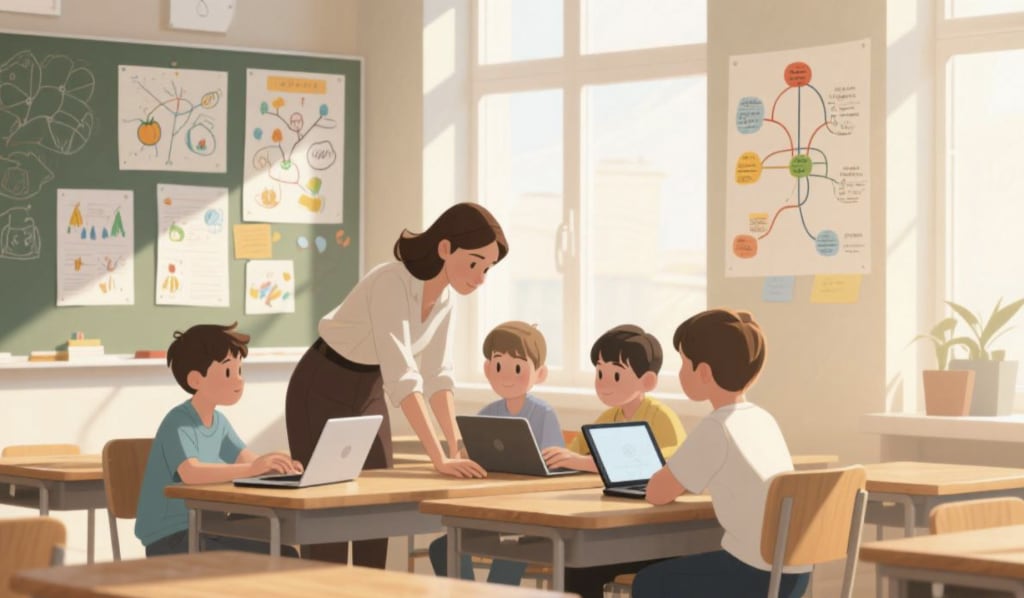
It’s a Tuesday morning in Room 204 at Lincoln Middle School in Portland, Oregon. Ms. Carter, a 12-year veteran teacher, isn’t standing at the front of the class scribbling equations on a whiteboard. Instead, she’s leaning over a student’s shoulder, guiding him through a digital graphing tool on his Chromebook. Across the room, a group of four kids huddle around a tablet, debating a history project—not the textbook version, but a collaborative timeline they’re building with Padlet, where they’ve embedded videos, primary sources, and even a voice memo from a local veteran. At the back, two students who’d previously struggled with focus are glued to an adaptive math app, its algorithms gently adjusting problem difficulty based on their real-time progress.
This isn’t a futuristic classroom. It’s today’s education, rewritten by a quiet revolution called blended learning—a hybrid approach that marries traditional face-to-face teaching with digital tools. And as I’ve spent months interviewing teachers, students, and ed-tech experts, one truth keeps surfacing: when done right, blending tech and humanity doesn’t replace the “human element”—it amplifies it.
The Myth of “Tech vs. Teachers” (Spoiler: They’re Teammates)
Let’s start with a common fear: Will robots replace teachers? The short answer? No. In fact, the most effective blended classrooms I visited had more teacher-student interaction, not less. Take Maria Gonzalez, a 5th-grade teacher in a high-poverty Texas school. Before blending, she spent 70% of her time lecturing and grading worksheets. Now, her students use Khan Academy for foundational skills during “station rotations,” freeing her to work one-on-one with kids who need extra support or lead small-group projects on climate change (a topic that actually sparks their curiosity).
“Tech handles the ‘what,’” Maria told me, “but the ‘why’ and ‘how’—that’s where I come in. Last week, a student who’d never raised his hand before started explaining to me why he chose a specific data set for his project. That moment? That’s teaching.”
Data backs this up. A 2024 study by the Clayton Christensen Institute found that schools using blended learning models reported a 30% increase in student engagement, not just because of screens, but because teachers had more time to personalize feedback. Think about it: when a student masters multiplication basics via an interactive game, their teacher isn’t stuck re-teaching—it’s time to dive into real-world applications, like budgeting for a mock lemonade stand.
The Tools That Matter (And the Ones That Don’t)
Of course, not all tech is created equal. Let’s cut through the hype: a flashy VR field trip to ancient Rome is cool, but if it doesn’t tie to a student’s curiosity or a teacher’s lesson goal, it’s just a distraction. The magic happens with tools that solve specific problems.
Take formative assessment apps like Kahoot or Mentimeter. These aren’t about “gamifying” tests—they’re about giving teachers instant insights. During a recent visit to a NYC high school, I watched a chemistry teacher use Socrative to poll her class mid-lecture. “Only 12% of you got that last question right,” she said, adjusting her lesson on the spot. “Let’s revisit bonding vs. reactions.” In the old model, she’d have waited days for quiz results—by then, confusion would’ve hardened into frustration.
Or collaboration platforms like Google Workspace or Microsoft Teams. These aren’t just about group projects; they’re about building community. At a rural Vermont school, students in a special education class use Flipgrid to record weekly “gratitude videos” for peers. A nonverbal student, who’d previously communicated only through gestures, now types short messages (“I liked how you helped me with math”) that classmates read aloud. Tech here becomes a bridge—not a barrier.
And let’s not forget the unsung hero: learning management systems (LMS) like Canvas or Schoology. They’re not sexy, but they organize chaos. A first-year teacher in Chicago once told me, “Before Canvas, I spent hours hunting for missing assignments in my email. Now, I can see at a glance who’s behind, send reminders, and even link resources directly to the lesson plan. It’s like having a personal assistant—for free.”
The Human Cost of Going Too Far
But here’s the catch: tech can’t fix broken systems. I’ve seen schools dump tablets into classrooms without training teachers, leading to frustration on both sides. Or worse, replace recess with “digital learning time,” forgetting that movement and play are critical for young brains.
One story haunts me: a middle school in Florida adopted an AI “tutor” that graded essays in seconds. Sounds efficient, right? But students stopped caring about feedback. “Why try hard if a robot just gives me a score?” one 8th grader told me. The principal later admitted, “We forgot that learning isn’t just about being right—it’s about growing. The robot couldn’t tell a kid, ‘Your thesis is strong, but let’s work on supporting it with examples.’”
That’s why blended learning’s true power lies in balance. Tech handles the routine; humans handle the heart.
So, Where Do We Go From Here?
If you’re a teacher reading this, start small. Try a single station rotation with a free tool like Quizizz for vocabulary practice. If you’re a parent, ask your school: How is tech enhancing, not replacing, human interaction? And if you’re a student, don’t just click through—ask why. “Why are we using this app?” “How does it help me learn better?”
Because at the end of the day, education isn’t about screens or algorithms. It’s about the moment a student realizes, “I get it!”—and the teacher who gets to witness it. Tech can make those moments more frequent, more personalized, and more joyful. But it’s the human connection that makes them unforgettable.
Looking to explore blended learning tools? Here are a few teacher-approved picks (no affiliate links—just resources I’ve seen work in real classrooms):
• Kahoot: For quick, engaging formative assessments.
• Padlet: Great for collaborative projects and idea-sharing.
• Flipgrid: Perfect for building community through video.
Let’s build classrooms where tech empowers, not replaces, the magic of teaching and learning. After all, the future of education isn’t about screens or code—it’s about people.
About the Creator
Keep reading
More stories from liang ming and writers in Education and other communities.
Beyond the One-Size-Fits-All Classroom: How Personalized Learning is Redefining Education in 2025
Let me tell you about Mia. Three years ago, Mia was a 9th-grader in a bustling urban high school—bright, curious, but lost. Her math teacher taught algebra at a pace that left her bored (she’d already mastered the basics over summer with a YouTube tutor), while her history class moved so slowly that she’d zone out, doodling in her notebook. By October, her grades were a rollercoaster: A’s in science (her passion), D’s in subjects that felt “too slow” or “too fast.” When I asked her why she hated school, she shrugged: “It’s like everyone’s eating the same meal, but some of us are starving and others are stuffed.”
By liang ming8 months ago in Education
Generosity Without Boundaries: Advancing Equity Through Philanthropy
Philanthropy has always played a meaningful role in shaping societies and improving the lives of individuals in need. From supporting educational programs to funding healthcare initiatives, acts of giving have helped communities overcome many challenges. In today’s diverse world, however, philanthropy is taking on a deeper purpose. It is increasingly focused on equity—ensuring that resources and opportunities are distributed fairly among people from different backgrounds and circumstances.
By John Olin Killgore2 days ago in Education


Comments
There are no comments for this story
Be the first to respond and start the conversation.