
Beyond the Textbook: How Modern Education is Redefining Learning for a Changing World
From Stagnant Classrooms to Dynamic Journeys: How Adaptive Learning, Collaboration, and Teacher Innovation Are Redefining What It Means to Educate
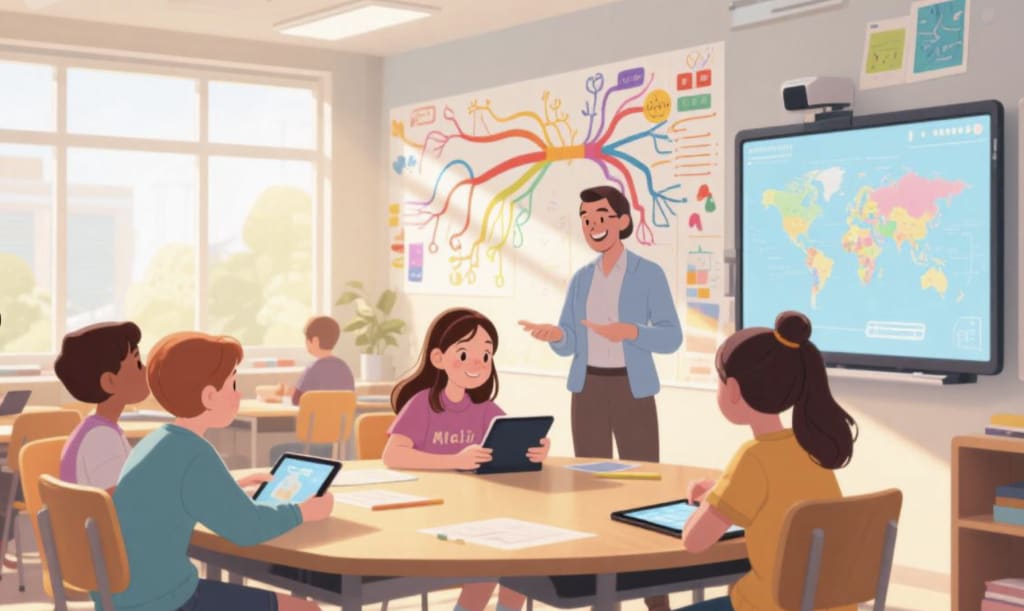
It’s 8:30 a.m. on a Tuesday, and 14-year-old Mia stares at her math worksheet, eraser in hand. The problem—“Solve for x: 3(2x – 5) + 7 = 4x + 12”—looks simple enough, but she’s been stuck for 20 minutes. Her teacher, Ms. Carter, circulates the room, but with 28 students, she can’t pause to unpack every confusion. By lunchtime, Mia scribbles down a half-hearted answer and moves on, her confidence in math wavering.
This scene plays out in classrooms worldwide. Traditional education, built on one-size-fits-all lectures and standardized curricula, struggles to keep up with the diverse needs of today’s learners. But as the world evolves—driven by technology, globalization, and complex global challenges—so too must education. The good news? A quiet revolution is underway, driven by tools, teachers, and innovators reimagining what learning can be. Let’s dive into three key shifts transforming classrooms (and lives) for the better.
1. From “One Size Fits All” to “Made Just for You”: The Rise of Adaptive Learning
In Mia’s case, her struggle with algebra wasn’t due to laziness—it was a mismatch between her learning pace and the lesson plan. Traditional classrooms often leave advanced students bored and struggling ones behind, creating a “learning gap” that widens over time. Enter adaptive learning platforms, which use AI to tailor content to individual students’ strengths and weaknesses.
Take Khan Academy, for example. Used by over 150 million learners globally, its platform tracks progress in real time. If a student masters fractions quickly, it skips ahead to decimals; if they stumble on long division, it serves up extra practice problems with step-by-step video tutorials. For Mia, this would mean no more sitting through lessons she already understands or rushing through concepts she doesn’t. A 2023 study by the RAND Corporation found that students using adaptive math tools saw a 12% improvement in test scores compared to peers in traditional classes—proof that personalized pacing works.
https://www.khanacademy.org/
2. Collaboration Over Competition: Building Skills for the Real World
The modern workplace isn’t about memorizing facts—it’s about solving problems with diverse teams. Yet most classrooms still prioritize individual tests over group projects. That’s changing, thanks to tools designed to foster collaboration inside and outside the classroom.
Consider Padlet, a digital bulletin board where students can share ideas, links, and even voice notes in real time. During a unit on climate change, Mia’s class might use Padlet to post articles, photos of local pollution, or ideas for community action. A student in Tokyo could add data on rising sea levels, while one in Nairobi shares photos of solar-powered schools. This not only makes learning interactive but also teaches students to value global perspectives—a skill critical in today’s interconnected economy.
Teachers are also using platforms like Flip (formerly Flipgrid) to turn lectures into conversations. Instead of lecturing on the water cycle, a science teacher might post a short video asking, “Where have you seen evidence of the water cycle in your neighborhood?” Students respond with their own videos, sparking dialogue and peer teaching. A 2024 EdSurge survey found that 78% of teachers who use Flip report higher student engagement, especially among shy learners who thrive in low-pressure digital spaces.
https://padlet.com/
3. Teachers as Guides: Reclaiming the Heart of Education
Critics of edtech often worry: “Will robots replace teachers?” The answer? Absolutely not. In fact, technology is freeing teachers to focus on what they do best: nurturing curiosity, empathy, and resilience.
Take Mia’s teacher, Ms. Carter. With adaptive tools handling basic skill practice, she now spends more time mentoring students individually. Last month, she noticed Mia’s frustration with math and pulled her aside. Together, they used a whiteboard app to visualize algebraic equations, turning abstract symbols into tangible stories (“Imagine x is a pizza—you need to split it evenly!”). That small shift reignited Mia’s interest; she now volunteers to solve problems at the front of the class.
Tools like ClassDojo help teachers celebrate these moments publicly. It lets students earn “kindness points” for helping peers, share art projects, or post reflections on their learning journey. Parents also get access, bridging the gap between home and school. As educational psychologist Dr. Linda Darling-Hammond puts it, “Tech doesn’t teach—teachers do. The best tools amplify their ability to connect with students.”
The Future is Now: What’s Next for Learners Like Mia?
Mia’s story isn’t unique. Millions of students are benefiting from these shifts, but there’s still work to do. Schools need funding for reliable tech infrastructure, teachers require ongoing training to integrate tools effectively, and policymakers must ensure equity—so no student is left behind because of their zip code or background.
If you’re a student, parent, or educator looking to explore these tools further, here are a few more resources to get started:
• Duolingo: Makes language learning fun with bite-sized games (great for building global communication skills). https://www.duolingo.com/
• Canva for Education: Lets students create stunning presentations, posters, and infographics (because creativity matters). https://www.canva.com/education/
Education isn’t just about preparing students for the future—it’s about helping them thrive today. By blending the human touch of great teaching with the power of technology, we’re moving closer to a world where every learner feels seen, supported, and inspired. And for Mia? She’s now tutoring her peers in math, proof that when education adapts, everyone wins.
What’s one change you’d love to see in your classroom? Share your thoughts in the comments below—I’d love to hear from you.
https://shopping-feedback.today/education%3C/p%3E%3C/div%3E%3C/div%3E%3C/div%3E%3Cstyle data-emotion-css="1x3zcuc-StoryContent">.css-1x3zcuc-StoryContent{pointer-events:none;}
About the Creator
Keep reading
More stories from liang ming and writers in Education and other communities.
Beyond the One-Size-Fits-All Classroom: How Personalized Learning is Redefining Education for a Diverse Generation
Let’s start with a scene that feels eerily familiar: A 9th-grade math class, 30 students, one teacher. The lesson is on quadratic equations. The student in the front row scribbles notes furiously, already solving bonus problems in their head. The student next to them stares at the board, brow furrowed—last week’s algebra basics still feel shaky. By the time the bell rings, the teacher has rushed through examples, answered two questions, and mentally noted: “I need to send extra worksheets to Maria, but wait, where did I put Javi’s makeup work from last month?”
By liang ming6 months ago in Education
Golf Handicap Reduction Without a Swing Overhaul: Smarter Ways to Play Better Golf
Lowering your handicap does not always require technical changes or hours on the range; it requires rebuilding your swing. Many golfers overlook the fact that scoring improvement often comes from strategic thinking, mental discipline, and better preparation. By focusing on how you play rather than how you swing, you can unlock consistent progress and enjoy the game more. This article explores practical, on-course methods that help you shoot lower scores while keeping your swing exactly as it is.
By Ian Schenkel Haliburtonabout 13 hours ago in Education
The Editorial Stack: Building Content Teams for the Multi-Platform Era
In an age where content travels across screens, feeds, formats, and audiences in real time, the old newsroom model no longer fits the demands of digital publishing. Today's media landscape requires more than great writers and sharp editors—it demands a multi-disciplinary, agile, and strategically aligned editorial stack. From video producers to data analysts, newsletter editors to TikTok creators, modern content teams must be designed with versatility and collaboration at their core.
By James Kaminskyabout 17 hours ago in Education


Comments
There are no comments for this story
Be the first to respond and start the conversation.