
Beyond the One-Size-Fits-All Classroom: How Personalized Learning is Redefining Education for Real Kids
From the Factory Model to Individualized Pathways: How Personalized Learning is Transforming Education for Real Students
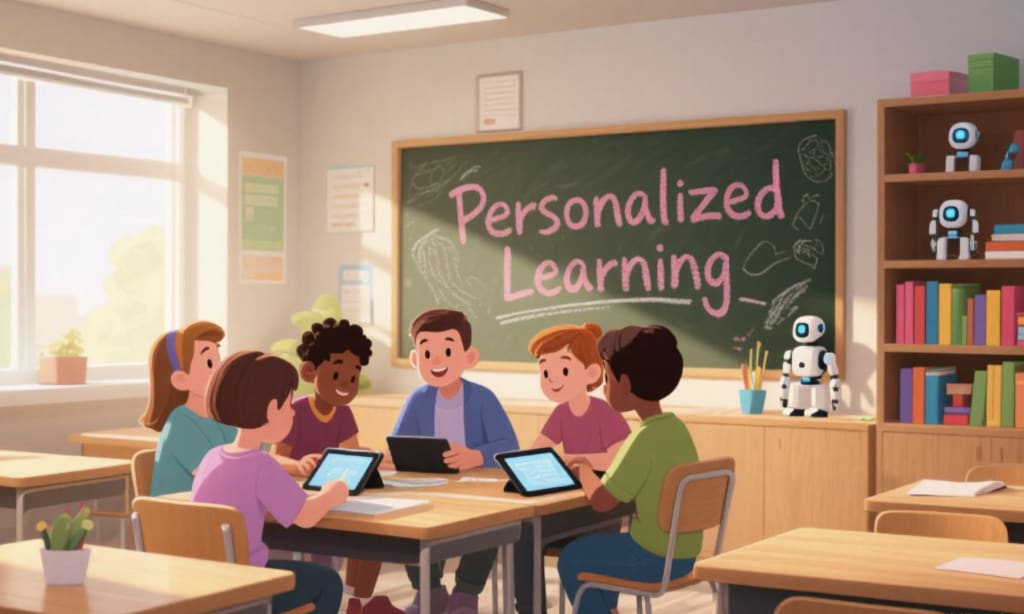
It was a Tuesday afternoon in my 7th-grade math class, and I froze mid-lecture. At the front of the room, Mia—quiet, sharp, and always two steps ahead—was doodling complex algebraic proofs in her notebook while the boy next to her, Liam, stared at the board, his brow furrowed as if trying to decode hieroglyphs. Across the room, Maria, who’d missed three days last week due to a family illness, was frantically scribbling notes to catch up. This can’t be right, I thought. We’re teaching to the middle, but no one’s actually here.
That moment stuck with me. Traditional education, for all its merits, often treats students like cogs in a machine—standardized curricula, rigid pacing, and one-size-fits-all assessments. But here’s the truth: No two brains learn the same way. A child who struggles with fractions might thrive when taught through baking measurements; a teen bored by textbook essays could write brilliant poetry if given the choice. The future of education isn’t about better lectures—it’s about personalization. And thanks to a shift in mindset (and technology), that future is already here.
The Problem with “Standard” Education
Let’s start with the facts. The National Center for Education Statistics reports that by 8th grade, 65% of students are either below proficient or just barely meeting grade-level standards in reading. Why? Because most classrooms operate on a “teach to the test” model, where the goal is to cover material quickly, not deeply. A student who needs extra time on fractions gets labeled “slow”; a gifted learner who masters concepts in a week gets stuck re-learning the same material. It’s like trying to fit square pegs into round holes—and both the pegs and the holes suffer.
Take my former student, Ethan. He was a 9th grader with dyslexia, but his passion was robotics. In a traditional English class, he struggled with reading assignments, so he disengaged. That is, until his teacher let him research and present on the history of robotics instead of writing essays. Overnight, Ethan went from a “C” student to a motivated learner—he even started tutoring peers on how to blend technical writing with storytelling. His story isn’t unique. Research from Harvard’s Graduate School of Education found that students in personalized learning environments show 30% higher growth in math and reading than their peers in traditional settings. When learning aligns with a student’s interests and pace, engagement (and outcomes) skyrocket.
Technology: The Tool, Not the Teacher
Critics often worry that personalization means replacing teachers with algorithms. Nothing could be further from the truth. Technology is a tool—a powerful one—that frees educators to focus on what they do best: connecting with students.
Consider adaptive learning platforms like Knewton (www.knewton.com), which uses data analytics to adjust lesson plans in real time. If a student masters algebra basics quickly, the platform might introduce geometry problems next; if they stumble with variables, it sends targeted practice exercises. Teachers, meanwhile, get actionable insights—like which students need more one-on-one support or which topics the class as a whole is struggling with. It’s not about replacing human interaction; it’s about making those interactions matter more.
Or take ClassDojo (www.classdojo.com), a tool that helps build classroom culture while tracking individual progress. Teachers can share photos of students collaborating on projects, send parents video updates on their child’s breakthroughs, and even set personalized goals (e.g., “Maria will raise her hand to answer questions 3 times this week”). The result? A classroom where every student feels seen—not just as a test score, but as a unique learner.
The Human Element: Why Teachers Still Matter Most
Technology can personalize how we teach, but it’s the human connection that makes learning meaningful. Great teachers don’t just deliver content—they ask questions, listen, and adapt.
I recently spoke with Maria Gonzalez, a 3rd-grade teacher in Chicago who uses “learning stations” to personalize her class. Each station focuses on a different skill: one for reading fluency, another for math games, and a third for creative writing. Students rotate based on their strengths and needs. “A shy kid might hate reading aloud in front of the whole class,” she told me, “but they’ll thrive when reading to a peer in a small group. By letting them choose their station (with guidance), I’m telling them, ‘Your voice matters.’”
Maria’s approach mirrors a growing trend: student agency. When kids have a say in how they learn—whether picking a project topic, choosing a book, or setting weekly goals—they become more invested. A 2023 study by the University of Michigan found that students with even a small degree of control over their learning environment were 40% more likely to persist through challenges.
How You Can Support Personalized Learning (Even If You’re Not a Teacher)
Personalized education isn’t just for schools. Parents, caregivers, and even community members play a role. Here are three simple ways to get started:
1. Ask, “What interests you?” Instead of assigning generic homework, ask your child (or student) what they’re curious about. A kid obsessed with dinosaurs might love a math lesson on measuring fossil sizes; a teen into music could analyze song lyrics to learn poetry devices.
2. Embrace “messy” learning. Not every project needs a perfect rubric. If your child wants to build a model volcano with baking soda instead of writing a report, let them. The goal is to foster curiosity, not just check boxes.
3. Advocate for flexibility. Talk to teachers about blending traditional and personalized methods. Maybe your school can try “genius hours” (where students explore a passion project for an hour a week) or offer choice in reading lists.
The Future Is Personal
Going back to that 7th-grade math class: Today, Mia is a college senior majoring in astrophysics, Liam is a high school teacher himself, and Maria—now a straight-A student—volunteers at our local library’s literacy program. They all thrived, but not because of a one-size-fits-all curriculum. They thrived because someone took the time to see them.
Education isn’t about filling heads with facts—it’s about lighting fires. And in an age where technology can help us tailor that fire to every student’s unique spark, there’s never been a better time to reimagine what learning can be.
So let’s stop teaching to the classroom and start teaching for the future. After all, the next Einstein, the next Maya Angelou, the next great innovator—they’re sitting in a classroom right now. Let’s make sure they get the education they deserve.
---
Have thoughts on personalized learning? Share your stories in the comments below—or tag a teacher who’s making a difference!
About the Creator
Keep reading
More stories from liang ming and writers in Education and other communities.
Beyond the Textbook: How Personalized Learning is Rewriting the Rules of Education
Let me tell you a story. Last year, I sat in on a 9th-grade math class at a public high school in Brooklyn. Maria, a quiet student with a knack for art, slumped over her algebra worksheet, erasing the same problem for the fifth time. Her teacher, Ms. Carter, circulated the room, pausing to help a boy struggling with fractions and then a girl confused by quadratic equations. By the bell, Maria’s paper was still half-blank—she’d spent the hour staring at problems that felt like hieroglyphics, while the concepts she wanted to explore (like how geometry shapes art) sat unaddressed in her notebook.
By liang ming6 months ago in Education
Hosting a Book Fair
How many of you remember the “best week ever!” from when you were a child? Book fairs were the staple of many of our childhoods with Scholastic leading the way. While there are many choices for book fairs today and I absolutely want to talk about them, that’s going to be a later article.
By Reb Kreyling6 days ago in Education
Communicating with Confidence: Building Trust Through Simplicity
Trust is the cornerstone of any meaningful relationship, whether professional or personal. At the heart of trust lies the ability to communicate clearly. People naturally respond to straightforward, reliable, and easy-to-understand information. Professionals who prioritize clarity establish credibility and foster confidence in others. Clients, colleagues, and partners feel assured that they can make informed decisions when the messages they receive are transparent and well-articulated.
By Stacey Yim4 days ago in Education



Comments
There are no comments for this story
Be the first to respond and start the conversation.