
Bagua Feng Shui: Everyday Practical Guide (2)
The Three Elements of the Bagua Map: Time, Directions, and Energies


The Eight Trigrams (Bagua) are ancient divination symbols with a history spanning thousands of years. Each trigram represents one of eight natural phenomena in the ancient Chinese worldview: Heaven (sky, universe), Earth, Thunder, Wind, Water, Fire, Mountain, and Lake.
Each trigram is composed of three lines, known as yao (爻). There are two types of lines: a solid line (Yang, 阳) and a broken line (Yin, 阴). The position of each line within a trigram also has symbolic meaning: the top line corresponds to Heaven, the bottom line to Earth, and the middle line to Humanity.
When applied in Feng Shui, the trigrams represent the vital life-energy relationship among Time (Heaven), Space (Earth), and Humanity. In Chinese culture, this vital energy is called Qi (气). Since human beings are the product of Heaven and Earth, human Qi is closely connected with both. Our lives, health, and fortune are significantly influenced by the Qi of Heaven and the Qi of Earth.
Feng Shui is both the knowledge and practice of understanding this influential Qi and adjusting human Qi to achieve harmony with the Qi of Heaven and Earth. It is believed that such harmony can improve one’s destiny.
1. Time and Directions in the Later Heaven Bagua Chart (Figure 1)
According to a passage in the I Ching (Book of Changes), the Later Heaven Bagua Chart was created. In this passage, “Seasons” (time) and “Directions” are combined to explain how the Eight Trigrams are arranged in eight positions.
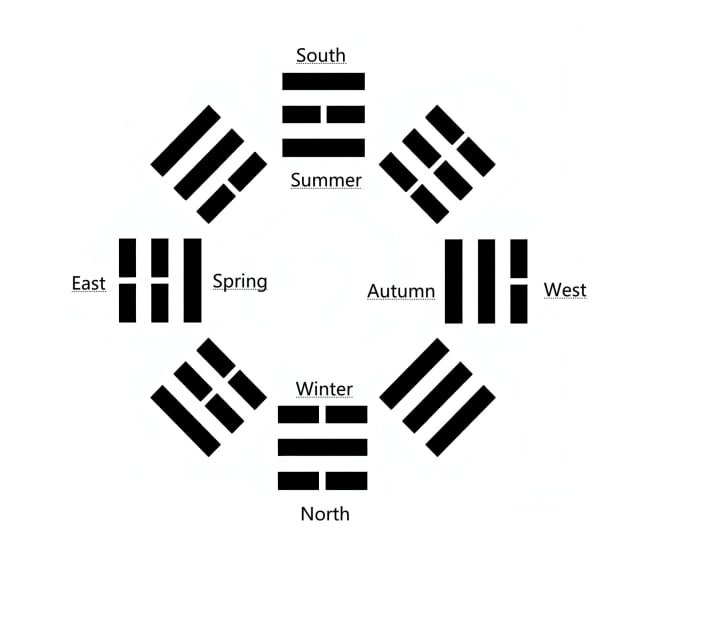
The ancient Chinese used this Chart to highlight the close relationship between time and directions. In Zhu Xi’s Fundamentals of the I Ching (Zhou Yi Ben Yi, 《周易本义》), the Later Heaven Bagua Chart is referred to as the “Wen King Bagua Directions” (文王八卦方位). Zhu Xi (1130–1200), a master of Neo-Confucian philosophy, was one of the most renowned scholars in Chinese history. From his explanation, it is clear that “direction” plays a critical role in this Chart.
However, in Western Feng Shui, the use of this Bagua Chart often overlooks the essential element of “time and direction.” Without this element, the Chart cannot convey its full meaning. As a result, many of the Feng Shui principles presented in Western Feng Shui books rest on an incomplete foundation. Even when real-life cases are included, they generally have little to do with the authentic Bagua Chart. In practice, the Chart is often treated more as a cultural symbol that adds an air of mystery, rather than being applied as the practical tool it was originally intended to be.
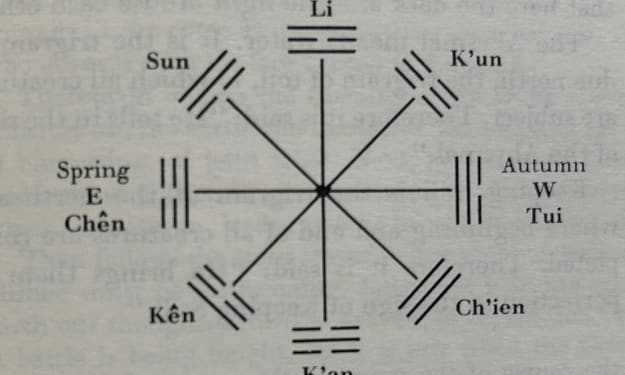
2. The Energy Element of the Later Heaven Bagua Chart (Figure 2)
The third element in the Later Heaven Bagua Chart is Qi, expressed through the Five Energies (Wu Xing, 五行), more commonly known as the Five Elements.

The Eight House system is based on the energy structure of the Later Heaven Bagua Chart. Its core principle is to divide the eight trigrams into two groups, each associated with different elemental energies:
• East Four Houses (东四宅) (Figure 3): The four trigrams Zhen (East), Xun (Southeast), Li (South), and Kan (North). These are associated with Water, Wood, and Fire energies.

• West Four Houses (西四宅) (Figure 4): The four trigrams Qian (Northwest), Dui (West), Gen (Northeast), and Kun (Southwest). These are associated with Earth and Metal energies.

This division reflects how the Later Heaven Bagua Chart organizes the trigrams into two balanced sets of energy orientations.
If a house belongs to the East Four group, the main door, master bedroom, and kitchen should each be placed in the directions of the East Four trigrams. If it belongs to the West Four group, these key areas should each fall within the West Four trigrams.
3. Example: A Traditional Courtyard Residence
In traditional Chinese residences, the most common courtyard layout places the main hall in the north, corresponding to the Kan trigram. Kan is associated with Water energy and belongs to the East Four Trigrams. Therefore, the front door of such a courtyard should be located in the east, southeast, or south. The most popular placement is in the southeast, the position of the Xun trigram. Xun is associated with Wood energy, and in the Five Elements system, Water (Kan trigram) generates Wood (Xun trigram). Such a residence is known as a “Kan House with a Xun Door.”
Conclusion
In short, when examining a home’s Feng Shui, we first identify its associated trigram—that is, its directional alignment. Then we check whether the directions of the front door, the main bedroom, and the kitchen correspond to trigrams within the same group. Among these three, the front door is especially important. Why? We will explore this in the next blog.
About the Creator
Lidong Yu
I am a Chinese Feng Shui consultant and educator, raised and trained in China. My work draws on classical Feng Shui traditions to help people better understand the relationship between themselves, their environments, and time through Qi.
Will Astronomy Guide Future Philosophy?
A Historical Bond Between Stars and Thought Astronomy has always guided philosophy. In ancient Greece, philosophers such as Aristotle and Plato grounded their metaphysical systems in cosmological models. The structure of the heavens influenced theories about perfection, motion, and causation.
By shahkar jalal7 days ago in Education



Comments
There are no comments for this story
Be the first to respond and start the conversation.