
Bagua Feng Shui: Everyday Practical Guide (1)
A series introducing authentic Feng Shui step by step — with cultural context and simple, practical tips.

Preface
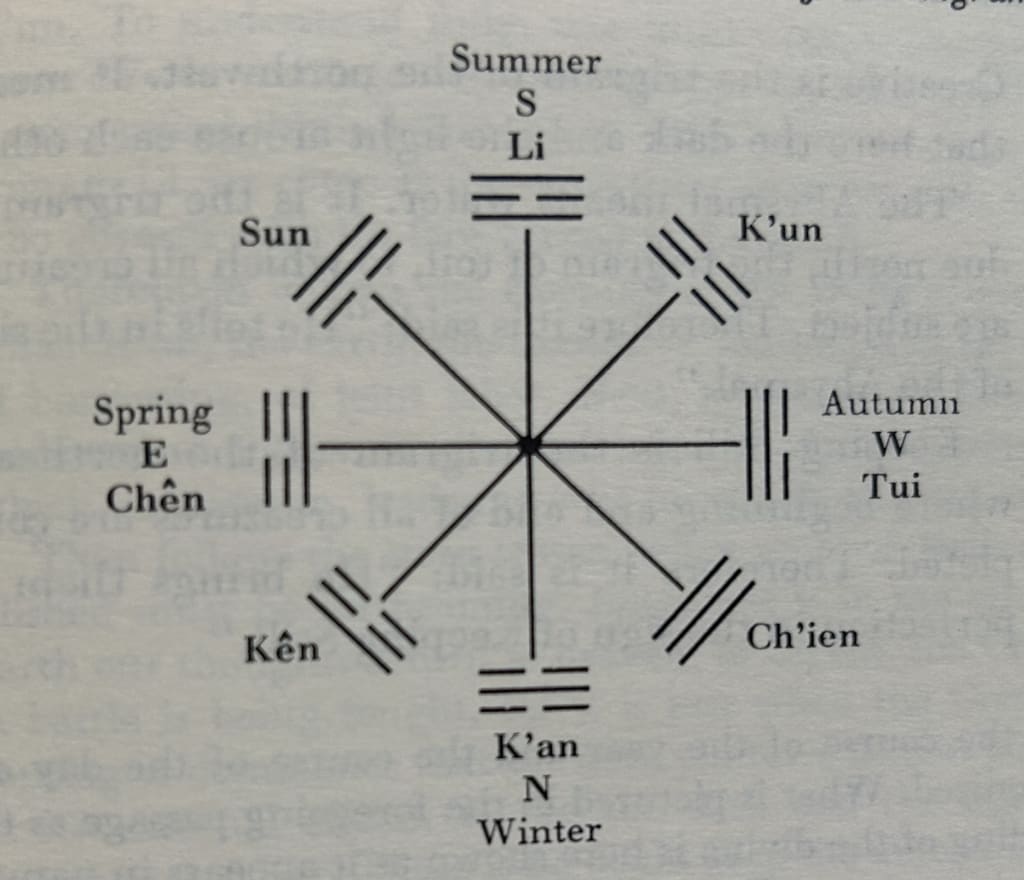
Starting today, I am launching a new series titled “Bagua Feng Shui.” Unlike my previous topical articles, this series will systematically introduce authentic Chinese Feng Shui. At its heart lies the Bagua Map—a concept that often appears in Western Feng Shui, though frequently misused. For many readers, the true meaning of this map remains unfamiliar. In this series, I will share fundamental Bagua knowledge together with practical Feng Shui applications drawn from this chart—applications you can use in everyday life.
The theory behind this series is based on Eight House Feng Shui (also called Eight Mansions Feng Shui, 八宅风水), which was highly popular during the Qing Dynasty (1644–1911) and remains influential today. At its core is the Later Heaven Bagua Chart—a translation I adopt from The I Ching: A Biography, one of the finest English works on the I Ching (Zhou Yi, 周易) that I have read. Since many Western Feng Shui enthusiasts are already somewhat familiar with this chart, I will use it as the foundation for the applications introduced here.
I must emphasize, however, that this series only presents basic Feng Shui knowledge. Professional Feng Shui practitioners in China apply much more complex and advanced methods. Therefore, you should not regard this series as a full presentation of authentic Feng Shui. It is not professional-level instruction, but rather an entry point into more serious Feng Shui studies. Even though it introduces only basic knowledge, it is still far superior to what is found in most English-language Feng Shui books, because it offers authenticity, systematic structure, and practicality, all supported by logical explanation.
Even so, the applications introduced here can still be helpful. Since Feng Shui is about dynamically and systematically adjusting both our living environments and our daily habits, this series is designed not only to provide accurate Feng Shui knowledge, but also to help you develop a “Feng Shui eye” to see the world, and to cultivate good life habits guided by Feng Shui principles in order to meet the many challenges of modern life.
Problems in Western Feng Shui
There are two major problems when Western Feng Shui enthusiasts try to learn Feng Shui:
1. A lack of basic critical judgment.
For example, why must the front door of a house be placed at three specific Gua positions in the so-called “Three-Door Bagua”? Shouldn’t someone question this? Yet no book offers any explanation—not even Sarah Rossbach’s, where this principle was first introduced. I am certain Ms. Rossbach herself did not know, because no such Feng Shui principle exists; in fact, it contradicts the fundamental logic of Feng Shui.
2. Lack of clarity and systematic structure.
Western Feng Shui is often defined simply as the art of furniture arrangement. But why furniture arrangement? What Feng Shui principles actually support this idea?
Some books claim that by rearranging furniture, one can avoid sha (煞), such as sharp edges from walls or furniture. However, in authentic Feng Shui, sha is divided into two categories: visible sha (形煞), like the sharp edges mentioned above, and qi sha (气煞), which is invisible.
Certain physical forms inside a home may create visible sha, and rearranging furniture can sometimes reduce it. Yet this is not always valid from a Feng Shui perspective, because qi sha is invisible and constantly changing. Identifying it requires a professional practitioner using a luopan (Feng Shui compass). Ironically, while moving furniture may help avoid visible sha, it can also create a new qi sha without your awareness. This shows that Feng Shui is far more complex than simply rearranging furniture.
Purpose of This Series
In this series, my goal is not only to share authentic Chinese Feng Shui, but also to present it systematically—explaining both its theories and applications. Along the way, I will introduce the historical development of Feng Shui, real-life cases, classical anecdotes, and cultural highlights.
In the next article, I will introduce the Later Heaven Bagua Chart and three basic yet important concepts associated with it.
About the Creator
Lidong Yu
I am a Chinese Feng Shui consultant and educator, raised and trained in China. My work draws on classical Feng Shui traditions to help people better understand the relationship between themselves, their environments, and time through Qi.
When the Shelter Closes
Across the street from my house, a man slept under a tree, his dog by his side. My first, naive thought: he must be traveling through. But he kept coming back, often sleeping there during the day. Then it hit me—that person might not have a home.
By Bride of Sound3 days ago in Humans


Comments
There are no comments for this story
Be the first to respond and start the conversation.