
The Three Tiers of Feng Shui: From Form to Technique to Dao
Understanding the Structural Depth of Classical Feng Shui

Feng Shui, like any mature intellectual tradition, unfolds across different tiers of understanding.
Just as academia distinguishes between instructors, lecturers, and professors—each reflecting a different depth of mastery—Feng Shui also progresses through increasingly deeper levels of practice. These levels move from the visible and material, to the technical and energetic, and ultimately to the philosophical ground from which the system itself arises.
Recognizing these tiers helps clarify why contemporary interpretations of Feng Shui often differ so dramatically from its classical foundations.
The First Tier: The Level of Form (器)
The most basic tier is the physical or material level (Qi, 器).
This level concerns visible and tangible elements—what can be directly perceived. In modern life, furniture arrangement is often treated as the primary focus of Feng Shui at this stage.
Here, general principles such as Yin–Yang balance are applied to enhance comfort, functionality, and spatial harmony. Many popular recommendations belong to this tier: adjusting furniture placement, improving lighting, or modifying room orientation to create smoother spatial flow.
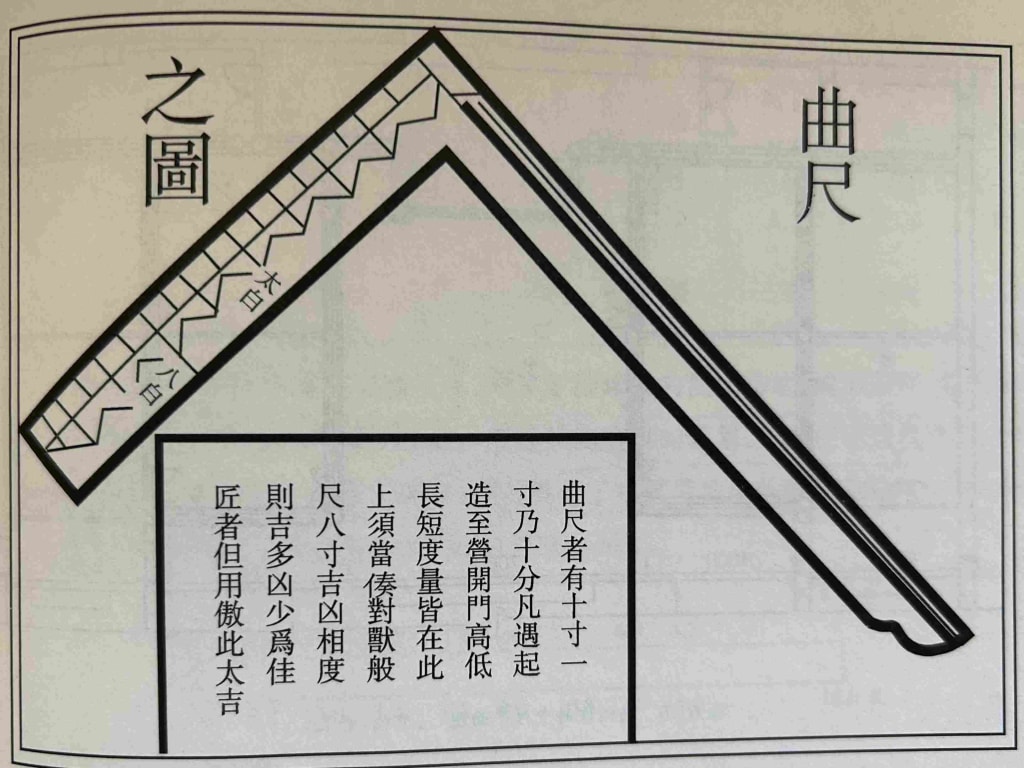
Yet classical Feng Shui did not originate as interior decoration. Architecture itself embodied Feng Shui principles—from site selection and structural orientation to proportional measurements. Traditional builders used tools such as the Lu Ban Ruler (鲁班尺), whose calibrated markings reflected symbolic and cosmological meanings.
At this level, Feng Shui is primarily concerned with form. It addresses what is externally observable.
The Second Tier: Technique (术)
The second tier represents the professional level of practice, corresponding to shu (Shu, 术), or technique.
At this stage, Feng Shui becomes a systematic discipline rather than a collection of symbolic suggestions. Practitioners typically follow established schools—such as Xuan Kong (玄空) or Eight Mansions (八宅)—each with its own analytical structure. Yet all are grounded in a shared cosmological framework centered on Qi, the Five Elements, and the logic of the Zhou Yi ().
The defining feature of this tier is its focus on Qi (气)—the invisible and dynamic structure of energetic interaction. Unlike the first tier, which emphasizes visible form (器), the second operates within the unseen relationships among time, direction, and shifting energetic patterns.
A simple example illustrates the distinction.
Mirrors are widely used in many popular or Westernized Feng Shui systems. In classical Chinese practice, however, they are applied with much greater caution.
First, a mirror does not gently regulate Qi; it reflects energy directly and forcefully.
Second, mirrors carry deep cultural and symbolic associations within Chinese tradition, including ritual and psychological meanings. Their use therefore requires careful discernment.
From an energy-theory perspective, the way a Feng Shui consultant understands mirrors often reveals the depth of their theoretical foundation. In simplified systems, mirrors are commonly classified as Water energy. However, when examined through the cosmology of the Zhou Yi, a different understanding emerges.
The mirror’s essential qualities—brightness and the quality of attachment—correspond to Fire energy, particularly through the symbolism of the Li trigram. In classical cosmology, Fire does not exist independently; it manifests only through attachment. In this sense, mirrors share the same fundamental energetic characteristics as Fire.
This distinction has practical implications. A residence should avoid directly facing large glass buildings that intensely reflect sunlight. Such structures function like enormous mirrors, generating excessive Fire energy. This reflected force can destabilize the surrounding energetic balance—unless, in rare cases, the occupants’ personal energetic structure specifically requires strong Fire influence.
At this tier, Feng Shui becomes a disciplined analysis of energetic structure rather than surface symbolism.
The Third Tier: Dao (道)
The third tier moves beyond technique into philosophy.
The origins of Feng Shui can be traced to the Shang–Zhou period (c. 16th century–256 BCE), when site selection was guided by divination practices that later formed the foundation of the Zhou Yi (I Ching). From this classical source emerged both Chinese philosophy and Feng Shui.
At its highest level, Feng Shui is not merely technical method but a manifestation of Dao—a profound intellectual tradition rooted in the cosmology of the Yi.
Historically, those who mastered Feng Shui were not casual practitioners but distinguished scholars. As noted by Li Dingxin (李定信) in A Study of Kan Yu Classical Texts, before the mid-Qing dynasty Feng Shui was studied primarily by highly educated literati trained in the Confucian classics, astronomy, geography, and philology.
Shen Zhureng (沈竹礽), founder of the Shen-style Xuan Kong (Flying Star) school in the late Qing dynasty, reportedly collected over 1,700 volumes related to the Zhou Yi in his search for its underlying principles. For him, Feng Shui was not separate from the Yi, but a practical extension of it. Part of the methodology I practice today is rooted in this Xuan Kong tradition.
Many influential masters—such as Guo Pu (郭璞) of the Eastern Jin, author of the Book of Burial (葬书)—were also accomplished scholars.
This historical pattern reveals an essential truth:
Authentic Feng Shui requires profound study.
Without understanding the Yi and the intellectual tradition behind it, one cannot truly access its depth. What is widely circulated today under the name “Feng Shui” often represents only fragments of a far larger philosophical and cosmological system.
Final Reflection
The three tiers—Form (器), Technique (术), and Dao (道)—are not separate practices but progressive layers of understanding.
The first addresses what we see.
The second analyzes what we cannot see.
The third seeks to understand why the system exists at all.
To move from Form to Technique, and from Technique to Dao, is to move from surface adjustment to intellectual inquiry—and ultimately toward insight that transcends technique itself.
About the Creator
Lidong Yu
I am a Chinese Feng Shui consultant and educator, raised and trained in China. My work draws on classical Feng Shui traditions to help people better understand the relationship between themselves, their environments, and time through Qi.
Mastering the Spotlight: Career Guidance for Future Experts in Theater Technology and Electrical Design
The world of theater is powered by more than talent on stage. Behind every compelling performance is a network of technical professionals who manage lighting systems, electrical layouts, sound coordination, and stage mechanics. For students pursuing careers in theater technology and electrical design, the field offers an exciting blend of engineering precision and artistic creativity. Success requires technical knowledge, hands-on experience, and a deep appreciation for storytelling through light and power.
By Brian Casellaa day ago in Education
Digital Shield: How Strategic Leadership in IT Protects Organizations from Cyber Threats
Strategic leadership in IT is now one of the most important parts of keeping any organization safe. Cyber threats grow each year, and attackers look for new ways to breach systems. Many businesses struggle because they do not prepare for these risks in time. With strong leadership, IT teams can understand threats early and build defenses that protect people, data, and operations.
By Keith Brautigam7 days ago in Education
Unofficial Challenge: What would you do if you were rich?
I love the kind of work I get to do in my career, but as I job search and browse apartments again due to another understaffed and unsustainable work environment that I did not intend to get into, my daydreams of better days consistently lean into the same question: What would I do if I didn't have to worry about my basic needs being met?
By Kay Husnick5 days ago in Writers


Comments
There are no comments for this story
Be the first to respond and start the conversation.