
Are women allowed to cover their face during Umrah?
Should women cover their face during Umrah?
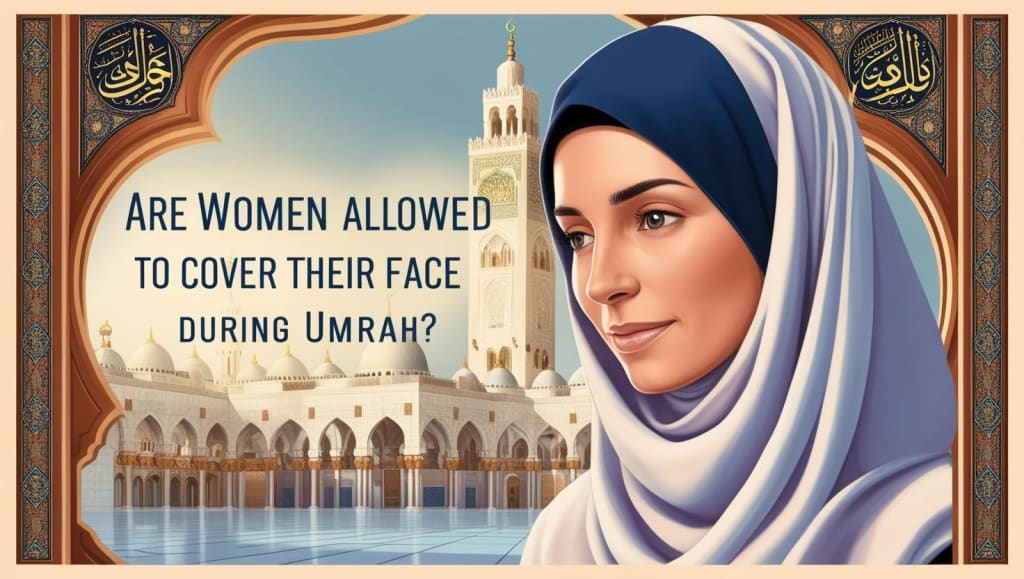
Every Muslim woman embarking on the holy pilgrimage of Umrah is highly motivated to maintain modesty and veil her face. This raises an important question: Are women allowed to cover their faces during Umrah?
This question has sparked debate, and the answer is not always straightforward. The principles of Ihram, which require spiritual purity during Umrah, include strict instructions regarding politeness. Although modesty is highly emphasized in Islam, the ruling on covering the face is interpreted differently during Umrah and Hajj, depending on the time and context. Moreover, women must be aware of the new Umrah dress code for ladies to embrace modesty during the lesser pilgrimage to Makkah. This article will explain these rulings and answer questions such as when it may be necessary to cover the face, as well as provide the opinions of various scholars and practical tips for maintaining modesty during this spiritual journey.
1. What Does Islam Say About Covering the Face During Umrah?
In Islam, modesty is a cultural practice and a divine principle. Islam values modesty for both men and women, as we see in the Quran:
"And tell the believing women to lower their gaze and guard their private parts, and not to display their adornment except that which is apparent, and to wrap a portion of their headcovers over their chests." (Quran 24:31)
Similarly, it is essential for women who perform Hajj or Umrah to follow the principles of Ihram. An important principle for women is keeping their faces and hands uncovered. As the Messenger of Allah (peace and blessings of Allah be upon him) commanded them.
"A woman in Ihram should not wear a niqab or gloves." (Bukhari 1838)
Source: https://sunnah.com/bukhari:1838
This commandment maintains humility and balances the observance of the simplicity necessary for Ihram, the removal of adornment and concentration on pure worship, and the promotion of equality among pilgrims.
2. Why Is Face Covering Prohibited for Women in Ihram?
In Ihram, women are not allowed to cover their faces, which has a profound meaning. Ihram is all about being simple and equal. Everyone is dressed the same way, showing no difference between rich and poor. The goal is to forget about fancy things and focus only on Allah.
This means women wear simple and modest clothes, but they cannot wear anything that covers their face or hands, like a niqab or gloves. The Prophet Muhammad (peace be upon him) told women not to cover their faces in the Ihram because it goes against the purpose of the Ihram. It is a time to be humble, pure, and free from any kind of showing off. If a woman needs to protect her face, she can use a loose cloth to shield it, but it should not touch her face.
"There is no superiority for a person in Ihram except in piety and righteousness." (Quran 49:13)
Source: https://quran.com/en/al-hujurat/13
This rule helps to keep the focus on worship and reminds everyone that we are all the same in front of Allah.
3. Is It Mandatory for Women to Uncover Their Faces During Umrah?
Many women may wonder if it is permissible to cover their faces during Ihram. The answer is no. Wearing a niqab or covering the face in a normal way is not permitted during Ihram. This is one of the rules of Ihram, and if someone does it intentionally, they may have to pay a fine.
But sometimes, women may need to cover their faces. For example, a woman can cover her face with a cloth or scarf in crowded places or when non-mahram men are nearby. The important thing is that the fabric does not touch her face or look like a proper niqab, as wearing a niqab or gloves is prohibited during Ihram.
These rules remind us to keep things simple and focus on worship during this sacred time.
Narrated Aisha (R.A):
Riders would pass us when we accompanied the Messenger of Allah (PBUH) while we were in the sacred state (wearing Ihram). When they came by, one of us would let down her outer garment from her head over her face, and when they passed on, we would uncover our faces.
Source: https://sunnah.com/abudawud:1833
Therefore, while covering the face is directly prohibited, indirect covering is permissible when necessary, such as loosely using a scarf to cover the face in the presence of non-mahram men.
4. What Do Different Scholars Say About Women Covering Their Faces During Umrah?
Let us look at what schools of thought say about the questions.
4.1 Hanafi Scholars
According to the Hanafi scholars, women are not permitted to wear a niqab or gloves during Ihram. However, if a woman needs to cover her face, she can use a loose cloth or scarf. This cloth should not directly touch her face.
4.2 Maliki Scholars
Maliki scholars also do not allow the wearing of a niqab during Ihram. However, they say that women can cover their faces with a cloth, for example, when non-mahram men are nearby.
4.3 Shafi'i Scholars
Shafi'i scholars agree that the niqab is not permissible during Ihram. However, they allow women to cover their faces loosely, especially if men are around.
4.4 Hanbali Scholars
Hanbali scholars allow women to cover their faces indirectly with a cloth. They point to examples of the wives of the Prophet (peace and blessings of Allaah be upon him) who used to cover their faces in the presence of non-mahram men during Hajj.
4.5 Contemporary Scholars
Scholars such as Sheikh Ibn Taymiyyah and Sheikh Ibn Uthaymeen also say that the niqab is not permissible in Ihram. However, they say that a loose scarf or cloth can be used to cover the face if necessary, provided that it does not violate the rulings of Ihram.
5. What Should Women Do If Non-Mahram Men Are Nearby?
Modesty is central to Islam and is essential to maintain during Umrah. If a woman is in the presence of non-mahram men during Umrah and feels the need to cover her face, she may do so without violating Ihram, but her garment must not touch her face. The goal is to strike a balance between modesty and the restrictions of Ihram.
6. Can Women Wear Sunglasses During Umrah?
Many women may wonder whether wearing a face mask or glasses during Ihram is permissible.
In the case of a woman suffering from a medical condition, glasses can be worn, but if she suffers from a medical problem, she can wear glasses that do not cover her face but rather leave it exposed. Apart from this, it is not permissible to wear any fashionable items that could cause you to be fined for fidya during Umrah.
7. Are There Exceptions or Situations Where Face Covering Is Allowed?
When women are in Ihram, they are not allowed to cover their faces directly with things like the niqab or burqa. Ihram is about humility and being open before Allah. The Prophet Muhammad (peace and blessings of Allah be upon him) said that women should not cover their faces in this particular situation.
But sometimes there are exceptions. If a woman feels embarrassed or uncomfortable because non-mahram men are looking at her, she can use a scarf or other cloth on her head to cover her face loosely without touching her skin. This is fine if the material does not stick to her face.
In modern circumstances, such as when someone is sick, wearing a mask is permitted for health reasons. Islam always prioritizes health and safety, and wearing a mask is not a matter of personal preference but of necessity.
The most important thing is the intention. Women should try to keep their focus on Allah and His worship. Covering one's face for a valid reason is okay, provided that it does not deviate from the meaning of Ihram.
8. What Happens If a Woman Covers Her Face by Mistake in Ihram?
If a woman accidentally covers her face during Ihram or deviates from the rules of Ihram, then no expiation or ransom is obligatory on her. However, if a woman deliberately violates the laws of Ihram, if she covers her face or does something forbidden while in Ihram, she must pay expiation or ransom.
"If someone does something wrong or acts arrogantly, let him fast for three days, feed six poor people, or sacrifice a sheep." (Quran 5:95)
9. Is the ruling on covering the face different between Hajj and Umrah?
Although the rulings on Ihram are the same for Hajj and Umrah, there may be some differences in individual practices. However, women are not permitted to cover their faces during Hajj. However, the intention behind Ihram is the same: to present themselves humbly before Allah, to abandon worldly adornment, and to highlight equality among all worshippers.
10. Practical Tips for Women to Maintain Modesty During Umrah
While maintaining the principles of Ihram, a loose scarf can be a practical option for covering the face without violating its principles.
Although the state of Ihram encourages external simplicity, its deeper purpose is to foster inner humility and spiritual devotion to Allah.
Although avoiding crowded areas during Hajj may be difficult, it is essential to take extra care to protect one's modesty.
Before performing Umrah, if you have any concerns, confirm this advice with scholars so that you can find a better solution and avoid these problems.
Conclusion
In simple terms, Ihram does not allow women to wear a veil or cover their faces with a veil. But Islam is flexible and still respects modesty. Ihram's rules remind us to be pure and humble when we stand before Allah. Women can indirectly cover their faces using a cloth that does not touch the skin if necessary.
The most important thing to remember is that Ihram is not just about what you wear. It is about staying focused on worship and being sincere in your prayers. When you go for Umrah, make sure that your heart is pure, your intentions are sincere, and follow the guidance of Islam. May Allah accept your Umrah, draw you closer to Him, and bless you with blessings and peace.
About the Creator
Keep reading
More stories from Muminah Tannous and writers in Education and other communities.
Umrah for Beginners: A Guide for First-Timers
Are you going to perform Umrah for the first time? Umrah, for the first time, can be hesitating and complex, but honestly, it doesn’t look to be. Performing a pilgrimage to Mecca is the desire of every Muslim because it will give you memories, spiritual experiences, and good feelings.
By Muminah Tannous2 years ago in Education
Mobile Driver’s License Verification in 2026
As digital identity technologies evolve, mobile driver’s license verification is emerging as a practical and secure way to confirm identity in both physical and digital environments. Mobile driver’s licenses (mDLs) represent a shift away from plastic cards toward cryptographically protected credentials stored on smartphones — combining convenience for users with stronger security for businesses and authorities.
By Regula Forensics3 days ago in Education
How Data and Analytics Are Powering Hospitality Marketplace Growth
The hospitality marketplace is evolving fast, and success now depends on more than great service and competitive pricing. Platforms, hotels, vacation rentals, and travel brands are leaning on data and analytics to make smarter decisions, improve guest satisfaction, and stay ahead of shifting demand. From pricing to personalization, analytics is shaping how businesses attract customers and increase revenue.
By Jason Nissen3 days ago in Education
Affection and Healing for Yourself
During the night of the last quarter moon, I gathered my ritual supplies. I carefully handled the chunk of black tourmaline that would protect me from your overall negative and narcissistic energy. I carefully walked the house with my stick of selenite in hand, asking the universe to cleanse our working space.
By Alisha Wilkins ✒️🦋🖋️4 days ago in Fiction


Comments
There are no comments for this story
Be the first to respond and start the conversation.