
Advantages and Disadvantages of Decision Tree Algorithm
"Pros and Cons of the Decision Tree Algorithm: A Comprehensive Analysis"

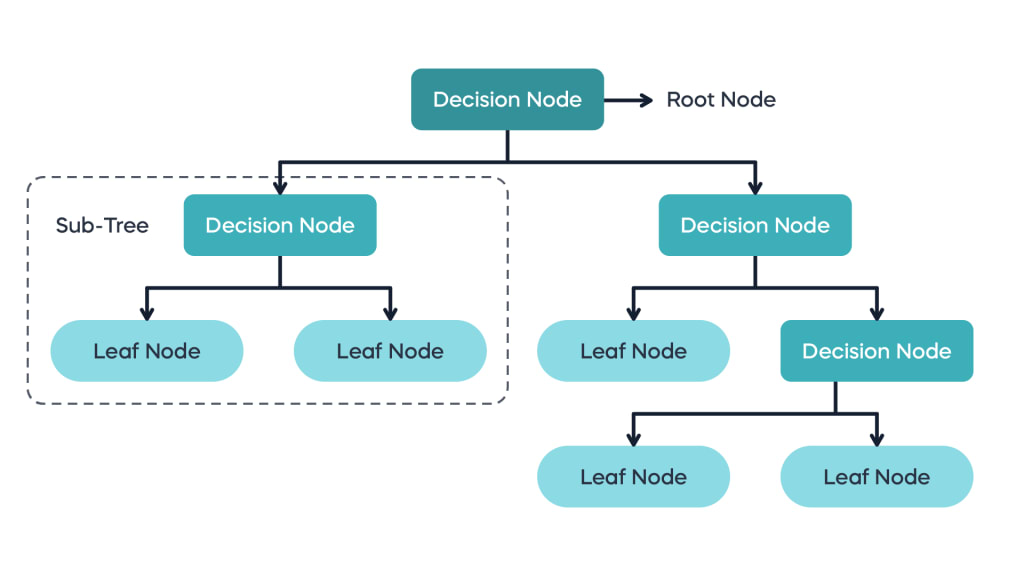
What is Decision Tree Algorithm
The decision tree algorithm is a supervised machine learning technique that is widely used for classification and regression problems. A decision tree is a tree-like model that is constructed by recursively partitioning the input space into smaller regions based on the value of one or more features. Each internal node in the tree corresponds to a test on one or more features, and each leaf node corresponds to a class label or a numerical value that represents the output of the model.
The decision tree algorithm works by selecting the best feature at each node to split the data into two or more subsets that are as pure as possible in terms of the target variable. The purity of a subset is measured by a metric such as the Gini index or entropy, which measures the degree of homogeneity within the subset.
Once the decision tree is constructed, it can be used to make predictions on new data by traversing the tree from the root node to a leaf node that corresponds to a predicted class or value. The decision tree algorithm can handle both categorical and continuous data and can be used for both binary and multi-class classification, as well as regression problems.
Advantages:
- Easy to Understand: Decision trees are easy to understand, visualize, and interpret. The resulting decision tree can be easily explained to others, including non-technical stakeholders.
- Applicable to both categorical and continuous data: Decision trees can handle both categorical and continuous data, making them a versatile algorithm.
- Fast Prediction: Once a decision tree is trained, it can quickly make predictions on new data. This makes decision trees suitable for real-time and online applications.
- Can Handle Missing Data: Decision trees can handle missing data by simply skipping the missing value during the tree construction process.
- Can Handle Irrelevant Features: Decision trees can handle irrelevant features by not including them in the tree construction process.
Disadvantages:
- Overfitting: Decision trees can easily overfit the data, especially when the tree is too deep or too complex. Overfitting occurs when the tree is too specific to the training data and fails to generalize well to new data.
- Limited to Binary Trees: Decision trees are limited to binary trees, which means each node in the tree can only have two branches. This can lead to large, complex trees for multi-class classification problems.
- Sensitive to Data: Decision trees are sensitive to small changes in the training data, and a small change in the data can result in a completely different tree.
- Biased Trees: Decision trees can be biased towards features with a large number of levels or features that appear earlier in the tree construction process.
- Instability: Decision trees can be unstable, meaning small variations in the data can result in a completely different tree
Summary
The decision tree algorithm is a supervised machine learning technique used for solving classification and regression problems. It works by constructing a tree-like model where each node represents a test on one or more features, and each leaf node represents a class label or a numerical value that represents the output of the model. The algorithm selects the best feature at each node to split the data into subsets that are as pure as possible in terms of the target variable. Decision trees can handle both categorical and continuous data and can be used for binary and multi-class classification, as well as regression problems.
The main advantage of decision trees is that they are easy to understand, interpret, and visualize. Decision trees can also handle missing data and irrelevant features. However, decision trees are prone to overfitting, especially when the tree is too deep or too complex. Various techniques such as pruning, regularization, and ensemble methods can be used to address overfitting.
About the Creator
Data Driven Private Investing: Why Deal Intelligence Determines Long-Term Returns
Private markets offer access to high-growth companies, specialized assets, and differentiated return streams. However, the complexity of private transactions requires more than capital commitment. Smarter investing begins with disciplined private deal intelligence, which transforms fragmented information into structured insight. Investors who rely on verified data rather than promotional narratives are better positioned to generate sustainable returns.
By Michael Christopher Venturino5 days ago in Education
How False Claims About Bill Gates and COVID-19 Spread Online
The COVID-19 pandemic was one of the most disruptive global events in recent memory. With fear, uncertainty, and rapidly changing science driving public discourse, misinformation spread almost as quickly as the virus itself. Among the many unfounded claims that circulated, one of the most persistent involved Microsoft co-founder Bill Gates — wrongly accused of using the pandemic for personal gain, control, or even population manipulation. But why did such false narratives take hold, and how did Bill Gates become a focal point of COVID-related conspiracy theories?
By Irshad Abbasi 5 days ago in Education



Comments
There are no comments for this story
Be the first to respond and start the conversation.