
About 2000 Years ago USA
Spiritual Traditions and Social Structures of Early Indigenous Peoples

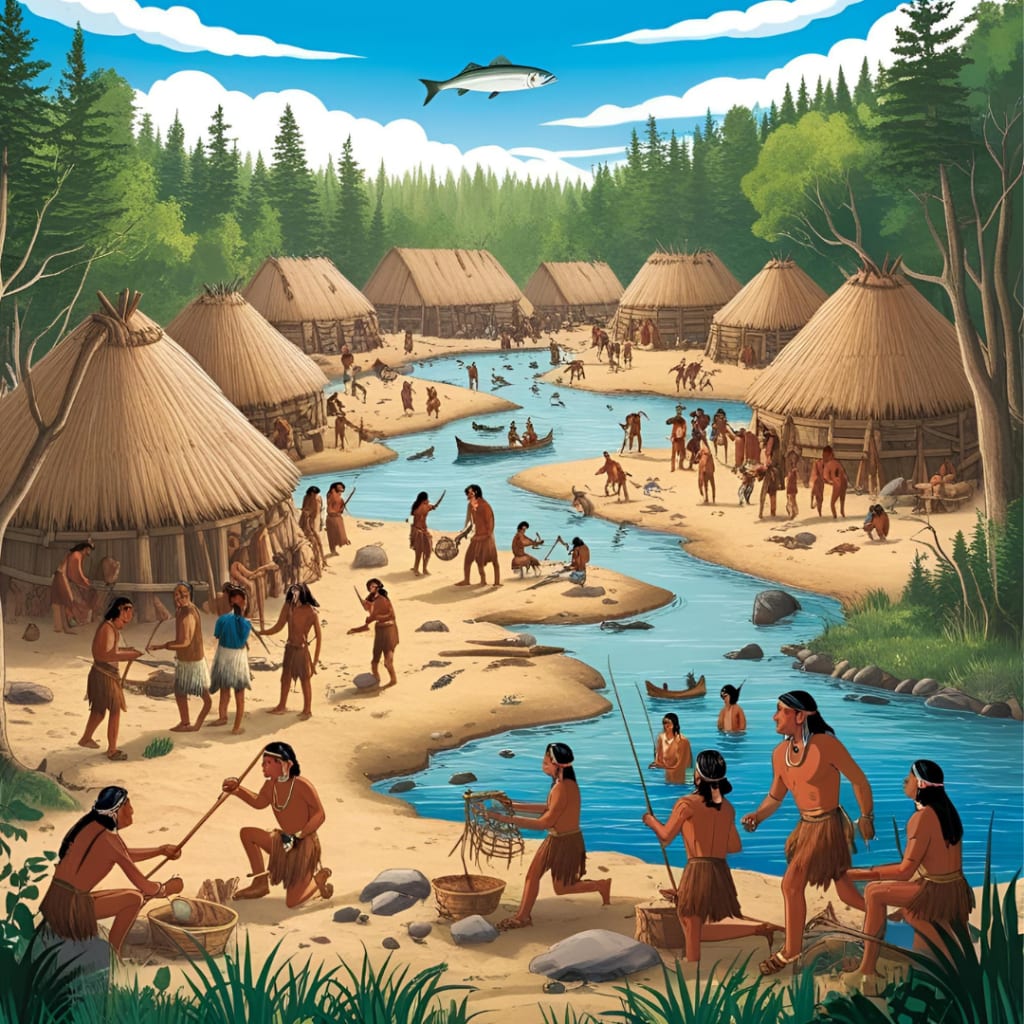
Life in North America 2,000 Years Ago:
Approximately 2,000 years ago, the land that is now the United States was home to a variety of Indigenous cultures that had developed sophisticated ways of life, spiritual traditions, and societal structures. At this time, civilizations were emerging in different regions, each adapting to their environment with unique innovations. The land was untamed and diverse, stretching from vast forests and river valleys to arid deserts and fertile plains. These ancient peoples had no written language as we understand it today, but they left behind clues about their lives through archaeology, oral traditions, and artifacts.
The Eastern Woodlands and Mound Builders:
One of the most remarkable groups living in what is now the United States around 2,000 years ago was the Hopewell culture, which thrived in the Ohio and Mississippi River valleys. The Hopewell people were known for constructing elaborate earthworks and mounds, often used for ceremonial and burial purposes. These mounds, some of which still exist today, suggest a society with a complex religious structure and a deep understanding of astronomy.
The Hopewell people were accomplished artisans, creating intricate jewelry, pottery, and carvings out of materials such as copper, mica, and shells. They also established extensive trade networks that stretched across North America, exchanging goods like obsidian from the Rocky Mountains, seashells from the Gulf of Mexico, and copper from the Great Lakes. The Hopewell society was not a centralized empire but rather a loose network of connected communities with shared cultural practices.
Further south, the Adena culture, which predated and overlapped with the Hopewell, was also engaged in mound-building. Their burial mounds contained elaborate grave goods, indicating a social hierarchy where leaders and spiritual figures were revered.
The Great Plains and the Early Bison Hunters:
In the central part of North America, the ancestors of the Plains tribes lived as hunter-gatherers, relying heavily on the vast herds of bison that roamed the region. Using tools made from stone and bone, they hunted bison for food, clothing, and shelter. Although horses had not yet been introduced (they would come much later with European contact), these early Plains people were skilled at hunting on foot, sometimes using drive lanes and buffalo jumps—natural cliffs used to herd and kill large numbers of bison at once.
These societies were largely nomadic, moving with the seasons to follow their food sources. They lived in temporary shelters like tipis made from animal hides, which allowed them to move easily from place to place. In addition to hunting, they gathered wild plants, nuts, and berries, supplementing their diet with whatever the land provided.
The Southwest and Early Puebloan Cultures:
In what is now the American Southwest, Indigenous peoples were already developing agricultural societies based around maize (corn), beans, and squash—known as the "Three Sisters." These early farmers were ancestors of later groups such as the Ancestral Puebloans (Anasazi), Hohokam, and Mogollon cultures.
The Hohokam, who lived in present-day Arizona, built extensive irrigation canals to cultivate crops in the desert, demonstrating advanced engineering skills. These canals allowed them to sustain large communities in an otherwise harsh environment. The Ancestral Puebloans, who occupied areas of present-day Utah, Colorado, Arizona, and New Mexico, built pit houses and early forms of the cliff dwellings that would later become famous in places like Mesa Verde.
These groups engaged in long-distance trade, acquiring turquoise, shells, and even parrots from Mexico. Their pottery and textiles showed remarkable craftsmanship, and their spiritual lives were deeply connected to the land, expressed through rock art, ceremonial kivas (underground chambers), and complex oral traditions.
The Pacific Northwest and Coastal Cultures:
Along the Pacific Northwest, Indigenous groups thrived in a landscape rich with forests, rivers, and ocean resources. The ancestors of the Tlingit, Haida, and Coast Salish people relied heavily on fishing, particularly salmon, which they caught using sophisticated techniques such as weirs and fish traps. They also hunted marine mammals, gathered shellfish, and harvested plants like berries and roots.
Their societies were organized into clans with strong leadership, and wealth was displayed through potlatch ceremonies—large feasts where hosts gave away goods to demonstrate their status and generosity. Totem poles, carved from massive cedar trees, told the histories and legends of their people, serving as artistic expressions and historical records.
Their canoes, masterfully crafted from hollowed-out cedar logs, were essential for transportation, trade, and even warfare. They traveled along the coast and inland waterways, engaging in trade with neighboring communities and maintaining strong cultural ties across vast distances.
The Southeast and Agricultural Chiefdoms:
In the southeastern part of North America, early Mississippian cultures were beginning to form out of the Woodland traditions. Around 2,000 years ago, the Indigenous peoples of this region cultivated maize and other crops, living in settled villages along rivers. Though the full rise of the Mississippian culture would come centuries later, the foundations of mound-building and chiefdom societies were already taking root.
The Southeastern peoples lived in villages consisting of thatched-roof houses built from wood and mud, arranged around central plazas. These plazas were likely used for ceremonies, dances, and communal gatherings. Some societies practiced early forms of social stratification, with elite members buried in mounds accompanied by intricate grave goods.
They also developed complex religious beliefs that were expressed in their art, which included carved stone statues, pottery, and shell engravings. Many of these artifacts suggest a spiritual worldview centered on balance, transformation, and the connection between the natural and supernatural worlds.
The Arctic and Subarctic Peoples:
Far to the north, in what is now Alaska and northern Canada, the ancestors of the Inuit and other Arctic peoples adapted to one of the harshest environments on the planet. Hunting seals, whales, and caribou provided them with essential food, clothing, and tools. They built homes from sod and animal skins and developed the technology of the kayak and the dogsled, allowing them to navigate their icy world efficiently.
The Subarctic peoples, such as the Athabaskan groups, lived in dense forests and relied on hunting, fishing, and foraging. Their mobile way of life helped them survive in an environment where resources were spread thin across vast areas.
Cultural and Spiritual Life:
Despite their geographic diversity, many of these Indigenous cultures shared common spiritual themes. They saw the world as interconnected, with humans, animals, and the land existing in balance. Ceremonies, dances, and oral traditions passed down knowledge and reinforced their beliefs. Shamans and spiritual leaders played crucial roles, serving as healers, storytellers, and intermediaries between the physical and spiritual realms.
Conclusion:
The United States 2,000 years ago was not an empty land waiting to be discovered—it was already home to thriving cultures, each uniquely adapted to their environment. These Indigenous societies built complex communities, engaged in extensive trade, developed artistic traditions, and cultivated deep spiritual connections with the world around them. Though their ways of life would be challenged by the arrival of Europeans many centuries later, their legacy remains an essential part of American history. Today, Indigenous peoples continue to honor and preserve their ancient traditions, reminding us that the story of North America did not begin with colonization but stretches back thousands of years into the past.
About the Creator
Kazi Mirajul Islam
I am expert in digital Marketing .I am also E- book writer & story writer. I am committed to delivering high-quality content.Also create social media account like Facebook,twitter account ,Instagram ,you tube account create and mained.
Keep reading
More stories from Kazi Mirajul Islam and writers in Education and other communities.
The Age of Discovery: Voyages to the New World"
Around 500 years ago, the early 16th century (approximately the year 1524), the world was undergoing tremendous change. This period marked the height of the Renaissance in Europe, the Age of Exploration, and the continued rise and fall of powerful empires across the globe. Here’s a detailed look at the state of the world half a millennium ago.
By Kazi Mirajul Islam10 months ago in Education
Python vs Rust Performance: Speed, Memory Usage, and Scalability Explained
When developers compare programming languages, performance is often one of the most debated factors. Two languages that frequently come up in these discussions are Python and Rust. While both are powerful in their own ways, they approach performance, memory management, and scalability very differently. This makes the Python vs Rust comparison especially relevant for teams choosing the right technology for their next project.
By Lennox Graya day ago in Education
💦The Water Cycle💦
Water is one of the most essential substances on Earth. It covers over 70% of our planet’s surface and is crucial for all forms of life. But have you ever wondered how water moves continuously around the Earth? How rivers, oceans, clouds, and rain are all connected in a constant cycle? This amazing natural process is called the water cycle, and it ensures that life never runs dry.
By Talha khanabout 5 hours ago in Education
Miss Persephone's Manual to a Seemingly Ordinary Life
Miss Persephone was found at the dining table, her blue eyes swollen, her tears arriving and retreating like the tides of the ocean. Earlier that day, her family had visited her in the retirement home where she had lived for eight years. It was her eightieth birthday.
By Imola Tóth2 days ago in Fiction




Comments
There are no comments for this story
Be the first to respond and start the conversation.