
8 Challenges of Using BIM in Construction Project Management and How to Overcome Them
From Complexity to Clarity: Tackling the 8 Biggest BIM Challenges in Project Management

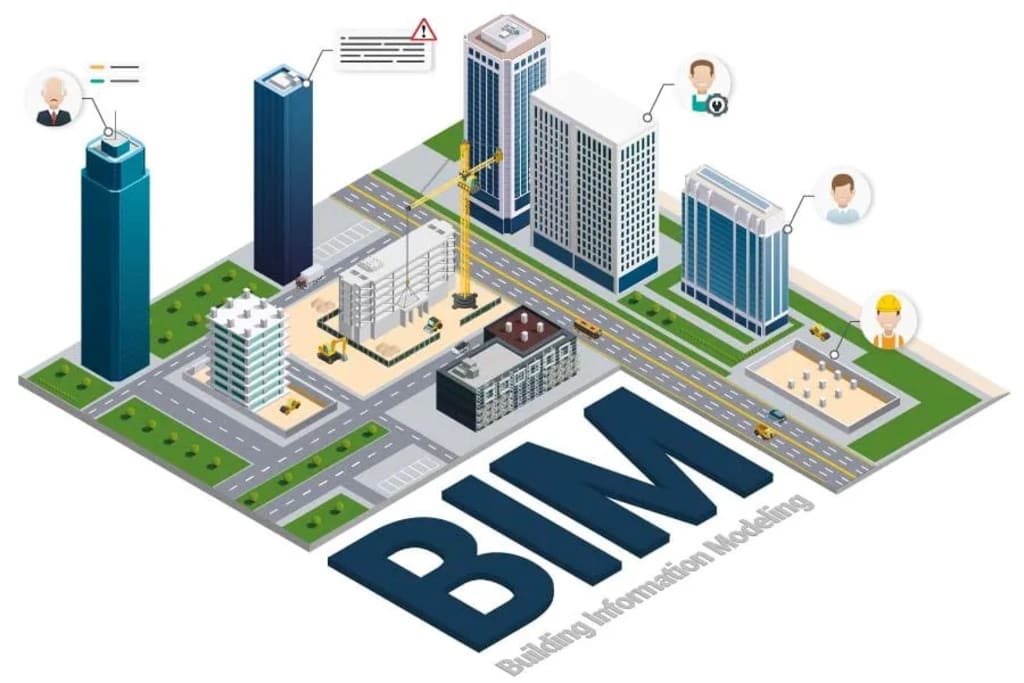
As the construction industry evolves in response to the demands of the modern world, Building Information Modeling (BIM) has emerged as a transformative tool that reshapes how projects are managed and maintained.
According to a McKinsey Global Institute report, BIM adoption can reduce project costs by 5-10% and improve productivity by up to 15% in design and construction phases.
This digital transformation has empowered teams to collaborate in real-time and enhance project outcomes. Despite the vast potential, BIM in construction project management is not without its challenges.
A 2020 survey by Dodge Data & Analytics revealed that 43% of construction firms still struggle with BIM adoption, primarily due to high upfront costs, software interoperability issues, and a lack of skilled personnel.
These hurdles can hinder the smooth implementation of BIM, preventing firms from reaping its full benefits. The BIM coordination process, which requires seamless integration between various project teams, is often complicated by these barriers.
To navigate this complex landscape, organizations are increasingly turning to BIM consulting services and BIM coordination solutions to mitigate risks and streamline implementation. With proper strategies in place, overcoming these obstacles becomes not just achievable, but essential. This article examines the eight most common challenges in BIM adoption and offers practical, data-backed solutions to help construction firms maximize the value of BIM in their projects.
Why BIM is critical for modern construction project management:
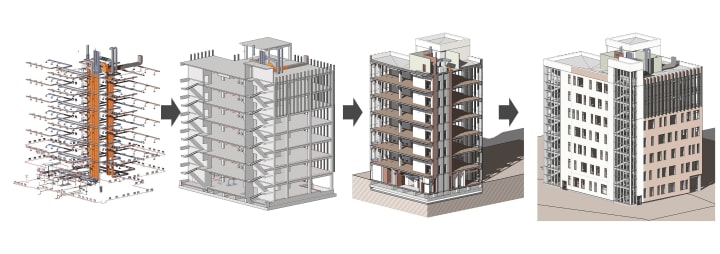
Building Information Modeling (BIM) is essential for modern construction project management due to its ability to streamline collaboration and improve efficiency across the project lifecycle. By centralizing data in a digital model, BIM allows architects, engineers, contractors, and project managers to work from a single source of truth, reducing errors and miscommunication.
This collaborative approach leads to more accurate project planning, better resource management, and proactive risk mitigation. BIM coordination services enable teams to identify design clashes early, preventing costly issues during construction. Furthermore, its ability to provide real-time data throughout the project allows teams to make informed decisions, saving both time and costs. As construction projects become more complex and demands for sustainability increase, BIM's role in ensuring compliance, optimizing performance, and managing facilities post-construction has become indispensable.
Ultimately, BIM is not just a tool; it is a fundamental strategy that drives success in today’s highly competitive construction industry.
The adoption of Building Information Modeling (BIM) in construction project management has brought significant advancements in how projects are executed. Despite its transformative impact, BIM implementation presents several challenges that can hinder its full potential.
From high initial costs to interoperability issues, these obstacles require careful consideration and strategic solutions.
In this article, we explore the eight key challenges faced by construction professionals when integrating BIM into their workflows and offer practical solutions to overcome them, ensuring smoother project delivery and enhanced efficiency.
8 Challenges of Using BIM in Construction Project Management and How to Overcome Them
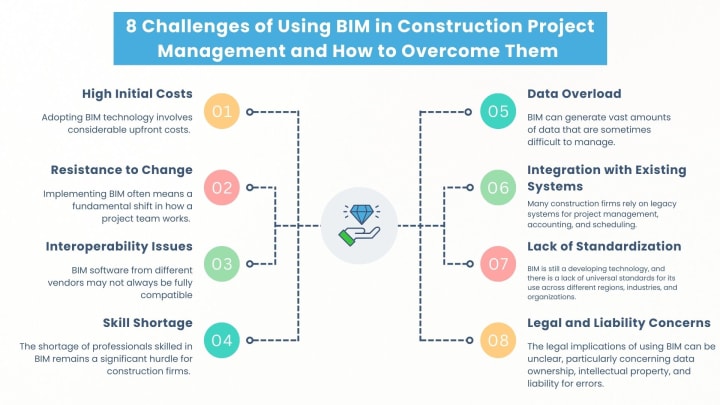
1. High Initial Costs
Challenge:
- Adopting BIM technology involves considerable upfront costs. These expenses typically cover software licenses, high-performance hardware, and comprehensive training for the team. For smaller construction firms or those working with tight budgets, this initial investment can be a major deterrent.
- The reluctance to commit resources to BIM can delay or prevent its implementation, limiting the potential for long-term project optimization.
Solution:
- One effective way to manage these costs is by opting for cloud-based BIM solutions, which reduce the need for expensive physical infrastructure, such as high-end workstations and server setups.
- A phased implementation strategy can help spread out the initial financial burden, starting with smaller, manageable projects to demonstrate BIM’s value.
- Over time, the efficiency and cost savings realized through reduced rework, faster project timelines, and enhanced collaboration typically outweigh the initial investment.
- A solid BIM training program for existing staff can ensure maximum return on investment by enhancing their capabilities and utilizing BIM’s full potential.
2. Resistance to Change
Challenge:
- Implementing BIM often means a fundamental shift in how a project team works. Many construction professionals are accustomed to traditional methods, such as paper-based designs or 2D drawings.
- The adoption of BIM requires embracing digital workflows, which can be met with resistance due to fears of new technology, lack of understanding, or simply reluctance to change well-established practices.
Solution:

- To overcome this challenge, firms should foster a culture of digital adoption by focusing on the benefits that BIM brings to day-to-day operations.
- This includes offering comprehensive training to all team members, from project managers to construction workers, emphasizing how BIM reduces errors, minimizes rework, and facilitates faster decision-making.
- Companies should also adopt BIM champions, individuals within the organization who act as advocates for BIM, helping to bridge the gap between technical and non-technical teams. Regular demonstrations of BIM’s positive impact on past projects can also motivate teams to embrace the change.
3. Interoperability Issues
Challenge:
- BIM software from different vendors may not always be fully compatible, leading to issues when different project stakeholders (architects, engineers, contractors) use varying tools.
- These interoperability issues can lead to data loss, discrepancies in design elements, or delays in project timelines, especially when real-time collaboration is essential.
Solution:
- To address this, companies can prioritize using BIM collaboration platforms that support multi-software interoperability.
- Platforms like Autodesk BIM 360 or Trimble Connect facilitate data exchange across various BIM tools, allowing for real-time updates and smooth collaboration.
- Defining data standards for BIM workflows and establishing clear protocols for file management can ensure consistency and minimize errors when data is transferred between systems. Investing in integration software or middleware tools that bridge the gap between incompatible systems can further reduce these friction points.
4. Skill Shortage

Challenge:
- The shortage of professionals skilled in BIM remains a significant hurdle for construction firms. While the demand for BIM knowledge is growing, many employees still lack the necessary training or expertise to fully utilize BIM’s capabilities.
- This skill gap can prevent organizations from efficiently deploying BIM and achieving its maximum potential.
Solution:
- To overcome the skill shortage, firms should establish robust BIM training programs for their teams. This includes providing access to certified training courses, workshops, and hands-on BIM tutorials.
- Companies can also collaborate with educational institutions to offer internships or apprenticeships that focus on BIM technologies, allowing fresh graduates to integrate into the workforce with relevant skills.
- Hiring BIM consultants or partnering with BIM consulting firms can temporarily fill the gap while the internal workforce builds expertise. This dual approach, upskilling existing employees while bringing in external expertise, can accelerate BIM adoption and long-term success.
5. Data Overload
Challenge:
- BIM can generate vast amounts of data that are sometimes difficult to manage. For large construction projects, the influx of detailed design data and other project-related information can overwhelm teams, leading to inefficient decision-making and missed opportunities.
- Without clear organization, this data overload can lead to delays, errors, or confusion about which data to prioritize.
Solution:
- To mitigate data overload, it is crucial to implement data management systems that organize and categorize BIM data in an intuitive way. BIM tools that offer integrated dashboard visualizations allow project teams to see key project metrics at a glance, focusing on what matters most.
- Establishing data standards and processes for data entry, updates, and version control ensures consistency across the project.
- Project managers should establish clear data access protocols, only allowing authorized team members to access certain project data, so that stakeholders aren’t overwhelmed by information overload. Proper training in data management also ensures that teams can extract actionable insights from the data without becoming bogged down in it.
6. Integration with Existing Systems
Challenge:
- Many construction firms rely on legacy systems for project management, accounting, and scheduling. Integrating BIM with these existing tools can be complex, time-consuming, and sometimes costly.
- Lack of integration may hinder BIM’s effectiveness, as project data in BIM models may not sync easily with other systems, leading to data discrepancies and manual work.
Solution:
- A gradual approach to integration is essential, starting with linking BIM with core project management systems. Many BIM platforms now offer API integrations that allow easy connection with existing systems.
- Cloud-based BIM platforms like Autodesk BIM 360 and Procore also offer integrations with widely used tools, reducing the need for manual data entry and ensuring consistency across systems.
- Implementing middleware solutions can help bridge gaps between BIM and other construction software. A detailed plan for integration, backed by ongoing technical support, ensures smooth data transfer and minimizes disruptions.
7. Lack of Standardization
Challenge:
- BIM is still a developing technology, and there is a lack of universal standards for its use across different regions, industries, and organizations.
- Without a common set of guidelines, the BIM process can vary significantly, leading to inefficiencies and confusion, particularly on multi-disciplinary projects involving various stakeholders.
Solution:
- Construction firms should proactively adopt and implement BIM standards like ISO 19650, which provides a standardized framework for BIM processes.
- Encouraging participation in industry-specific BIM groups and staying up-to-date on evolving standards ensures companies remain aligned with best practices.
- Establishing internal BIM protocols for file naming, data exchange formats, and model creation can help maintain consistency across projects. As BIM standards continue to evolve, regular updates to workflows and processes should be integrated into company practices.
8. Legal and Liability Concerns
Challenge:
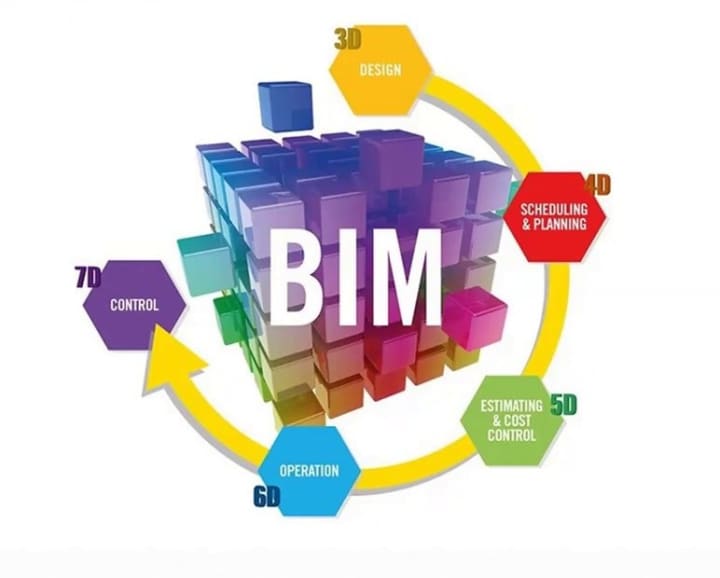
- The legal implications of using BIM can be unclear, particularly concerning data ownership, intellectual property, and liability for errors.
- With multiple stakeholders contributing to a project, determining responsibility for design errors, delays, or cost overruns related to BIM models can be a complex issue, especially in case of legal disputes.
Solution:
- To address legal and liability concerns, companies should develop clear BIM contract terms that outline each party's responsibilities regarding data ownership, updates, and model accuracy.
- Legal frameworks should be established to govern the use of BIM data, including intellectual property rights, ensuring each stakeholder’s roles and liabilities are clearly defined.
- Firms should consider BIM-specific insurance policies that protect against potential legal claims resulting from data errors or omissions. Consulting with legal experts who specialize in BIM-related contracts ensures that all aspects of data usage, ownership, and liability are properly addressed.
Conclusion:
While BIM presents several challenges, proactive strategies and solutions can significantly mitigate its impact. By focusing on training, standardization, and integration, and leveraging the right tools and technologies, construction firms can maximize BIM’s benefits. BIM is not just a tool but a transformative strategy for the modern construction landscape and overcoming these challenges will position firms to lead in efficiency, innovation, and project delivery.
Read Further:
About the Creator
Alishna Brown
I am a renowned author, speaker and educator on BIM technology in the Architecture, Engineering, and Construction (AEC) industry. With over a decade of experience in the field, I have become a thought leader and consultant.
Keep reading
More stories from Alishna Brown and writers in Education and other communities.
Transforming New York's Skyline: The Impact of Point Cloud Modeling on Skyscraper Construction
The construction industry in New York City is known for being innovative. It is always looking for ways to build taller, faster, and better. Point cloud modeling has become an important tool. It gives a clear and detailed way to construct skyscrapers. By creating very accurate digital models of buildings and their surroundings, point cloud technology helps improve project management. This includes the steps from design and planning to construction and maintenance.
By Alishna Brown10 months ago in Education
The Grounded Cure: Discovering the Therapeutic Power of Digging in the Dirt
In our fast-paced, high-stress world, people are increasingly seeking simple, meaningful ways to improve their mental well-being. One of the most powerful—and underrated—forms of therapy doesn’t come from a pill or a screen. It comes from the earth itself. Digging in the dirt, whether for gardening, landscaping, or simply for the joy of connecting with nature, offers real emotional relief. This earthy, hands-on activity engages the senses, calms the mind, and restores a sense of peace and purpose that’s often missing in daily life.
By Dina Vardal8 days ago in Education
From Job to Prison: Revenge, Sacrifice, and Ending
The story begins by showing a bald and strong man named Bradley, who is a car mechanic by profession. As usual, Bradley reaches the garage with a broken car, but after arriving there, he sees that the garage owner is anxiously waiting only for him, which makes him a little surprised. Then the garage owner calls him into his office. Hearing this, Bradley understands that he is about to be fired from his job, and exactly that happens. The owner tells him that these days the garage is going through a financial crisis, and that is why he is being forced to fire some workers. But this is only an excuse, because Bradley is a hard-tempered man, and the owner wants to remove him and hire someone who flatters him. Now since Bradley is a tough man, he does not argue with the owner. He goes to the locker room, takes out his belongings, takes his car, and silently leaves for home. And yes, friends, this is where the downfall of Bradley’s life begins, which continues straight until the end of the story and ends there. Anyway, Bradley stops his car in front of his house, and at the same time he sees that his wife Lauren is sitting in her car, talking to someone on the phone. Bradley becomes suspicious of her. To know the truth, he keeps watching her carefully for some time. When he becomes sure, he immediately goes to Lauren and tells her to open the car door. His wife says, “You came back from work very early today.” At the same moment, Bradley notices marks of someone else’s lips on her neck and says to Lauren, “Give me your phone.” But Lauren refuses to give the phone, because of which Bradley forcefully snatches the phone from her, and his suspicion turns out to be correct. She is talking on the phone with another man. In anger, Bradley tells Lauren to go inside the house. Lauren says, “At least listen to me.” Bradley says, “I said go inside the house.” Then Lauren silently goes inside the house. Now, he had already been fired from his job a little while ago, and now his wife’s affair, because of which he had become even more disturbed, so he starts taking out all his anger on Lauren’s car. How? You can see that yourself. Yes, he is so angry that he does not even realize that his hands have been badly injured. After that, he calms himself down and goes inside the house and questions Lauren about how many days she has been with the other man. Lauren tells him everything, that for the past three months she had been having an affair with someone else. Actually, Bradley’s wife had an abortion a few days earlier, because of which she used to remain sad, and Bradley often stayed busy with his work. Because of this, Lauren felt lonely and very depressed at home, and to fill this emptiness, she had to take support from another man. Hearing these things, Bradley realizes that he should have given time to Lauren. He apologizes to Lauren for this and says that from today, from right now, they will both start a new life. Lauren agrees. After that, Bradley tells Lauren that he has been fired from his job and now he will work for a man named Gil, who is a drug lord. As soon as she hears Gil’s name, Lauren clearly refuses and says, “You yourself said that you would never work with Gil.” Bradley says, “Yes, but in such circumstances, we cannot live like a prosperous family. To run a family, money is needed, and at this time I have no other option.” He also assures Lauren that he will do this work very carefully.
By Filmon Ke Raaz | Movie Mysteries Explainedabout 10 hours ago in Education
Miss Persephone's Manual to a Seemingly Ordinary Life
Miss Persephone was found at the dining table, her blue eyes swollen, her tears arriving and retreating like the tides of the ocean. Earlier that day, her family had visited her in the retirement home where she had lived for eight years. It was her eightieth birthday.
By Imola Tóth4 days ago in Fiction



Comments
There are no comments for this story
Be the first to respond and start the conversation.