
1099-NEC vs 1099-MISC: The Guide to Choosing the Right Tax Forms
The IRS uses both Form 1099-NEC and Form 1099-MISC to track payments to non-employees, but choosing the wrong one can lead to penalties.

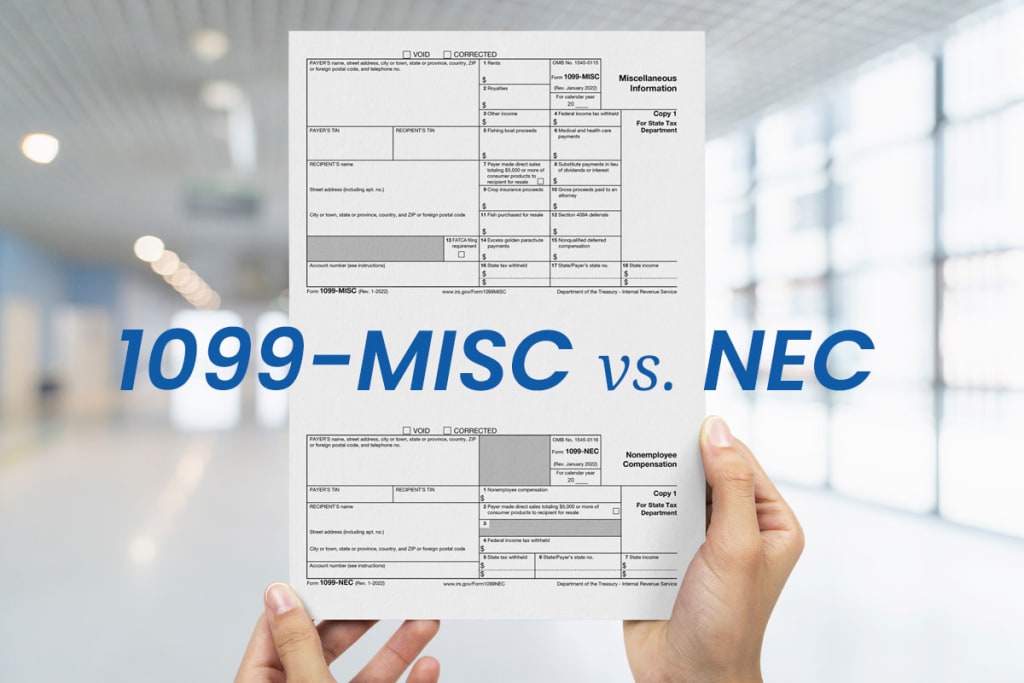
Every tax season, business owners face the same dilemma: which 1099 form should I use? The confusion between Form 1099-MISC vs 1099-NEC costs businesses millions in penalties each year. As the IRS processes over 2.6 billion information documents annually, getting your 1099 forms right isn't just important it's essential for your business's financial health.
The Return of Form 1099-NEC: Why It Matters Now
Many business owners remember when all non-employee payments went on Form 1099-MISC. That changed in 2020 when the IRS revived Form 1099-NEC after a 40-year hiatus. This wasn't just bureaucratic reshuffling—it was a response to the growing gig economy and the need for clearer reporting standards.
What exactly is Form 1099-NEC?
Think of Form 1099-NEC as the dedicated form for your business relationships that aren't traditional employment. If you paid a freelance designer $800 for a new logo, a consultant $1,500 for business strategy, or a contractor $2,000 for office repairs, you'll need Form 1099-NEC.
The threshold is straightforward: $600 or more to any single non-employee during the tax year. This includes:
- Independent contractors and freelancers
- Gig workers and temporary service providers
- Consultants and professional service providers
- Self-employed individuals
Form 1099-MISC: The Catch-All for Miscellaneous Income
While 1099-NEC handles your contractor payments, Form 1099-MISC remains the go-to for various other payments that don't fit the employee compensation model.
Common scenarios requiring 1099-MISC include:
- Rental payments of $600 or more (unless paid to a real estate agent)
- Royalty payments of $10 or more
- Prize and award money that isn't for services rendered
- Payments to attorneys (even if for legal services, if not reported elsewhere)
- Medical and healthcare payments to providers
- Crop insurance proceeds and fishing boat proceeds
The key distinction? 1099-MISC covers payments that represent income to the recipient but aren't compensation for services as a non-employee.
The Critical Differences That Could Save You Thousands
Many business owners make the costly mistake of using the wrong form or missing deadlines. The penalties start at $60 per form and can escalate quickly, with maximum penalties reaching over $4 million for large businesses.
Deadline differences matter:
Form 1099-NEC: Due January 31st (no grace period for electronic filing)
Form 1099-MISC: Due February 28th (paper) or March 31st (electronic)
Payment type distinctions:
Use 1099-NEC for: freelance work, contractor services, professional fees
Use 1099-MISC for: rent, royalties, prizes, attorney payments (not for legal services)
Real-World Scenarios: Which Form Would You Use?
Let's test your understanding with common business situations:
1. You paid a graphic designer $1,200 for a website redesign
Answer: 1099-NEC – Compensation for services as a non-employee
2. You rented office space from another business for $800 monthly
Answer: 1099-MISC – Rental income, not service compensation
3. You awarded $500 prize money in a local business competition
Answer: 1099-MISC – Prize income, not payment for services
4. You hired a marketing consultant for a $3,000 project
Answer: 1099-NEC – Professional services from a non-employee
The Step-by-Step Filing Process Made Simple
Filing these forms doesn't have to be complicated. Follow this straightforward process:
Step 1: Gather Information Early
Start collecting W-9 forms from vendors and contractors throughout the year. Don't wait until January—you'll be competing with every other business trying to get the same information.
Step 2: Determine the Correct Form
Ask yourself: "Was this payment for services performed?" If yes, use 1099-NEC. If it's for other types of income, use 1099-MISC.
Step 3: Complete the Forms Accurately
Double-check:
Recipient's name and TIN (matches W-9 exactly)
Payment amounts (tied to your accounting records)
Your business information
Step 4: Distribute and File
Remember you need to send:
Copy A to the IRS
Copy B to the recipient
Copy C for your records
Beyond the Basics: Pro Tips Most Businesses Miss
Get ahead of the W-9 game: Make collecting W-9s part of your onboarding process for new vendors. The IRS's TIN matching program can help verify information before filing.
Understand state requirements: Some states require copies of 1099 forms or have different thresholds. California, for instance, has specific requirements for certain payments.
Digital solutions save headaches: Consider using accounting software that tracks 1099 eligibility throughout the year and generates forms automatically.
Know your extension options: If you need more time, file Form 8809 by January 31st. But note: this only extends the deadline to provide forms to recipients, not the IRS filing deadline.
When to Seek Professional Help
While many small businesses can handle 1099 filing themselves, consider professional help if:
- You have multiple contractors with complex payment structures
- You're unsure about classification of workers
- You've received IRS notices about previous filings
- You simply don't have the time to ensure compliance
The Cost of Getting It Wrong
Beyond the immediate financial penalties, incorrect 1099 filing can trigger IRS audits, damage business relationships (when you send incorrect forms to contractors), and create accounting nightmares when trying to reconcile records.
One business owner we spoke with spent over $5,000 in professional fees to correct $800 in 1099 filing errors. The time and stress involved far exceeded the original penalty amounts.
Your Action Plan for Tax Season
Review payments from the past year to identify 1099 requirements
Verify you have W-9s for all applicable recipients
Mark deadlines in your calendar: January 31st for 1099-NEC
Consider e-filing for faster processing and automatic confirmation
Keep detailed records of when and how you filed
The difference between 1099-NEC and 1099-MISC comes down to the nature of the payment. When in doubt, ask: "Was this payment for work performed?" If yes, it's likely 1099-NEC. For other types of income, lean toward 1099-MISC.
Remember, in the world of tax compliance, what you don't know can cost you. Taking the time to understand these forms now can save you from costly penalties and stressful IRS communications later.
About the Creator
BooksMerge
BooksMerge finds expert articles on small business accounting, bookkeeping, payroll, and tax strategies. We simplify complex financial topics to help your startup thrive and stay compliant. personal service for startups & small businesses.
Keep reading
More stories from BooksMerge and writers in Education and other communities.
2025 Global Growth Forecasts Dimmed
Global growth forecasts for 2025 have been reduced due to higher taxes, weak investment, rising borrowing costs, and slow consumer demand. Small businesses will face tighter cash flow, increased operating costs, and reduced access to funding. With the right planning, small businesses can stay resilient and protected during this slowdown.
By BooksMerge2 months ago in Education
Hosting a Book Fair
How many of you remember the “best week ever!” from when you were a child? Book fairs were the staple of many of our childhoods with Scholastic leading the way. While there are many choices for book fairs today and I absolutely want to talk about them, that’s going to be a later article.
By Reb Kreyling3 days ago in Education
Communicating with Confidence: Building Trust Through Simplicity
Trust is the cornerstone of any meaningful relationship, whether professional or personal. At the heart of trust lies the ability to communicate clearly. People naturally respond to straightforward, reliable, and easy-to-understand information. Professionals who prioritize clarity establish credibility and foster confidence in others. Clients, colleagues, and partners feel assured that they can make informed decisions when the messages they receive are transparent and well-articulated.
By Stacey Yima day ago in Education




Comments
There are no comments for this story
Be the first to respond and start the conversation.