
10 Surprising and Unusual Facts About Iranian Society
10 Surprising and Unusual Facts About Iranian Society

10 Surprising and Unusual Facts About Iranian Society
Iran, in most Western media, is a country reduced to political slogans and nuclear negotiations, but it holds one of the world's oldest, most complex civilizations. The Islamic Republic hides a society full of paradoxes underneath its surface: ancient traditions standing side by side with modern desires, and public piety disguising private pragmatism. To understand Iran means going through its complex social codes, unexpected cultural trends, and the peculiar ways its people have adapted to the political and geographical realities. Here are ten facts about Iranian society that may seem strange, but are key to understanding its fascinating and multifaceted soul.
**1. The Dual Society: The "Zaher" and the "Baten"
One of the most basic and puzzling concepts to outsiders is the sharp division between public and private life, referred to as *Zaher* (the apparent, outer) and *Baten* (the hidden, inner). Publicly, the rules of the Islamic Republic are followed: modest dress (most especially the hijab, which is compulsory for women), segregation by gender in certain official settings, and public displays of religious observance. Behind high walls, however, private homes thrive. Here, parties with mixed genders, Western music, dancing, and secular conversations are the order of the day. This is by no means considered hypocrisy but rather a very valid way of survival. This is a social adjustment that enables private freedom while keeping up appearances in public, two parallel universes that most Iranians move through with ease.
**2. The Art of "Taarof": The Ritual Politeness War
Taarof is the intricate and often baffling Iranian system of ritual courtesy and hyper-politeness. It reigns over social interactions to such a degree that literal meaning is often opposite to the intended meaning. The most classic example is the ritual of offering to pay for a meal. The host will insist, sometimes vehemently, on paying. The guest is culturally obliged to refuse, equally vehemently. This back-and-forth can continue several times, the host's insistence growing stronger, until the guest finally, and gracefully, accepts the host's "generosity." To immediately accept the first offer is considered rude. The same applies to invitations, compliments, and bargaining in markets. For foreigners, Taarof can be a minefield, but for Iranians, it is the essential lubricant of social life, a performative dance which demonstrates respect, humility, and cultural refinement.
**3. Nation of Poets and Funeral Lovers
The Iranians' attachment to their poetry is profoundly spiritual. Works from 13th-century poets such as Rumi and Hafez are not only literature but immediate guides through life, love, and spirituality. Most families will have a *Divan-e-Hafez* at home and use it for *Faal-e-Hafez*: A form of bibliomancy by which wishes are made, and the book is opened at random-to interpret what the poem says for an answer. This deep cultural melancholia, known for its focus on love, loss, and the fleeting nature of life, also finds expression in a unique attitude to mourning. Shiite commemoration ceremonies, such as for the martyr Hussein, are massive, emotional, and deeply theatrical public displays of grief, with chest-beating and sobbing. This public embracing of sadness is very central and, to outsiders, odd part of the Iranian emotional landscape.
**4. The most surprising plastic surgery capital of the world
With one of the highest rates of nose jobs per capita in the world, Iran is often referred to as the "nose job capital of the world." A walk through affluent parts of the capital displays a sea of both men and women with small, white bandages on their noses-the universal sign of recent surgery. It's a trend driven by a complex mix of factors. With the mandatory hijab covering a woman's hair, her face-and particularly her nose-becomes a primary focal point of her beauty. But in a society with such strict social codes, cosmetic surgery becomes an acceptable and highly sought-after form of individual self-expression and a marker of modern, global identity.
5. Temporary Marriage ("Sigheh"): A Religious Loophole for Relationships
Arguably among the most controversial and strange institutions in Iran is *Sigheh*, or temporary marriage. This Shia Islamic practice allows a man and a woman to enter into a fixed-term marital contract, which can be from a few hours to 99 years. While it has historical and religious roots in legitimizing relationships while traveling, in modern Iran, it is a complex, often stigmatized phenomenon. For some, it is a means for young, unmarried couples to have a religiously sanctioned relationship in a society where pre-marital sex is forbidden. Others might find it controversial and a practice that can be exploited. Whatever your view, *Sigheh* represents a unique religious and social framework for the regulation of sexuality and relationships that exists almost nowhere else in the modern world.
**6. The Underground Party Scene and "Proxy" Culture
Despite an outright ban on both alcohol and mixed-gender dancing, Iran's underground party scene is thriving and quite extensive. Inevitably born out of the public/private (*Zaher/Baten*) split, these parties are held in secret locations in basements or remote villas. Iranians are also among the world's most adept users of VPNs to circumvent state censorship in accessing blocked social media and news sites. It has given rise to a "proxy culture," in which technological workarounds have become part of quotidian life. All of this cat-and-mouse with the authorities has made the population quite tech-savvy and resilient in the pursuit of global connection.
7. The "No" Nod: The Unspoken "Yes" Gesture
Non-verbal communication in Iran is often the opposite of what Westerners would imagine. The most common point of confusion arises with the "no" nod. Whereas if an Iranian tilts their head back slightly and clicks their tongue, meaning "no," a simple side-to-side head shake, or what means "no" in the West, is interpreted as a confused "I don't understand." A single downward nod of the head can be taken to mean "yes." This leads to comic and frustrating misunderstandings where a foreigner asks a question, the Iranian responds in what looks like a Western "no" (the side-to-side shake), and the foreigner leaves believing the answer was negative, when the Iranian was merely signalling confusion.
8. The Superstitious Mind: The Evil Eye and "Jinn"
Despite being a highly educated and technologically capable society, superstition runs deep in Iran. Belief in the "evil eye" (*Nazar*) is widespread. It is thought that envy or excessive praise can bring bad luck. To ward it off, people wear blue eye-shaped amulets, burn wild rue (*esfand*) to create protective smoke, or spit three times (or say "pooh-pooh-pooh") to symbolically ward off misfortune. Similarly, belief in *Jinn*—invisible beings made of "smokeless fire" mentioned in the Quran—is common. A sudden illness or strange occurrence might be attributed to a *Jinn*, and some people even claim to communicate with them. This blend of Islamic belief and pre-Islamic superstition is a normal part of the Iranian worldview. 9. The Picnicking Obsession: "Sofreh" on Every Patch of Grass Iranians are world-class picnickers. On any Thursday evening-otherwise known as the start of the weekend-or Friday, parks, gardens, and even the thin strips of grass beside highways are set up like perfect dining rooms. Families lay out a *sofreh*, the traditional cloth, on the ground and unpack an incredible feast of kebabs, herbs (*sabzi*), rice (*polo*), and samovars of tea. They will sit for hours eating and drinking tea, playing backgammon (*nard*) or just socializing. This is more than just eating; this is a kind of sacred national pastime, a way to connect with family, nature, and a slower pace of life amidst the chaos of the city. **10. The Paradox of Gender: Repression and High Education The image of Iranian women as solely repressed and marginalized is incomplete and misleading. While the legal and social system is heavily patriarchal, Iranian women have fiercely pursued education as their path to empowerment. They now make up over 60% of university entrants, outpacing men in many fields like medicine, basic sciences, and engineering. This has created a profound paradox: a generation of highly educated, ambitious women operating within a system that legally restricts their potential (e.g., in inheritance, divorce, and child custody). This tension between repression and achievement has created a powerful, silent feminist revolution from within, making Iranian women one of the most formidable and potentially transformative forces in the future of their society. Iranian society is a country of striking paradoxes: the site where ancient poetry inspires contemporary life, public piety cloaks private parties, and "no" often signifies "yes." These amazing facts are not simple novelties but rather strategies of survival, cultural treasures, and learned adaptations of a people whose glorious past and turbulent present cannot be reduced to simplistic political discourse. To learn about Iran means to understand its paradoxes, since it is through them that the nation's resilient, poetic, and consistently surprising spirit may be grasped.
About the Creator
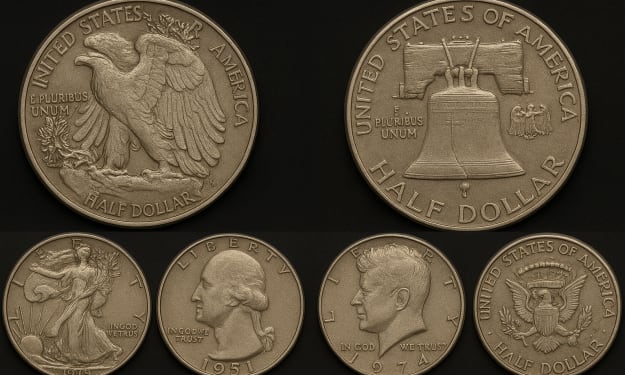
Half Dollars That Defied Time: Kennedy, Franklin & Walking Liberty
If you’ve found yourself holding an old half dollar, you’ve probably wondered: is this just pocket change, or could it be something more? I’ve had that same conversation with countless collectors in my eight years as a numismatist. The answer often hinges on three legendary names: Walking Liberty, Franklin, and Kennedy. More than just silver, these coins are tangible pieces of 20th-century America. This guide will help you understand their stories, values, and which one might be the perfect fit for your goals, whether you're building a collection or an investment.
By Laura Bennett2 days ago in Education
Center Stage with Paul Stewart
*** I'm keen to republish the interviews I did for my series with Vocal creators. It's been a few years and I thought it might be nice to revisit these wonderful conversations. I'll be releasing them one at a time for a few weeks/months.
By Heather Hublera day ago in Interview



Comments
There are no comments for this story
Be the first to respond and start the conversation.