
Your Backpack Is (Literally) Made From Plastic Bottles—And That’s Awesome
How RPET backpack suppliers are turning ocean waste into everyday style.


Hey you—yes, you, the one scrolling this while sipping oat-milk latte from a reusable cup (heroic), but also just tossed a crumpled water bottle into the “maybe recycling?” bin because the lid was still on (we’ve all been there). Take a breath. Put the guilt down. Grab your favorite snack (preferably unpackaged—or at least in compostable wrapper, no judgment if it’s slightly squished). Because today, we’re talking about something quietly revolutionary happening on your back: your backpack. Yep—the one you’ve had since 2021 that somehow survived three internships, a spontaneous road trip, and that one time you tried to fit an entire library into it. That backpack? It might be made from your old water bottle. Or your neighbor’s. Or that beach-hopper’s plastic bag that floated into the ocean and then got rescued, washed, shredded, melted, spun, and reborn as a sleek, water-resistant, Instagram-ready shoulder companion. Wild, right?
Let’s get real for a sec: you didn’t sign up to be a climate hero. You signed up for convenience, durability, and a decent laptop compartment. But here’s the delightful plot twist: thanks to RPET backpack suppliers—the unsung ninjas of sustainable fashion—you now get all three, plus bonus points in the “I’m-not-accidentally-funding-the-plastic-industrial-complex” department.
So—what even is RPET? (Don’t worry, no pop quiz. Just friendly jargon-demolition.) RPET stands for Recycled Polyethylene Terephthalate—a mouthful so dramatic it deserves its own theme music. In plain English? It’s PET plastic (the stuff your soda bottles, salad containers, and that mysterious “#1” symbol on your takeout container are made of) that’s been collected, cleaned, chopped into flakes, melted into pellets, and spun into new polyester fibers. Think of it like giving plastic a spa day, followed by a full career pivot—from landfill-bound waste to high-performance fabric.
And here’s where it gets personal: one medium-sized RPET backpack = roughly 15–25 recycled plastic bottles. Let that sink in. Not “about the same amount.” Literally. Your bag has done more environmental heavy lifting than your entire “I’ll-start-composting-next-month” resolution. It’s basically a tiny, wearable recycling plant—with pockets.
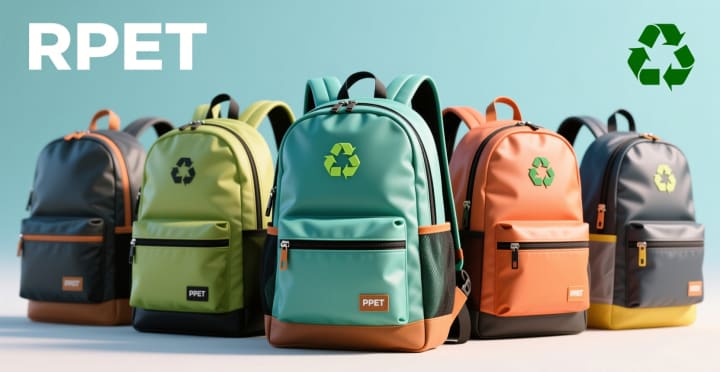
Now, I know what you’re thinking: “Wait… recycled plastic? Doesn’t that mean it’s… cheap-looking? Like those stiff, shiny backpacks from middle school that smelled faintly of regret and cafeteria pizza?” 😅 Nope. Today’s RPET? It’s silky, sturdy, color-rich, and often more durable than virgin polyester (thanks, molecular memory—science is weird and wonderful). It drapes nicely. It resists fading. It survives being shoved under airplane seats, dragged across cobblestones, and used as an impromptu pillow during train naps. And yes—it comes in actual colors: not just “corporate grey” and “despair beige,” but moss green, terracotta rust, deep indigo, and even limited-edition tie-dye made from ocean-bound plastic collected off Bali’s shores. (Yes, really. Someone out there is turning trash into tie-dye. We salute them.)
What’s especially refreshing (pun absolutely intended) is how RPET backpack suppliers are changing the game—not with loud slogans or virtue-signaling billboards, but with quiet consistency. They’re the ones auditing supply chains down to the dye house, ensuring low-water, non-toxic pigment processes. They’re partnering with coastal communities in Vietnam and Ghana to collect plastic before it hits the sea—not as charity, but as co-creation. They’re publishing annual impact reports that read less like PR fluff and more like “Here’s exactly how many kg of CO₂ we saved, how many bottles we diverted, and how much fair-wage labor we supported.” No greenwashing. Just green doing.
And here’s the kicker: they’re making sustainability frictionless. No need to sacrifice style for ethics. No need to pay triple for “eco-luxury” that feels suspiciously like wearing burlap chic. A great RPET backpack looks like it belongs next to your vintage denim jacket and your thrifted leather boots—not instead of them. It’s fashion that doesn’t ask you to choose between looking good and doing good. It says: You can have both. And your backpack will hold your laptop, your lunch, your hopes, and your quietly rebellious stance against single-use culture—all without breaking a sweat.
Of course, it’s not magic. RPET isn’t a silver bullet for the plastic crisis (we still need systemic change, policy reform, and way less plastic production overall). But it is a powerful, accessible, everyday act of reimagining value: what we discard becomes what we carry—literally. Every time you sling that RPET backpack over your shoulder, you’re not just hauling your stuff. You’re carrying intention. You’re closing a loop. You’re whispering to the world: “I see the problem. And I choose to wear the solution.”

So next time you’re shopping for a new bag—whether you’re upgrading from that duct-taped relic or treating yourself after surviving another quarterly report—take a peek at the label. Look for “100% RPET,” “GRS-certified” (that’s Global Recycled Standard—think of it as the “organic cotton” seal, but for recycled fabrics), or better yet, brands that name their supplier partners (shout-out to folks like Ripstop by the Sea, Tentree, Herschel’s Reclaimed line, and the quietly brilliant indie makers on Etsy who source directly from certified recyclers in Taiwan and Portugal).
And if you already own one? Give it a little pat. Thank it. Tell it it’s doing great work. Then go refill your water bottle—with the lid properly removed this time—and head out into the world, stylishly, responsibly, and just a little bit lighter in conscience.
Because let’s be honest: saving the planet shouldn’t require a cape.
Just a really good backpack.
And maybe one less plastic bottle.
— ✨ Your fellow human, occasional over-packer, and proud wearer of a backpack born from 22 former water bottles (and one very determined recycling facility in ).
About the Creator
Venus and Jupiter Shine Together: A Stunning Planetary Display in Earth’s Sky
For skywatchers across the world, there are few sights more captivating than seeing bright planets glowing in the night sky. Among these celestial wonders, the close appearance of Venus and Jupiter from Earth is one of the most spectacular. When these two brilliant planets appear close together in the sky, they create a stunning astronomical event that fascinates both professional astronomers and casual stargazers alike.
By Irshad Abbasi 2 days ago in Earth
The Piggy Project
I’ve had so many names in this life I lose track of which ones were ever really mine and which ones I wore because someone needed me to. Some were handed to me before I had words to refuse them, before I knew what they meant, before I knew I could say no. Most weren’t meant to hurt. That doesn’t mean they didn’t leave marks. Marks that told me who I belong to, who I am by way of who claims me, recognizes me in the good and bad, who walks beside me.
By Fatal Serendipity6 days ago in Confessions




Comments
There are no comments for this story
Be the first to respond and start the conversation.