
World Population
Understanding the Complexities and Challenges of a Growing Global Community
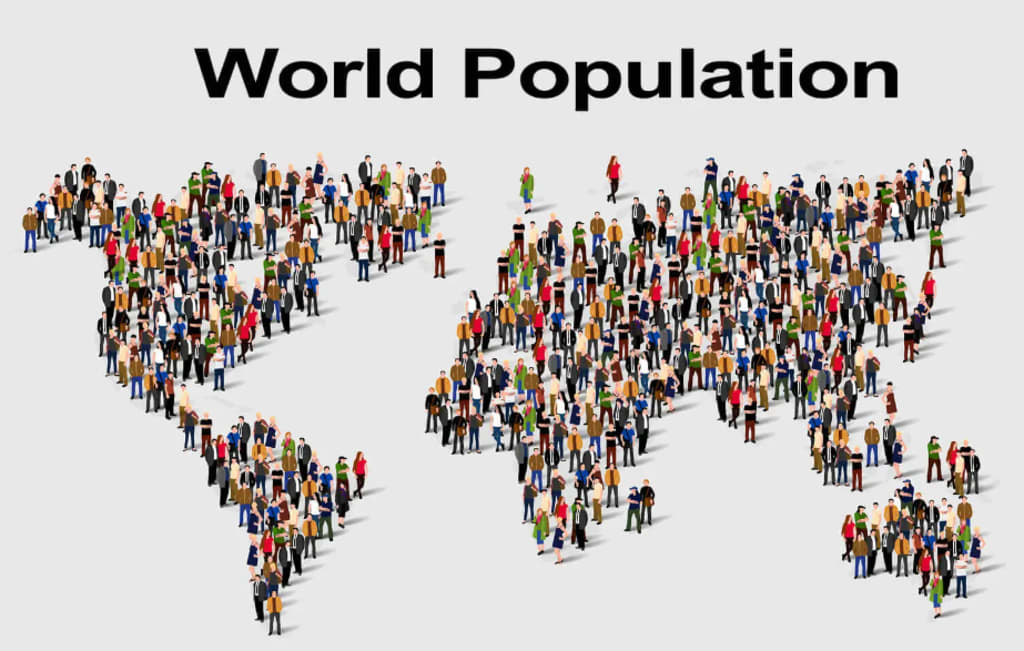
The world population is the total number of humans inhabiting the Earth at a given time. As of 2021, the estimated global population was approximately 7.9 billion people. The population has been growing at an exponential rate, increasing from around 1 billion in 1800 to over 7 billion in 2011. The world's population is expected to continue to grow, although at a slower rate than in the past, reaching an estimated 9.7 billion by 2050.
Population growth is determined by a number of factors, including fertility rates, mortality rates, migration patterns, and government policies. In many parts of the world, fertility rates have been declining due to factors such as improved access to contraception and increased education for women. However, in some regions, such as sub-Saharan Africa, fertility rates remain high, leading to rapid population growth.
Mortality rates have also declined globally, due in part to improvements in healthcare and sanitation. This has led to an increase in life expectancy, with the global average rising from around 30 years in the early 1900s to over 70 years today. However, some regions still experience high mortality rates due to factors such as poverty, disease, and conflict.
Migration patterns also play a role in population growth. People move from one region to another for a variety of reasons, including economic opportunities, political instability, and climate change. In recent years, the number of people displaced by conflict and persecution has increased significantly, with an estimated 82.4 million people forcibly displaced at the end of 2020.
Government policies can also impact population growth. Some countries have implemented policies to encourage or discourage population growth, such as China's one-child policy, which was in place from 1979 to 2015. Other countries have policies aimed at increasing immigration to offset low birth rates and an aging population.
The world's population is not evenly distributed, with some regions experiencing much higher population densities than others. Asia is the most populous continent, with over 4.6 billion people, followed by Africa with over 1.3 billion people. Europe, North America, South America, and Oceania each have populations of around 500 million or less.
Within countries, population density can also vary significantly. Urban areas tend to have higher population densities than rural areas, with cities such as Tokyo, Delhi, and Shanghai having populations of over 20 million people. This concentration of people in urban areas can lead to issues such as overcrowding, traffic congestion, and pollution.
Population growth has significant implications for society, the environment, and the economy. As the world's population continues to grow, there will be increasing demand for food, water, energy, and other resources. This can lead to environmental degradation, depletion of natural resources, and increased competition for scarce resources.
Population growth can also impact social and political stability. In regions with high population growth rates, there may be greater competition for jobs, housing, and other resources, leading to social unrest and political instability. In addition, population growth can exacerbate issues such as poverty, inequality, and gender disparities.
To address these challenges, there have been efforts to promote sustainable development and to address the root causes of population growth. These efforts include increasing access to education and healthcare, promoting gender equality, and implementing policies to reduce fertility rates. There have also been efforts to promote sustainable resource use and to reduce greenhouse gas emissions to mitigate the impact of population growth on the environment.
In conclusion, the world's population is a complex and dynamic phenomenon, influenced by a range of factors including fertility rates, mortality rates, migration patterns, and government policies. As the population continues to grow, there will be increasing challenges related to resource use, environmental degradation, and social and political stability.
About the Creator
Keep reading
More stories from James Peter and writers in Earth and other communities.
Solar Power
Introduction: Solar power is a type of renewable energy that is generated by harnessing the energy of the sun. It is one of the cleanest and most sustainable forms of energy available, and has the potential to play a significant role in meeting the world's energy needs while reducing our reliance on fossil fuels.
By James Peter3 years ago in Earth
Half of World’s CO2 Emissions Come From Just 32 Fossil Fuel Firms, Study Shows
A groundbreaking new study has revealed that 32 fossil fuel companies are responsible for half of global carbon dioxide emissions since the industrial era began. The findings highlight the outsized influence of major oil, gas, and coal producers on climate change, and raise urgent questions about accountability, regulation, and the transition to cleaner energy.
By Aarif Lashari2 days ago in Earth
Plans Lodged for Assembly Rooms Replacement
Plans have been officially lodged for the replacement of the iconic Assembly Rooms, marking a major step in the transformation of one of the city’s most cherished cultural and social landmarks. The move aims to preserve the legacy of the site while creating a modern, versatile venue capable of hosting contemporary events, conferences, and community gatherings.
By Aarif Lashari3 days ago in Earth


Comments
There are no comments for this story
Be the first to respond and start the conversation.