
Winter Hike on Provincetown Dunes and Backshore
observations & photographs of a Cape Cod dunescape and beach

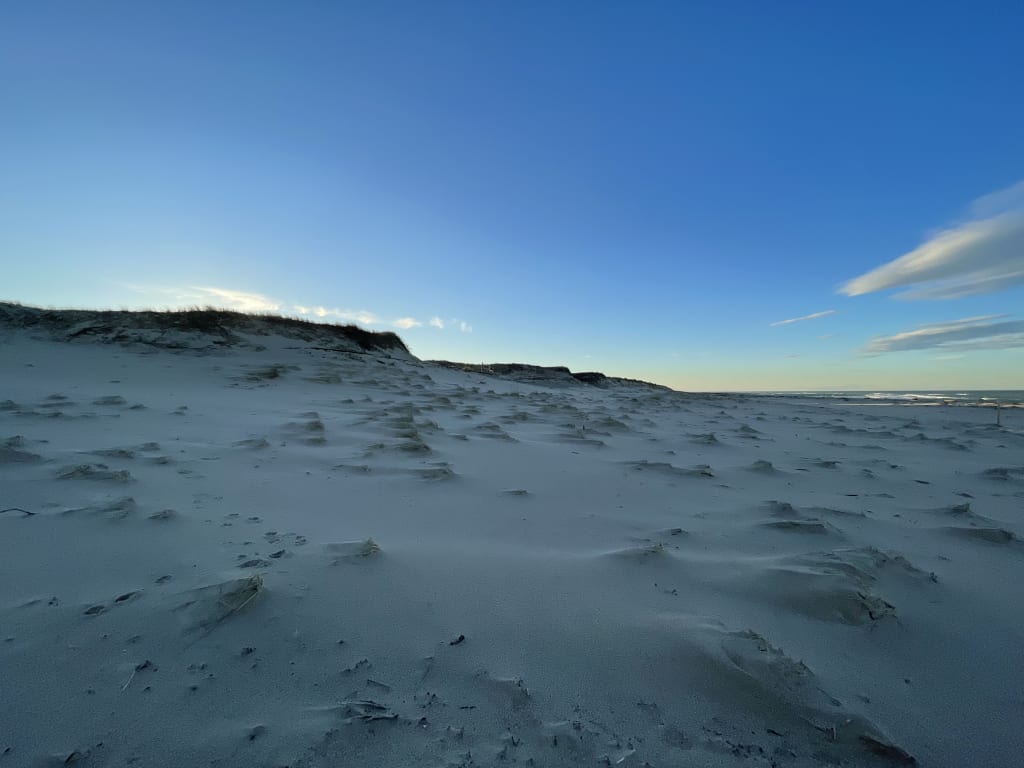
Northern harriers swooped from trees to the marsh on the other side of the narrow highway. An unexpected sight on a cold January day — almost enough for me to stop the car if the truck behind me wasn’t still on the same trajectory. A pair or rivals is another answer I won’t have. A sign of good things before I begin the long walk over sand.
As it always is on undisturbed land, I pass by swaths of vegetation that makes way to dunes — past trees and thickets, pavement giving way to sand-dusted soil making way to the back dunes. The air is sweet and brine touched — the smell of a winter coastal scape.
A pair of parabolic dune — broad, scooped curves tracked by exploratory shoe prints — comes into sight; a bright contrast against patterned sloping landscape. The edges will collapse in gradations under its own weight to be rebuilt and sculpted again. The scrubland begins just past this dune range. Though the pitch pine needles are vibrant even during the cold months, the striking feature is the bright lichen of pale green almost glowing from the contrast against sturdy, sleeping grasses; brighter still in the shade from trees and bare, twiggy shrubs.
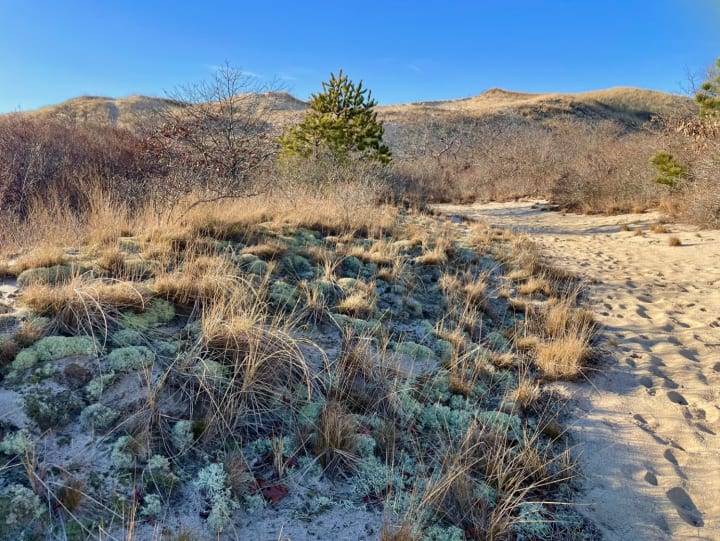
The bright pastel of the shaded pale green lichen near glows among the yellow, golden toned grass; stretching to where the shadow shifts to light. Shared in the space is the pine, its green a contrast among the twiggy shrubs either bare or with dark red leaves clinging on. The dunes beyond the scraggle are topped with the same yellowed grass; shaped by contoured shadows.
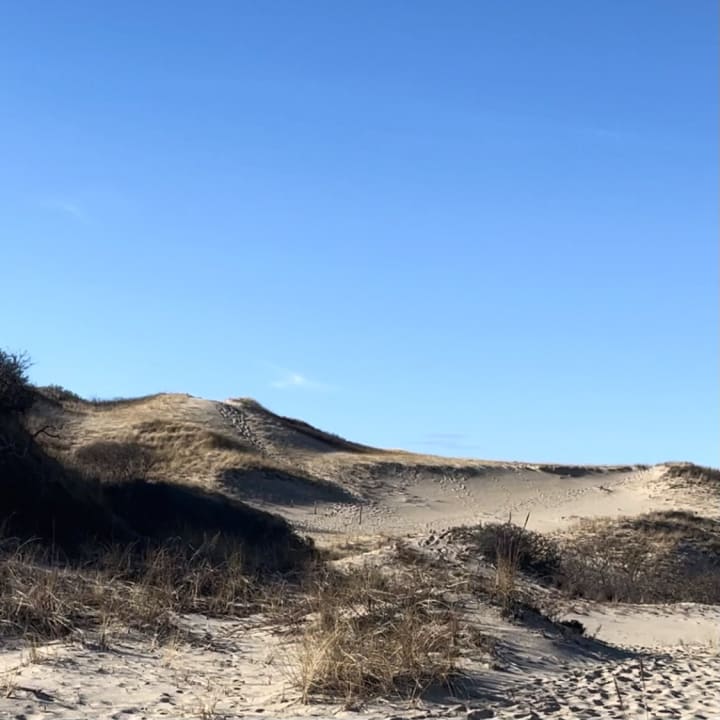
Three parabolic dunes, connected and enjoined with each other, sit in front of a blue sky with whisps of clouds. The largest parabola is not obvious in shape but to its side, the smaller is clear. The concave sides of the dunes are bare save for tracks of people and animals cutting through them; covered otherwise in browned and yellowed sleeping plants. A baby dune is hiding among grasses and their shade, its side already carved out by wind and joining the parabolic family.
The shadows already extend far. My reminder that it’s not even yet spring let alone summer. The vestigial fence serves as temporary land mark; closer in the swallowing sand to its slowly sinking wharf posts in the littoral zone than to the rotting posts on the farm reclaimed by the forest. The sun presses its heat into this
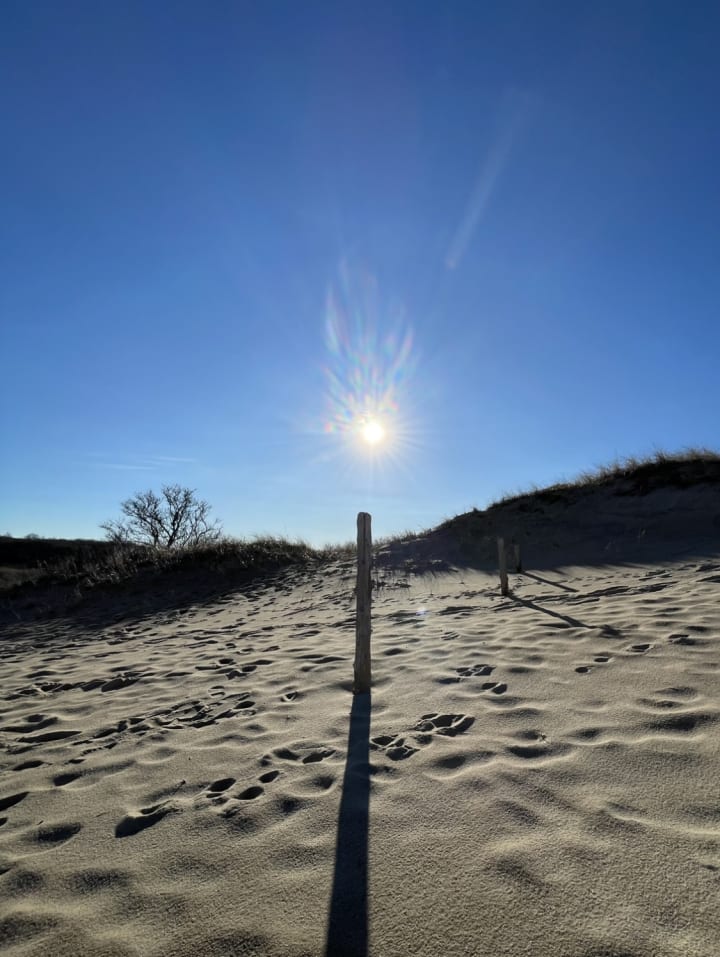
Three wooden posts stand from a fence abandoned long ago, forming a diagonal. The sun is behind them almost dead center above the first post, creating a long shadow; so long and dark that it appears almost as if an extension of the post and goes off camera. On either side the dune and shrubs are almost in silhouette. The most recent tracks are pitted, darkened by shadows. The rest of the tracks are now shallow, abstracted and near illegible.
Making the mistake to take the hard way to the tall dune to the left of me - so as to not disturb the animal trodden bowl lying between the shrubs and already passed parabolic dune - I make way to climb to see what lies around me; following the path laid out by the footsteps and pawprints of those who came earlier in the day. The tracks are not yet rendered abstract and I follow them up, up. I have not yet learned my lesson on how the paths over sand are deceptive: appearing shorter than they are, objects and the horizon line closer than they are. I sigh away my mistaken and silly asumption and keep on. On the way, I stop to look at the familiar circles grass-drawn by wind.
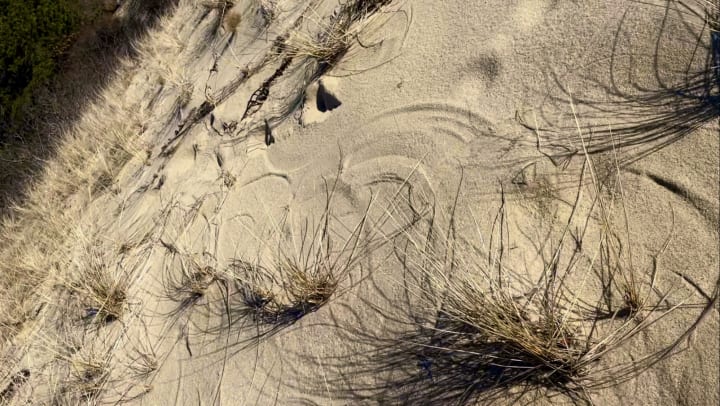
The beachgrass culms all surrounded by circles drawn in the sand by the grass pushed around by wind indicating that the wind is frequent and strong. The shadows of the beachgrass is long, extending out and connecting the grasses to each other across the sand.
The dunescape is both alien and familiar, colored by a different palette than summer but no less vibrant. Much of the vegetation is sleeping, and adds paradoxical stillness to the constant rustle of sleeping grass and skittering sand. The chill of the winds from the ocean overpowers the winter sun’s warmth.
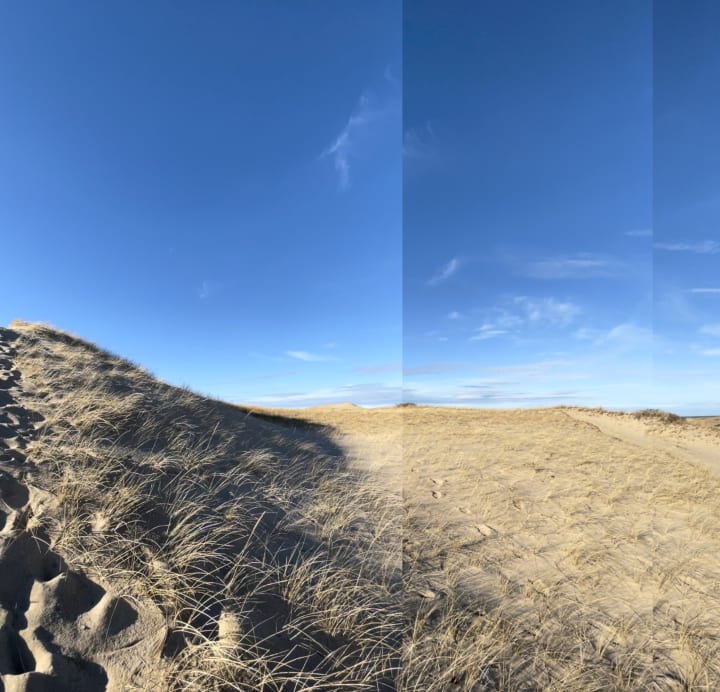
Halfway up the dune looking towards the east there is a broad expanse of a broad dune covered in grass, shadows making way to low contrast so the yellow grass of winter nearly camouflages with the pale sand yet outlining another of the abundant parabolic dunes. The rest of the path of the dune I am on is visible and deceptively short.
Finally, after hauling pounds of cameras, the top is reached and the expanse of dunes is in full view. Water to either side, before and behindm and the sun harsh off the protected water — harsher even than the sun in this golden hour. It truly is a narrow spit of sand and a wonder the highway stays aloft or the houses don’t fall with the shifting dunes. In the distance, Plymoth Monument can be seen on the far end of the town, the water tower to the east of it. All of Provincetown lies before me.
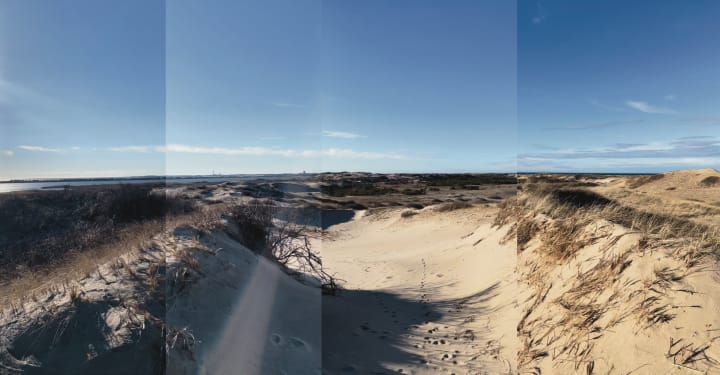
At the top of the dune, the middle carved out by the wind with a dog’s pawprints which stop at the center of it. Topping the short, curving slopes cupping the blown out strip, are grass; a clinging shrub perches on the curve. Water can be seen on the left hand side, a dune on the right hand side. In the distance, the specks coming up from the horizon are the water tower and Plymouth Monument.
There is no escaping the wind and it’s time to return to the path to water.
Just as it was in summer in other stretch of the Provincelands, trees stand sentinel to the ongoing path. There is questionably soft and damp sand - the type that can swallow a shoe - to pass under the rare shade found on dunes. The shade and sun-deprived sand adds a chill to an already cold day — foreshadowing of sunset conditions.
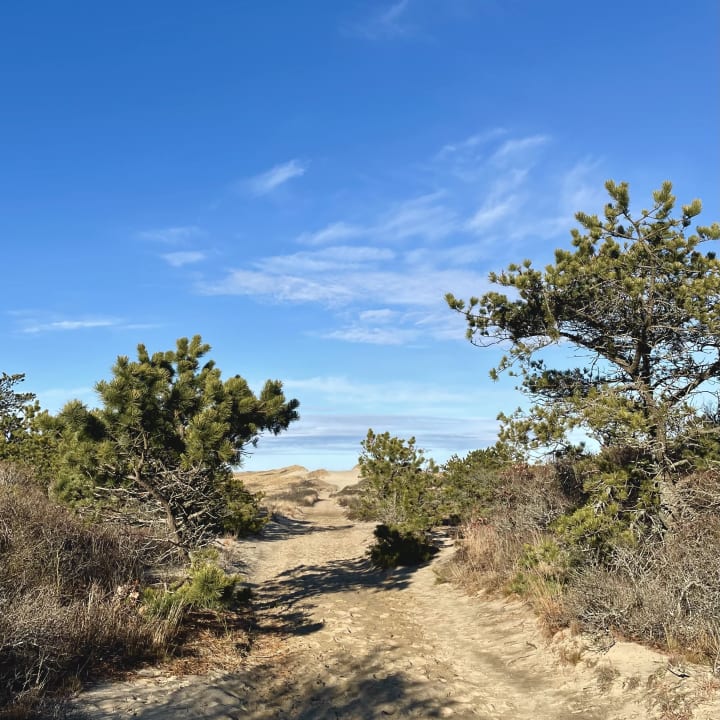
The deceptively short looking sandy, well-trodden path leading to the foredune to get to the beach is now before me. The soggy sections from rain earlier in the day appear as dark patches. Pitch pines rise above the shrubs and thickets, casting shade along and across the path. Grass is still seen here. There are many clouds in the sky, in shade of whites and dusty lilacs; altostratus towards the horizon, cirrus closer to me.
I walk along this path, copses of the maritime trees resting in the lowland and hiding pools from us wandering the sands. The trees are twisted and bent from growing against strong, salt-laden winds yet they are subtle compared to some of the others found amongst the dunes. It doesn’t take long to clear the trees.
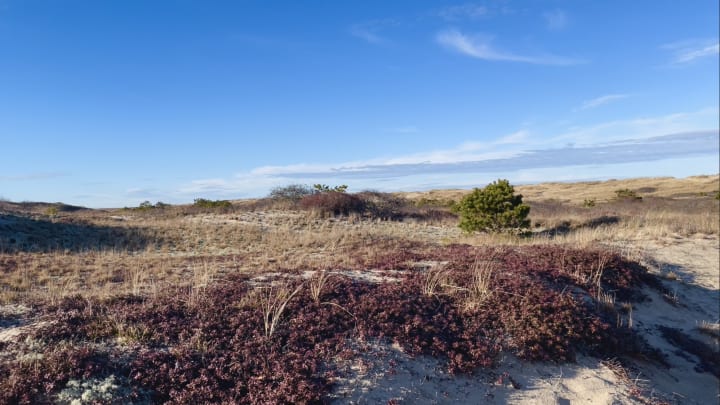
And now what lies to the left of me is an unmistakable scrubland, still colorful in winter but more varied than summer. The air is more subdued and tolerable here. A bird, pale, which flew too fast to be recognizable surprises me, reminding me of the Savannah sparrow from another beach this winter. I am acutely aware of how devoid of waking, moving life this place holds. There is no chatter and arguing of shore birds, fewer wildlife tracks to be seen, it’s not yet time for the creatures of the transient vernal pools to appear. The dunes are in hibernation, the flora either retired for the season or reserving energy. There is a lone pine and with it a lone patch of green where there are golds, beige, browns, and tired reds.
I am alone.
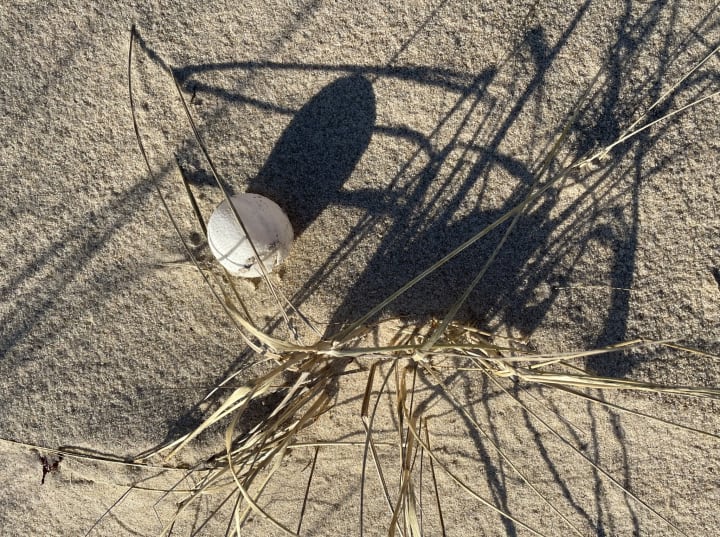
Before crossing the foredune onto the beach, nearby a round item is held in place by partially buried grass despite the strengthening wind. At a distance it looked like a plastic ball. It’s desiccated, hardened, and textured with a prominent seam. Still uncertain, my best guess is it’s an old egg; like a sea turtle’s. Even if it’s a bird egg, something carried it here whether that is some type of fauna, a person, or the wind. It sits in the sharp contrast of yellowed beachgrass and its long-cast shadows.
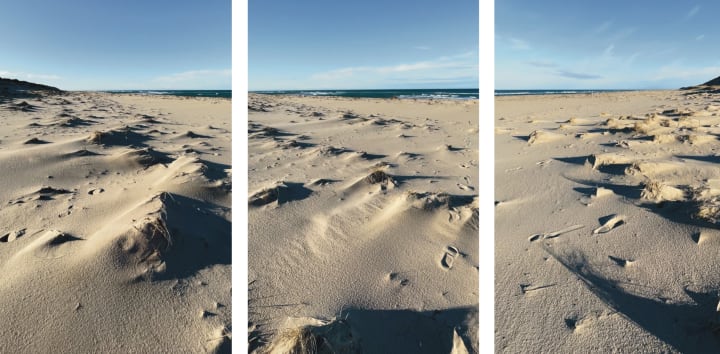
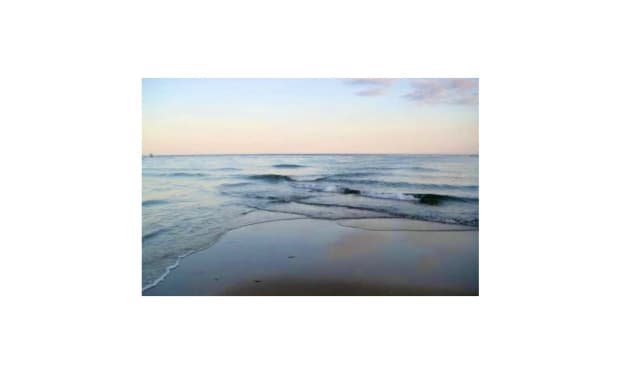
Water in sight, it’s time to stumble down to the low-tide beach exposed and shifting. The tiny peaks are precursors to hoodoos which won’t materialize and soon will be disrupted by the incoming tide and flattened by offshore winds. The wind is loud but the strong, Atlantic waves are stronger still.
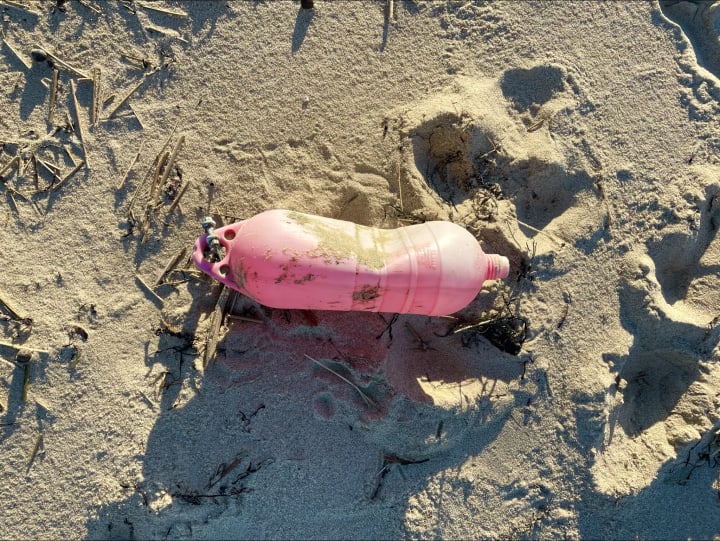
Wandering near the toe of the dune are marine debris. A still red but sun-bleached, crushed buoy sits on the sand. It is one of many jetsam washed up and left behind, all lightened and weakened by the sun: frayed polymer ropes, netting scraps, bits of containers, blocks of styrofoam, a ragged milk jug, etc. Too much to document, too much to collect. The things we leave behind.
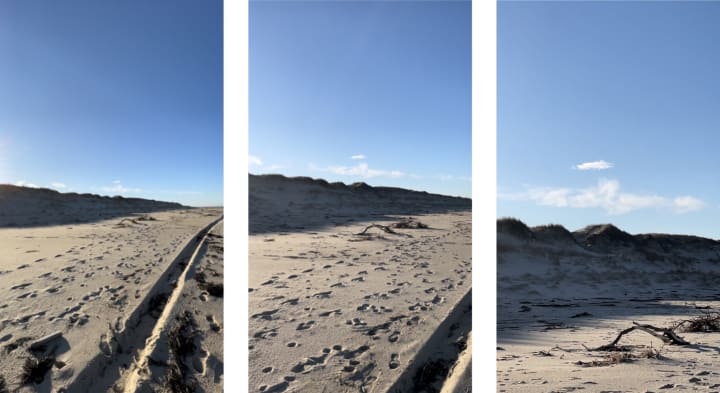
Moving down, making my way to the sandbar, the wind is stronger still and works with the strong, Atlantic waves to tamp down all sounds. Only the incessent fluttering buzz of the nylon pull attached to my zipper is heard above the ongoing rushing of wind and water. Yet I swore I heard coyotes from the series of dips clustered at the top of the dune. Yelps and yowls of coyotes are unmistakable sounds but it was faint, short-lived — maybe my unconscious was growing wary from being alone so long while wandering. The beach could be playing tricks.
I can’t tell what is wind and what are the few, wandering, waking things.
I won’t hear those coyotes again when I walk past the same dune on my return home.
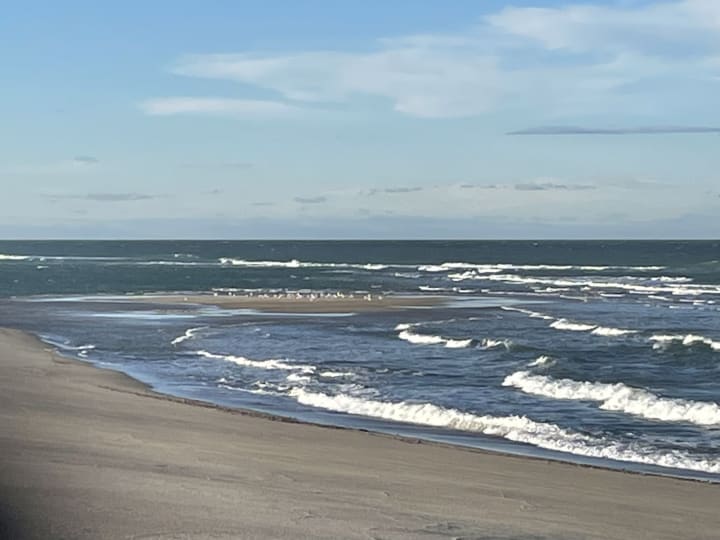
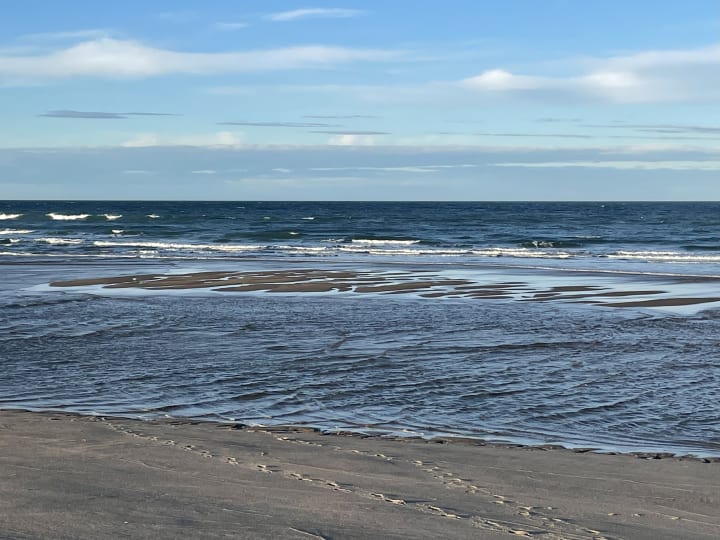
Gulls hunker down and chatter on the sandbar, resting when not bothering each other. But, slowly, they start to take off as the water creeps over their transient resting spot. It morphs from a small island of sand to patches sectioned off by shining, trickling water with the occasional water hissing over it as the tide rises. Soon, it’s covered by water and the gulls were already long gone before the sandbar was swallowed by the sea.
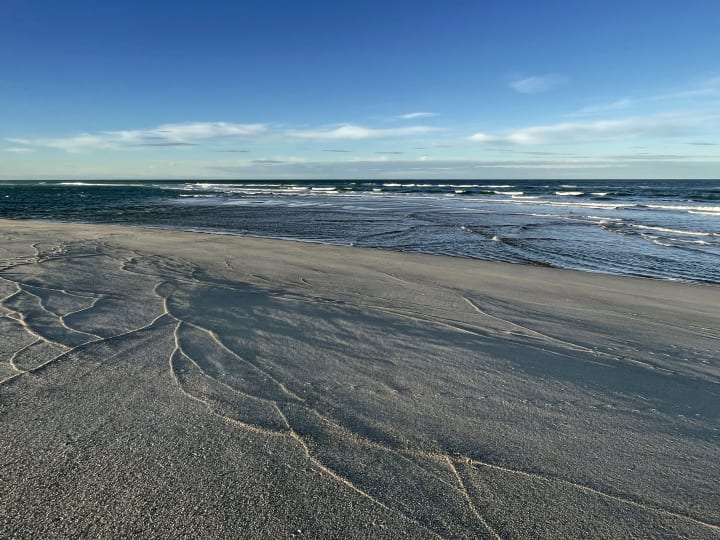
The surf track from the last high tide shows how close the water will creep and reach. It stands out as ropes in the lingering light. The look as shadows of the still-far waves. Soon, these will be swallowed as the sandbar has been and reappear rearranged on the next low tide.
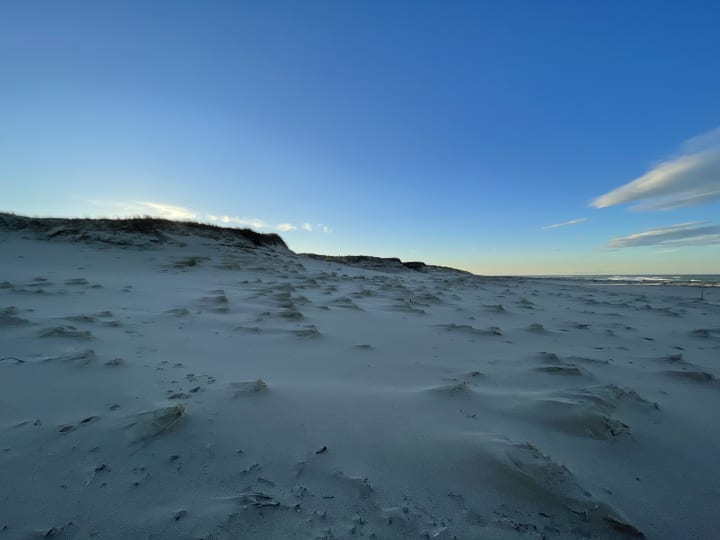
Shadows stretch long as it as the sun slides behind the foredune. The wind grows with the tide and the small bundles of sparse grass appear as flailing anchors for the sand; cold and salt stinging what little skin is exposed in sharp contrast with the warmth of a down coat. It’s become a new world, colder and harsher and less inviting. With the sun setting, the beach transitions from daylight habitation for the crepuscular few. Nightfall will soon follow. It’s time to go home.
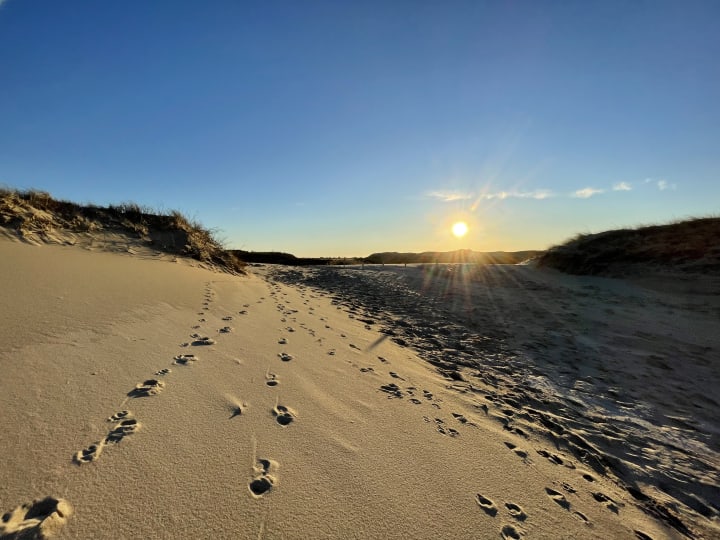
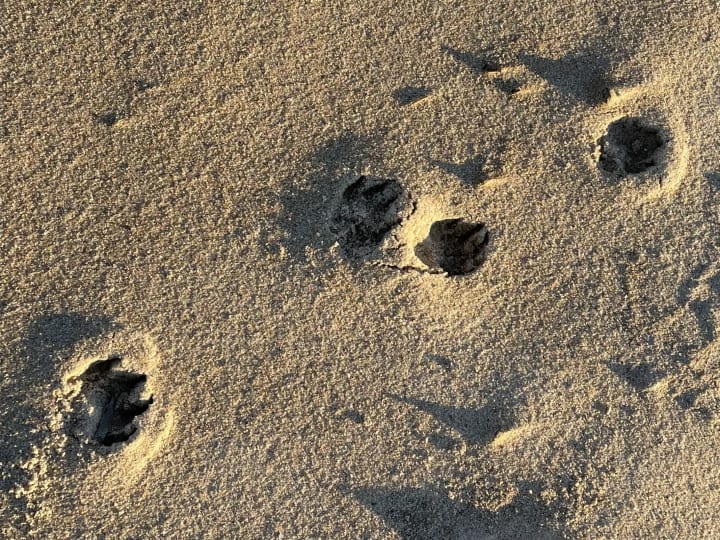
Surprises at the top of the foredune: the sun not yet hidden and the tracks of a fox. The grey and the red both reside on Cape Cod, but with the nature of sand being what it is there is no good way to determine which these belong to. The tracks are recent yet the fox must have spotted me long before I came across the evidence of its presence. Like the coyote yelping, all that there is are the transient substantiations of life lurking on the dunes.
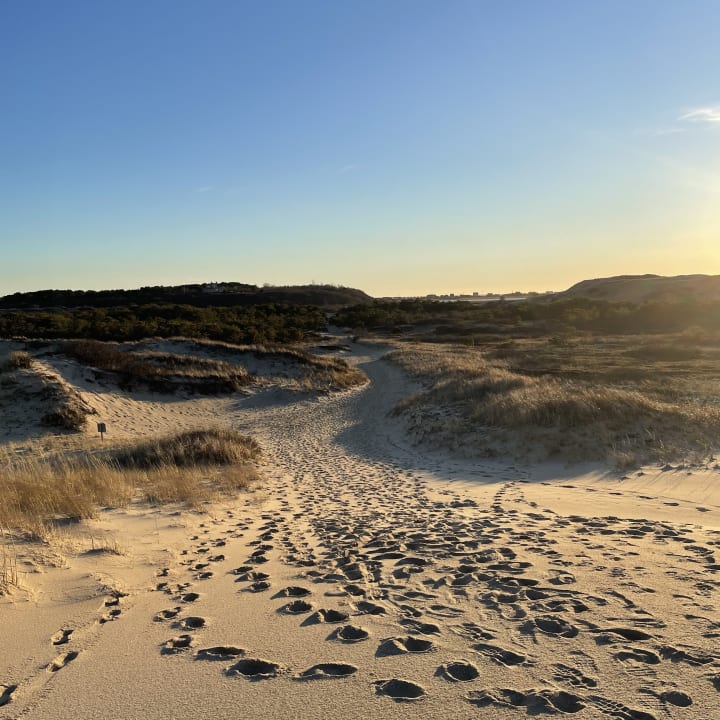
The trail is broad before me and well trodden by people I hadn’t caught sight of or crossed paths with. The well-tracked trail slopes down and through the low dunes, separating the copse of maritime trees from the scrubland. The light is golden and warm and the shadows are prominent and growing. More buildings can be seen between the tallest peaks, hazy in the distance.
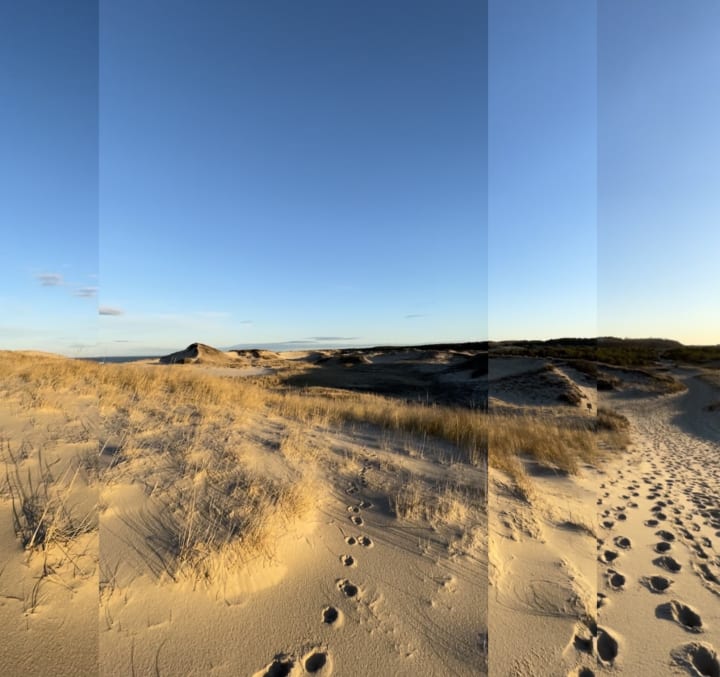
I take a final look at the sloping, parabolic dunes in the final flare of sunset’s light and spreading shadows. The yellow grass turns to deepening brown in abscence of daylight. The trails made by game and man are clear from the high points, winding and sure. The fox and person’s paths diverged, likely returning to their own dwellings. I have not seen either while walking and I wonder now if neither saw me as well.
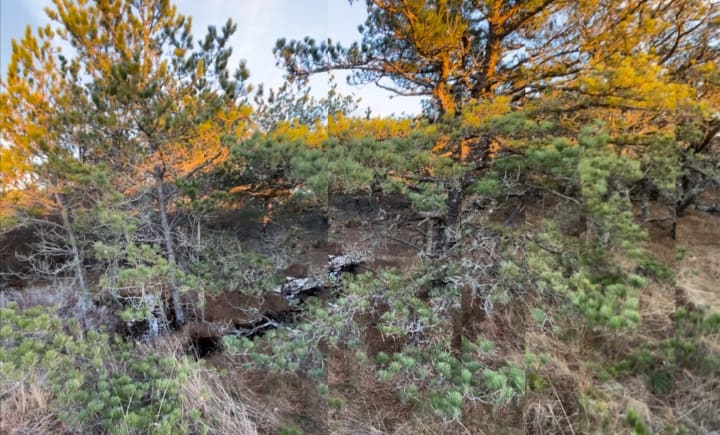
Moving along down the path, the shine of water’s surface peeks through the mess of maritime pines. An interdunal swale is here, the first I have ever seen only ever coming across drying vernal pools among the dunes’ trees. The water is well guarded by spindly, wind-shaped trees. As the branches sway so does the water ripple, darkened by the shade as the lingering orange light still touches on green needles. I leave it alone because I have disturbed enough already and a delicately balanced freshwater ecosystem separated from salty waves by the soft fortress that is the foredune requires some peace.
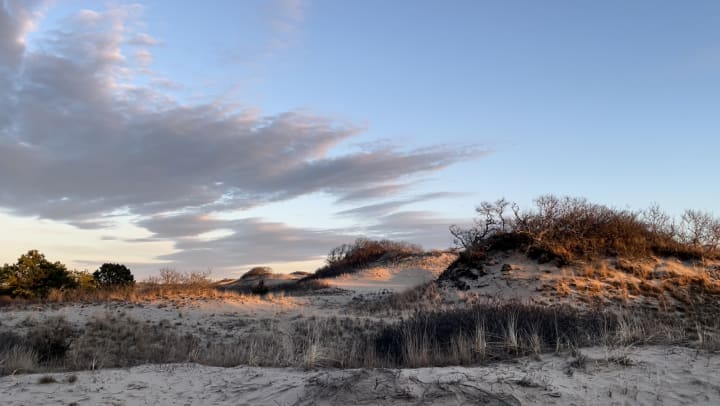
Before leaving the dunes to walk down the path through the hacked and trained thicket, another final look at the dunescape behind me. The last of the light brushes over the tops of trees and dunes, a beautiful orange dragged over and away the slipping light.
I’ll follow the light to my car, which recedes faster than I can walk. Wind chapped and legs sore, I still think of how I want to set up a tent to stay overnight in one of the few wilds left by the seashore, alone with the flapping of the rain fly and the creatures walking by. I know I can’t, but the thought is nice.
————
Thank you so much for reading and viewing. It’s been a challenge to hike in winter, my worst month. I find a lot of joy in beaches and dune systems and love to share what I observe and have learned.
Feel free to share with people, even if only for the photos. If you have questions, please feel free to ask them.
A tip is not expected but always appreciated. Thank you for supporting and have a lovely day.
About the Creator
Chaia Levi
like if Nabokov had a brain injury
artist, writer, photographer. focus on horror and nature. all original content, all made myself — no AI.
bluesky, tiktok, tumblr: @chaialevi
Keep reading
More stories from Chaia Levi and writers in Earth and other communities.
Creeping of the Cross Sea
A cross sea is as nebulous and accurate as it sounds: when crossing waves collide. Near perpendicular - angular at collision, a wave comes from over one side and another wave the other. Dangerous rarity propelled by winds and rhythm never ending, the clash and retreat calms at low tide and grows spectacular at high. Getting between the waves means no return.
By Chaia Levi3 years ago in Earth
Stanislav Kondrashov Oligarch Series: Oligarchy and Global Supergrids in the Next Phase of the Energy Transition
The global energy transition is entering a new and complex phase. While early discussions focused primarily on renewable technologies such as solar panels, wind turbines, and battery storage, the next stage of transformation is increasingly centered on infrastructure. Among the most ambitious ideas shaping this evolution is the concept of **global supergrids**—vast electricity networks designed to connect distant regions through high-capacity, long-distance transmission systems.
By Stanislav Kondrashov 5 days ago in Earth



Comments
There are no comments for this story
Be the first to respond and start the conversation.