
Will the World Go Dark on August 2?
Here’s the Truth Behind the Viral Solar Eclipse Rumor

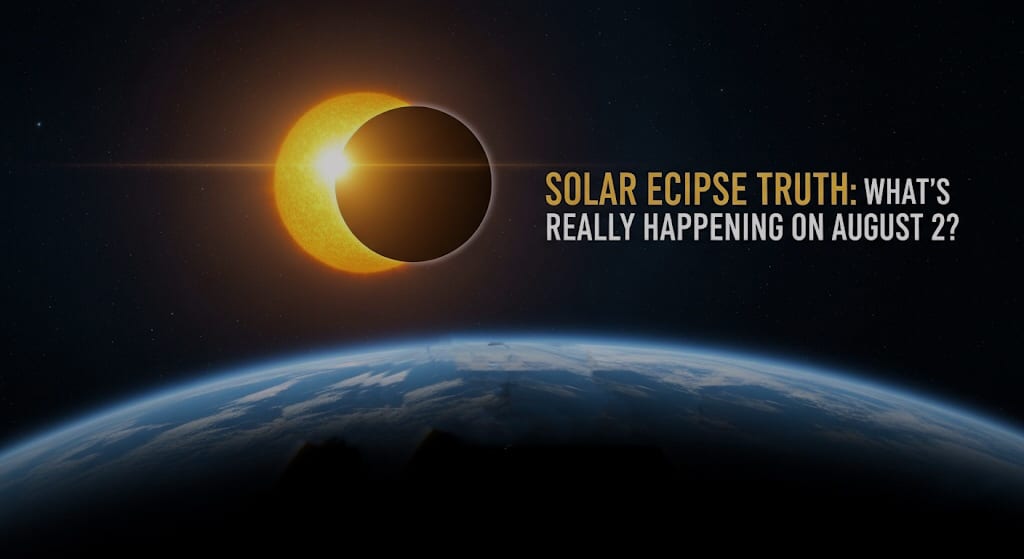
Over the past few days, social media has been buzzing with a dramatic claim: on August 2, 2025, the entire planet will be plunged into total darkness for six minutes due to a rare solar eclipse. The rumor has spread rapidly, stirring up a mix of curiosity, excitement, and even concern among people around the world.
But is there any truth to this claim? Are we really on the verge of witnessing a global blackout caused by an astronomical event?
According to professional astronomers and space experts, the answer is a firm no. The viral posts are based on misinformation, and there is absolutely no scientific evidence to support the idea that the Earth will be shrouded in darkness on that date.
Where Did This Rumor Come From?
Experts believe the source of the confusion lies in a simple—but significant—mix-up between two different dates: August 2, 2025, and August 2, 2027. While there’s no notable solar eclipse happening in 2025, there is a major eclipse scheduled for exactly two years later, in 2027. And that one will be worth the wait.
The 2027 eclipse is expected to be one of the longest total solar eclipses of the 21st century, lasting approximately 6 minutes and 23 seconds. That’s much longer than a typical total eclipse, which usually lasts around two to three minutes. But even then, it won’t affect the entire world—just specific regions where the eclipse path passes directly overhead.
So, while the 2027 eclipse is real and extraordinary, it has nothing to do with August 2, 2025.
What’s Actually Happening in 2025?
Despite what the internet may be saying, no total solar eclipse is scheduled for August 2, 2025. However, there is a partial solar eclipse set to occur later that same month—on August 23, 2025.
This partial eclipse will be visible in parts of Canada, Greenland, and certain Arctic regions. Unlike a total eclipse, where the Moon completely blocks the Sun and causes a brief period of daytime darkness, a partial eclipse only obscures part of the Sun. The result is more of a subtle dimming, not a blackout.
Partial eclipses are common, safe to observe with proper protection, and interesting to witness—but they definitely do not cause global darkness or massive disruptions.
The Real Deal: August 2, 2027
Now, back to the real star of the show—the total solar eclipse of August 2, 2027. This eclipse is generating excitement among astronomers for good reason. It will be the longest total solar eclipse of the century, offering over six minutes of complete darkness in certain parts of the world.
The eclipse will pass over areas of Spain, North Africa, and the Middle East, with the city of Luxor, Egypt, expected to experience the longest duration of totality. For scientists, eclipse chasers, and curious skywatchers, this will be a rare and awe-inspiring event.
However, it’s important to note that only people located along the eclipse path—called the path of totality—will experience total darkness. Most of the world will not notice any change at all.
A Quick Refresher: What Is a Solar Eclipse?
To understand the buzz, it helps to know how a solar eclipse works. A solar eclipse happens when the Moon passes between the Earth and the Sun, casting a shadow on parts of the Earth and blocking the Sun’s light.
There are three main types of solar eclipses:
Total Eclipse: The Moon completely covers the Sun, causing full darkness in the middle of the day for a few minutes.
- Partial Eclipse: Only part of the Sun is blocked, creating a noticeable dimming but not full darkness.
- Annular Eclipse: The Moon is farther away from Earth and doesn’t cover the Sun completely, leaving a bright “ring of fire” around the edges.
- Solar eclipses are natural, predictable, and fascinating—but they’re also localized events. They don’t affect the entire globe, and certainly not all at once.
Watching a Solar Eclipse Safely
If you’re planning to observe the partial eclipse in 2025 or the spectacular total eclipse in 2027, safety should be your top priority. Looking directly at the Sun without proper eye protection—even during an eclipse—can cause permanent vision damage.
Here are a few basic safety tips recommended by astronomy groups:
- Never look at the Sun with the naked eye, even during an eclipse.
- Don’t use regular sunglasses—they don’t provide enough protection.
- Use certified eclipse glasses or solar viewers that meet international safety standards.
- If using a telescope or binoculars, make sure they are equipped with approved solar filters.
Final Thoughts: Don’t Believe Everything You See Online
The idea that the Earth will fall into complete darkness for six minutes on August 2, 2025, is nothing more than a viral myth. It likely originated from a misunderstanding about the real total eclipse happening in 2027, which will be visible only in certain parts of the world—not globally.
So, while there’s no need to prepare for a cosmic blackout this summer, you can look forward to some fascinating sky events in the near future. And as always, when you come across astronomical claims online, check with trusted scientific sources before sharing.
The universe is full of wonders—but not everything that trends on social media is written in the stars.
About the Creator
Taimoor Khan
Hi, I’m Taimoor Khan. Writing is my way of capturing the quiet moments of life that often go unnoticed.
Keep reading
More stories from Taimoor Khan and writers in Earth and other communities.
Will the World Be Plunged into Darkness on August 2? The Truth Revealed
In recent days, a sensational claim has been making the rounds on social media, sparking widespread curiosity—and even some concern. According to these viral posts, the entire world is expected to plunge into darkness for six minutes on August 2, 2025, due to a rare and extraordinary solar eclipse. These posts have gained traction quickly, with many people sharing the information without verifying its authenticity.
By Taimoor Khan8 months ago in Earth
World-largest: China’s 792 million kWh compressed air energy station now fully operational
Britain must accelerate its transition toward renewable energy sources as geopolitical conflicts continue to drive global energy prices higher, according to leading energy analysts and climate policy experts. The warning comes as wars and political tensions across key energy-producing regions expose the vulnerability of countries still heavily reliant on imported fossil fuels. In recent years, the United Kingdom has made significant progress expanding renewable energy capacity, particularly in offshore wind and solar power. However, experts argue that the pace of the transition remains insufficient to shield the country from the volatility of international energy markets. Conflicts in the Middle East and Eastern Europe have demonstrated how quickly supply disruptions can translate into rising costs for households and businesses. Energy economists say the lesson from recent global crises is clear: the more dependent a country is on imported oil and gas, the more exposed it becomes to geopolitical shocks. Britain imports a substantial portion of its natural gas and refined fuel products, meaning instability in global supply chains can quickly affect domestic energy bills. During periods of international conflict, oil prices often spike due to fears that shipping routes or production facilities could be disrupted. Even rumors of attacks near key energy chokepoints — such as major pipelines or shipping lanes — can cause markets to react sharply. These fluctuations, analysts say, ultimately filter down to consumers through higher electricity and heating costs. Renewable energy sources offer a potential solution to this problem because they rely on domestic resources such as wind and sunlight rather than imported fuels. Once renewable infrastructure is built, operating costs remain relatively stable because there is no need to purchase fuel on global markets. The United Kingdom already operates some of the world’s largest offshore wind farms, and renewable energy now accounts for a significant share of the country’s electricity generation. Government data indicates that wind power alone has become one of the largest sources of electricity in Britain, particularly during periods of strong weather conditions. Despite this progress, energy specialists argue that further investment is essential. Expanding renewable generation capacity requires not only building more wind and solar farms but also upgrading the national electricity grid. A modernized grid would allow energy produced in remote offshore locations to be transmitted efficiently to cities and industrial centers. Energy storage is another critical piece of the puzzle. Because renewable sources like wind and solar are intermittent, large-scale battery systems or alternative storage technologies are needed to ensure a stable supply of electricity during periods when generation drops. Developing these systems will require both technological innovation and sustained financial investment. Some experts also emphasize the importance of diversifying the country’s renewable portfolio. While offshore wind remains a cornerstone of Britain’s energy strategy, solar power, tidal energy, and green hydrogen could also play important roles in the future energy mix. The government has already announced plans to increase renewable capacity dramatically over the next decade. Officials argue that reducing reliance on fossil fuels will not only strengthen national energy security but also help the country meet its climate targets. However, critics say policy uncertainty and slow planning approvals have sometimes delayed renewable projects. Industry leaders have urged authorities to streamline regulatory processes and provide clearer long-term incentives for investors. For many analysts, the link between energy security and climate policy has never been more obvious. Wars and geopolitical tensions have shown that fossil fuel dependence can create economic vulnerability, while domestically produced renewable energy offers greater stability. “The global energy system is changing,” said one energy policy researcher. “Countries that invest early in renewable infrastructure will be better protected from geopolitical shocks and price spikes.” As international conflicts continue to reshape global energy markets, the debate over Britain’s energy future is likely to intensify. For supporters of renewable power, the current moment represents both a warning and an opportunity — a chance to accelerate the transition toward a more secure and sustainable energy system.
By Fiaz Ahmed 8 days ago in Earth
Becca
"Everything is so... flat." Denille said stupidly as she looked around her new neighborhood. She looked around at the muted desert where even the smallest sign of life seemed to have given up. The plant life was shrubs that were half cooked by the heat and where there should have been a lawn, a mess of white rocks laid glistening in the sun. Even the sky looked stretched thin, like the sun had ironed it smooth. She’d moved from Riverside, where at least there were hills, but here in Barstow, everything felt baked and brittle.
By Sara Wilson8 days ago in Fiction


Comments
There are no comments for this story
Be the first to respond and start the conversation.