

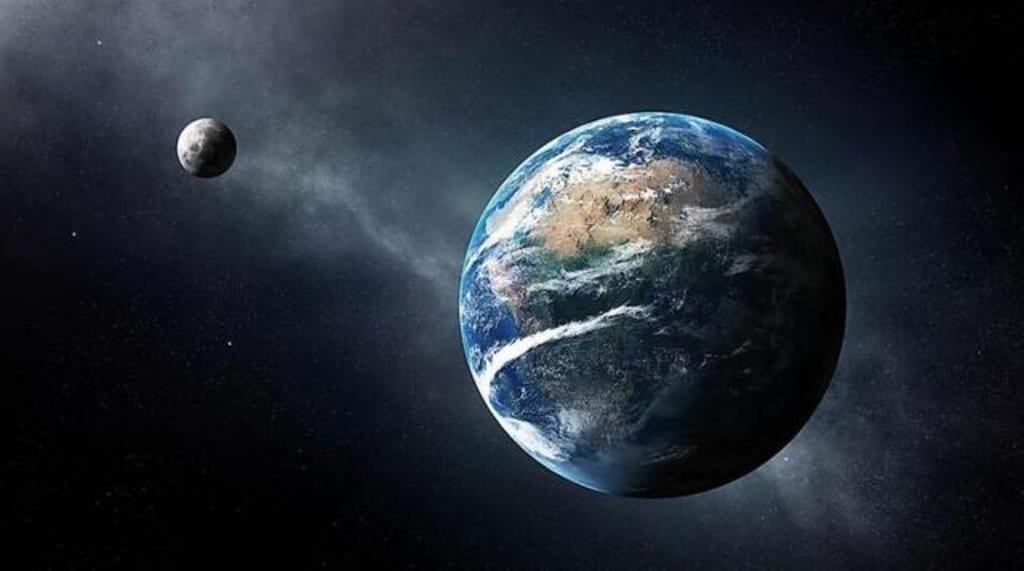
According to our knowledge of known life, liquid water is an essential substance for life, in other words, if there is liquid water on a planet, there is a possibility of life, and that is why scientists always consider liquid water as the first condition when assessing the possibility of life on a planet.
The stars in the universe are "big balls of fire" that are always releasing a lot of light and heat into this space. So near a star, there is always a region that is neither too cold nor too hot, just enough to allow liquid water to exist, and this region is called the "habitable zone.
One of the reasons why Earth is such a vibrant planet is that it is located in the habitable zone of our solar system. But it is puzzling that the Moon, which is only about 380,000 km away from Earth on average, is also located in the habitable zone of the solar system, but there is no life on the Moon, and it is dead.
Why is the Moon dead while the Earth is alive and well, also in the habitable zone of the solar system? One simple answer is that there is no liquid water on the moon. Well, we just said that liquid water can exist in the habitable zone, so why does it not apply to the Moon? AcThiss is explainable.
As we can see from the three-phase diagram of water, the temperature is only one of the conditions to keep water in a quid state, and another condition is pressure.
On Earth, this pressure is provided by the atmosphere, and the atmosphere, in addition to providing pressure, also plays a role in stabilizing and regulating the temperature of the Earth's surface, which makes the vast majority of the Earth's surface can allow the existence of liquid water. As we all know, the moon does not have an atmosphere to speak of, so of course w, it cannot exist on the moon in liquid form.
It is important to note that there is water on the Moon, and past data show that there is at least 600 million tons of water ice in the permanently shadowed areas of the Moon's poles, in addition to a small amount of water in the lunar soil, for example, our ChChange sample collection area, the analysis results show that in this area, one ton of lunar soil water content is about 120 grams, and one ton of lunar rock water content is about 180 grams.
Considering the water loss problem, it is not difficult to speculate that in the distant past, there should be much more water on the Moon than now, and if the Moon also had a proper atmosphere at that time, there could be a large amount of liquid water on the Moon, in which case the Moon could become a vibrant planet like the Earth.
InThecientific community did propose such an idea, for example, in 2018, Dirk Schulze-Makuch, an astrobiologist at Washington State University, published a paper in Astrobiology claiming that life could have existed on the moon in the distant past.
In the paper, he states that according to the "grand collision hypothesis," the moon formed when Theia (a primitive planet about the size of Mars) collided with Earth, and that during the formation of the moon, large amounts of superheated gas, including water vapor, were released from the moon's Da large amount of superheated gas, including water vapor, would have been released from the Moon's interior and formed a dense enough atmosphere that, after gradual cooling, the Moon's surface would have formed a massive liquid water collection area, thus giving the Moon the conditions to nurture life.
So the question arises, f life was possible on the Moon in the distant past, why is the Moon dead now? Let's turn our attention to the sun.
While the sun releases light and heat, it also "emits" large streams of high-speed charged particles in all directions, also known as the "solar wind", in the habitable zone of the solar system, the "solar wind In the habitable zone of the solar system, the speed of the "solar wind" can reach more than 400 kilometers per second, in the case of unprotected, a planet's atmosphere will be "blown" away by the "solar wind" continuously.
Fortunately, our Earth has a strong enough magnetic field that it can make the high-speed charged particle flow from the Sun "go around", so that the Earth's atmosphere will not be attacked by the "solar wind".
The reason why the Earth has a strong magnetic field is that the Earth has high-temperature ore because the volume and mass of the Earth are large enough, and the core of the Earth also exists a considerable number of radioactive elements, when these elements decay, it can add heat to the core of the Earth, so the temperature of the Earth's core is not easy to reduce, o that after billions of years, the core of the Earth can still maintain remain hot a
But the Moon is not as lucky as the Earth. In addition to being much smaller than the Earth, it also has very few radioactive elements inside (because, according to the "grand collision hypothesis", the Moon was formed mainly by the Earth, nd A the Moon was formed mainly from the outer layers of the Earth and Theia, and the radioactive elements are concentrated in the core of these two planets), so the temperature of the Moon's core drops very fast (compared to the Earth).
Although the Moon had a hot core at the beginning of its formation, and possibly a strong enough magnetic field as a result, the temperature of the Moon's core continued to drop and its magnetic field weakened over time, according to scientists' estimates, the Moon's core cooled completely about 3.6 billion years ago, which means that the Moon has lost its magnetic field ever since.
As you can imagine, without the protection of the magnetic field, the "solar wind" was able to drive in, so the moon's atmosphere (if there was one) would soon be stripped away, and without the atmosphere, there would be no liquid water on the moon, and life would not be possible, in this case, even if the moon was once a vibrant planet, it would become dead.
About the Creator
Robert Jack
One of the secrets of emotional stability for adults is to keep the expectations of others to a minimum.
Keep reading
More stories from Robert Jack and writers in Earth and other communities.
Our solar system has been invaded by another star
The Milky Way is a huge galaxy with hundreds of billions of stars, and the Sun is only one of them, not a particularly impressive star, which, together with many other stars in the galaxy, is orbiting around the center of the galaxy.
By Robert Jack4 years ago in Earth
San Francisco Food Banks: How Community Support Fights Hunger
San Francisco is a city filled with innovation, opportunity, and diverse communities, yet thousands of residents still struggle to secure enough nutritious food for their families. Rising living costs, fluctuating wages, and ongoing economic pressures make food insecurity a daily reality for many households. Food banks serve as an essential lifeline by providing access to healthy groceries, community resources, and supportive programs.
By Jason Pruet6 days ago in Earth


Comments
There are no comments for this story
Be the first to respond and start the conversation.