
Our solar system has been invaded by another star
Star of Schulz


The Milky Way is a huge galaxy with hundreds of billions of stars, and the Sun is only one of them, not a particularly impressive star, which, together with many other stars in the galaxy, is orbiting around the center of the galaxy.
Even if the probability of the Sun hitting other stars is very low, the strong gravitational force of a star passing near the Sun may affect various objects in the solar system, especially small objects, which may deviate from their original orbits, thus increasing the risk of the Earth being hit by small objects. Significantly higher, for us humans, this is not good news, after all, we all know what happened to the dinosaurs.
So is this possible or not? Our fears are not superfluous, because scientists have found that about 70,000 years ago, the solar system has been invaded by another star.
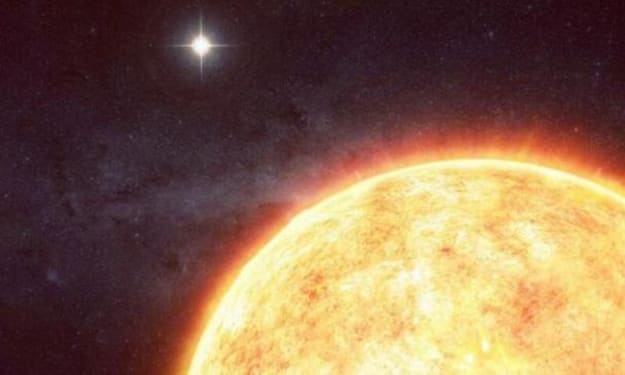
This star, Scholz's Star, is a red dwarf star in the sky, located in the constellation Kirin, about 20 light years away from us, and observations show that this star has a mass of 0.095 (±0.006) times that of the Sun and a radius of about one-tenth that of the Sun, in addition to It has a massive companion star with a mass 0.063 (±0.004) times that of the Sun and is a brown dwarf.
Since all the stars in the Milky Way are in motion and their trajectories cannot be perfectly synchronized with the Sun, most of the stars we observe have more or less certain velocities, in general, the velocities of these stars can be divided into "tangential velocities" and "radial velocities". radial velocities".
We can simply understand that the "tangential velocity" is the velocity of the star concerning us in one of the directions "up, down, left, or right", while the "radial velocity" is the velocity of the star concerning us in one of the directions "up, down, left or right". radial velocity" is the velocity of the star concerning us in one of the directions "near, far".
"An important reason why Schultz's star has caught the attention of scientists is that it appears to us to have almost no "tangential velocity", while it has a relatively fast "radial velocity It has a relatively fast "radial velocity" (about 82.4 km/s) and is oriented away from us, so if we go back in time, then at some point in the past, this star was very close to the Sun.
After discovering the anomaly of Schultz's star, scientists have carefully modeled the star's distance, the direction of motion, velocity, and gravitational field of the galaxy, and after running tens of thousands of simulations, the result is that there is a 98% probability that the star entered the solar system about 70,000 years ago The closest distance to the Sun is about 52,000 astronomical units, which is about 0.82 light years.
According to this simulation, the distance between Schultz's star and the Sun was already less than 1 light year, knowing that the real edge of the solar system is the Oort Nebula, a huge globular nebula with a radius of at least 1 light year, and this means that if this is the case, the solar system will be in the vicinity of the Oort Nebula. This means that if this is the case, this star has invaded our solar system.
However, it is too hasty to say that our solar system was invaded by another star based on computer simulations alone, and more evidence is needed to make this claim more credible.
Scientists speculate that the total mass of Schultz's star and its companion star could reach about 15% of the Sun's mass and that the gravitational force of such a large mass would have a significant effect on small objects orbiting in the outer reaches of the solar system so that 70,000 years later, we can still find some traces.
Based on this idea, scientists began to work on searching for small objects that might have orbital anomalies. Subsequent studies have shown that such small objects do exist in our solar system, and their number is quite high. So far, scientists have found about 400 small objects with exaggerated hyperbolic orbits, which are very different from the elliptical orbits common to small objects in our solar system.
Scientists believe that these small objects undoubtedly provide strong evidence for the above simulation results. It is conceivable that about 70,000 years ago, Schultz's Star invaded the solar system with its companion star and "brushed" the Sun at a distance of less than 1 light year, and under the influence of its gravity, some of the smaller objects that were close to it The orbits of some of the smaller objects close to it have become anomalous.
Fortunately, this event does not seem to have caused any harm to the Earth (otherwise there would probably be no humans on Earth), but we are more concerned about whether our solar system will be invaded by other stars again in the future, but the bad news is that scientists have found a star approaching our solar system.
The star, Gliese 710, is located in the sky in the constellation Serpens, about 62.3 light-years away, with a mass of about 57% of the Sun and a radius of about 58% of the Sun, and analysis based on known observations suggests that it will arrive near our solar system in about 1.4 million years It has an 86% chance of breaking into the solar system's "Otter Nebula".
Of course, we do not have to worry too much about this, after all, there are up to 1.4 million years, after such a long period of development, I believe that human technology has been developed enough, and should be able to solve the threat from the "Gliese 710".
About the Creator
Robert Jack
One of the secrets of emotional stability for adults is to keep the expectations of others to a minimum.
Keep reading
More stories from Robert Jack and writers in Earth and other communities.
Coincidence or another hidden agenda?
The Moon is the closest planet to Earth and the brightest and most easily observable object in the Earth's night sky. Interestingly, because the Moon always faces the same way toward the Earth, for us humans living on Earth, we can always observe only one fixed side of the Moon.
By Robert Jack4 years ago in Earth
Australia Horticulture Market 2026: Climate-Smart Farming, Export Demand & Agri-Tech Innovation
Australia Horticulture Market Overview Australia’s horticulture market plays a crucial role in the country’s agricultural economy, supplying fresh fruits, vegetables, nuts, flowers and nursery products to both domestic and international markets. The sector is widely recognized for high-quality produce, strong biosecurity standards and advanced farming practices. Growing consumer demand for nutritious foods, expanding export opportunities and continuous technological innovation in agriculture are driving sustained development across Australia’s horticulture industry.
By Amyra Singh6 days ago in Earth


Comments
There are no comments for this story
Be the first to respond and start the conversation.