
Why the Deeper the Ocean, the Stranger the Creatures?
Exploring the Mysterious Deep-Sea World

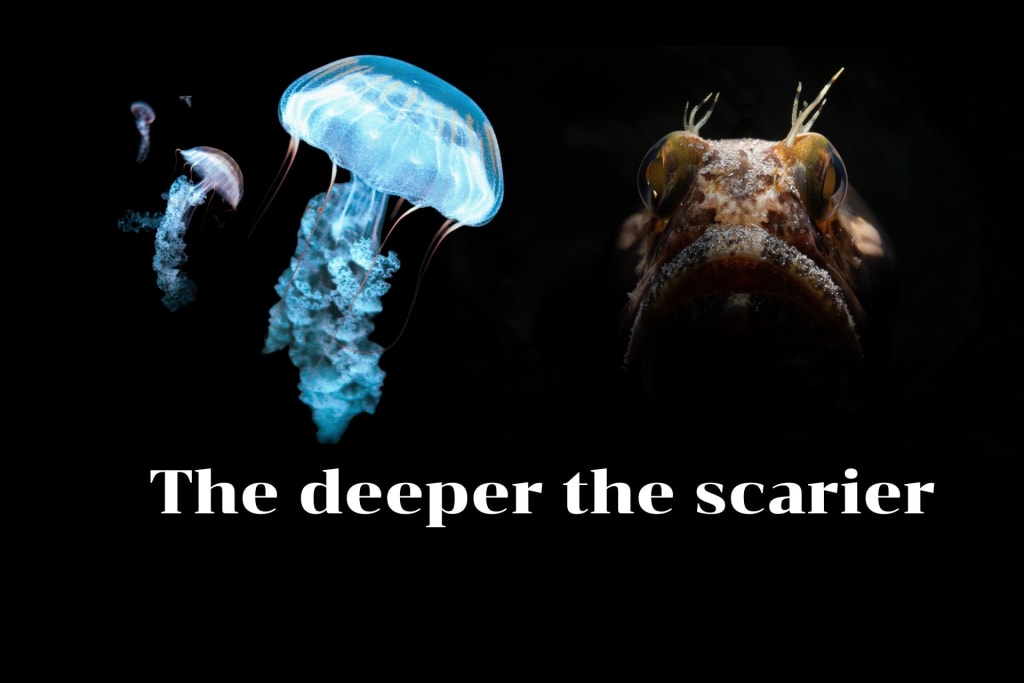
A World Unknown to Humans
The deep sea is one of the most mysterious and unexplored places on Earth. More than 80% of the ocean remains uncharted, making it a world filled with secrets. As we descend into the depths, the environment becomes more extreme light disappears, temperatures drop to near freezing, pressure increases dramatically, and food becomes scarce. To survive in such an inhospitable environment, deep-sea creatures have developed extraordinary adaptations, leading to bizarre shapes, glowing bodies, and unusual hunting strategies.
From terrifying Anglerfish with their bioluminescent lures to the jelly-like Blobfish, which changes shape under different pressures, these animals seem almost alien. But why does the deep sea create such strange life forms? Let's explore the factors that shape the weird and wonderful world of deep-sea creatures.
1. Extreme Pressure: Why Do Deep-Sea Creatures Look So Weird?
At a depth of 1,000 meters (3,280 feet), the water pressure is over 100 times greater than at sea level. At 10,000 meters (32,800 feet), such as in the Mariana Trench, the pressure is more than 1,000 times greater! This crushing force prevents most animals from surviving. However, deep-sea creatures have evolved unique ways to adapt.
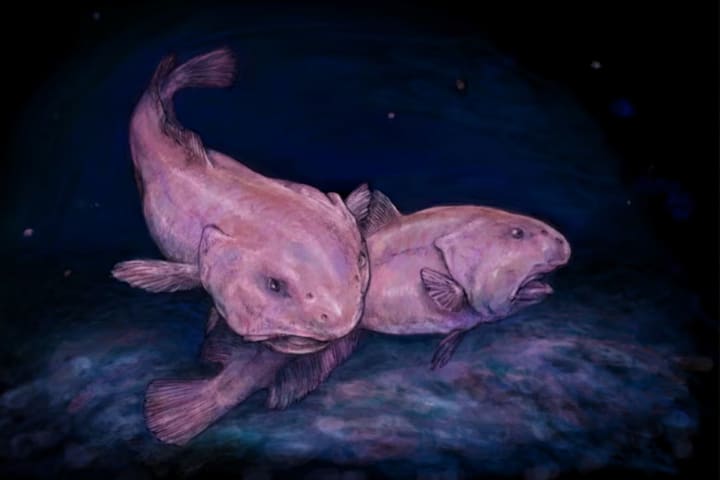
For example, the Blobfish, which lives at depths of around 600–1,200 meters, has a soft, gelatinous body with very little muscle or bone structure. At deep-sea pressures, its body maintains a normal shape, but when brought to the surface, where the pressure is much lower, it becomes a saggy, blob-like mass.
Other deep-sea creatures, like the Dumbo Octopus, have soft bodies that can withstand extreme pressure without breaking. Unlike most octopuses, it does not have an ink sac since there is no need for ink in the total darkness of the deep ocean.
2. Eternal Darkness: Why Do Deep-Sea Creatures Glow?
Below 200 meters, sunlight cannot penetrate, leaving the deep sea in perpetual darkness. To navigate, hunt, and communicate in this environment, many deep-sea creatures have evolved bioluminescence the ability to produce light using special chemical reactions inside their bodies.
One of the most famous examples is the Anglerfish, which uses a glowing lure attached to its head to attract unsuspecting prey. Another stunning example is bioluminescent jellyfish, which emit bright flashes of light to scare away predators or confuse them.
Some species, like Vampire Squid, even produce clouds of glowing mucus to escape from danger. This adaptation is critical for survival in a world where being invisible is not an option.

3. Scarcity of Food: Why Do Deep-Sea Creatures Eat Everything?
With no plants and little food available, deep-sea creatures must be opportunistic feeders. They consume anything they can find, from tiny organic particles known as "marine snow" to massive carcasses of whales that sink to the ocean floor, known as Whale Falls.
Some predators, like the Gulper Eel, have enormous, expandable mouths that allow them to swallow prey much larger than themselves. Their stomachs can also expand to store food for long periods, as meals in the deep sea are unpredictable and infrequent.
Another fascinating example is the Hagfish, which feeds on dead animals by burrowing into their carcasses and secreting slime to deter other scavengers. This gruesome but effective feeding strategy ensures survival in a place where food is scarce.

4. Strange Reproduction: When Males Become Part of Females
Reproducing in the deep sea is extremely challenging because animals are often few and far between. To solve this problem, some species have developed unusual reproductive strategies.
A famous example is the Anglerfish, where the male is much smaller than the female. When a male finds a female, he bites onto her body and fuses with her, eventually losing his eyes, fins, and internal organs until he becomes a permanent part of her body functioning only as a sperm source. This bizarre method ensures that whenever the female is ready to lay eggs, she has a mate available.
Other deep-sea creatures, like deep-sea squids, practice "instant mating" where they store sperm for later use, allowing them to reproduce even if they don’t find another mate for a long time.

5. The Deepest Point: What Lies in the Mariana Trench?
The Mariana Trench, the deepest part of the ocean at nearly 11,000 meters (36,000 feet), is home to some of the most extreme deep-sea creatures. Scientists have discovered strange animals here, such as amphipods that can withstand immense pressure and the Ghostfish, which looks like a transparent jelly-like tadpole.
Even in this hostile environment, life finds a way. Microorganisms living at these depths survive by consuming chemicals released from the Earth's crust. Some scientists believe that studying these organisms could give clues about life on other planets, such as Jupiter’s moon Europa, which has a vast subsurface ocean beneath its icy shell.
The Deep Sea Holds Many Secrets
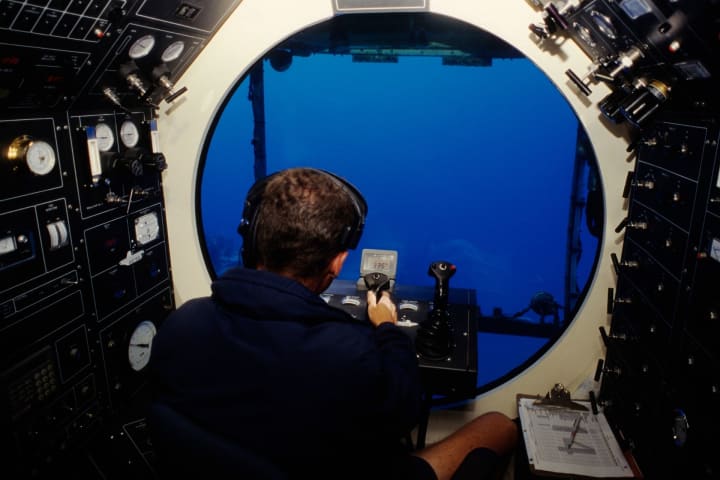
Despite advancements in ocean exploration, the deep sea remains largely unexplored. With every new expedition, scientists uncover more strange and fascinating creatures, proving that the deep ocean is one of the last great frontiers on Earth.
As technology improves, we may discover even more bizarre life forms in the unexplored depths. Who knows perhaps one day, we’ll find creatures beyond our wildest imagination, proving that the deep ocean is even stranger than fiction.
The deep sea is an alien world within our own planet, filled with mystery, danger, and wonder. From glowing predators to fish with expandable stomachs, nature continues to amaze us with its ability to adapt to even the harshest conditions. So, the next time you look out at the ocean, remember beneath the waves lies a world stranger than we could ever imagine.
#DeepSeaMysteries #OceanExploration #MarineBiology #StrangeCreatures #DeepSeaCreatures #NatureWonders #WildlifeEducation #AmazingAnimals #FunFacts
About the Creator
S.Phairat
We bring you concise summaries of fascinating articles and stories across various topics news, science, technology, culture, and everyday life.
A More Human Vocal
When we launched Vocal nearly a decade ago, the world was a very different place. LLMs did not exist, and stories were created one at a time by people sitting down to write, revise, and share something personal. Many of our assumptions about publishing, trust, and participation were built for a world where effort and output were inseparable.
By Justin @ Vocalabout 16 hours ago in Resources




Comments
There are no comments for this story
Be the first to respond and start the conversation.