
Why is Pluto not a planet
The Reclassification of Pluto: From Planet to Dwarf Planet
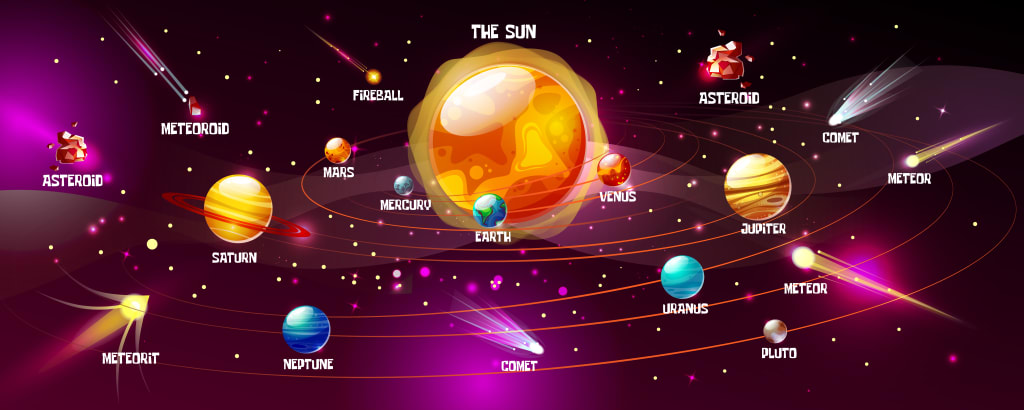
Uncovering the Controversy: Understanding the Demotion of Pluto from Planet to Dwarf Planet.
The solar system is the collection of celestial bodies that orbit around the sun. It includes the sun, the eight planets (Mercury, Venus, Earth, Mars, Jupiter, Saturn, Uranus, and Neptune), five dwarf planets (Ceres, Pluto, Haumea, Makemake, and Eris), and numerous other bodies such as asteroids and comets.
The sun, at the center of the solar system, is a medium-sized star that is primarily composed of hydrogen and helium. It is the source of light and heat for the solar system, and its gravity holds the planets and other bodies in their orbits. The innermost four planets, Mercury, Venus, Earth, and Mars, are known as the terrestrial planets because they have solid surfaces and are composed mainly of rock and metal. Mercury is the smallest and closest to the sun, while Venus is the hottest and Earth is the only known planet to support life. Mars, the fourth planet from the sun, is known for its reddish appearance and has been the subject of many space missions.
The outer four planets, Jupiter, Saturn, Uranus, and Neptune, are known as the gas giants because they are primarily composed of gas. Jupiter is the largest planet in the solar system and has a system of many moons. Saturn is known for its rings, which are made up of ice and dust particles. Uranus and Neptune are much farther from the sun and are not visible to the naked eye.
Kuiper Belt, a region of the solar system beyond Neptune, raised questions about Pluto's classification as a planet. These objects, similar in size and composition to Pluto, challenged the traditional understanding of what constitutes a planet.
In response to these discoveries, the IAU formed a committee to define the criteria for what makes a celestial object a planet. In 2006, the IAU proposed and voted on a new definition of a planet, which stated that a planet must meet three criteria: it must orbit the Sun, it must be spherical in shape, and it must have "cleared its orbit" of other celestial objects.
Under this new definition, Pluto failed to meet the third criteria as its orbit overlaps with the Kuiper Belt, and therefore, it was reclassified as a "dwarf planet." This decision sparked a great deal of debate and controversy, as many scientists and members of the public felt that Pluto should still be considered a planet based on its size and characteristics.
Critics of the IAU's decision argue that the "clearing its orbit" criteria is arbitrary and does not take into account the wide diversity of celestial objects in our solar system. They point out that the criteria would also disqualify Earth and Mars as planets, as their orbits overlap with asteroids. Additionally, the "clearing its orbit" criteria does not take into account the possibility of collision or the fact that many objects in our solar system may have formed in the same place.
Proponents of the IAU's decision argue that the new definition is necessary in order to have a consistent and scientifically accurate understanding of our solar system. They argue that the "clearing its orbit" criteria is based on scientific understanding of how planets form, and that Pluto's characteristics and orbit are more similar to those of the Kuiper Belt objects than to those of the traditional planets.
Despite the ongoing debate, the IAU's decision stands, and Pluto is officially classified as a dwarf planet. However, it's important to note that the definition of a planet is a human construct, scientists and the general public may have different opinions and interpretation of it. While the classification of Pluto as a "dwarf planet" may be disappointing to some, it is an important reminder of the ongoing process of scientific discovery and the constant evolution of our understanding of the universe.
In summary, Pluto was reclassified as a "dwarf planet" by the International Astronomical Union (IAU) in 2006, due to its failure to meet the third criteria of the IAU definition for a planet, which states that a planet must have cleared its orbit of other celestial objects. This decision was met with controversy and debate, as many scientists and members of the public felt that Pluto should still be considered a planet based on its size and characteristics. Despite the ongoing debate, the IAU's decision stands and Pluto is officially classified as a dwarf planet.
About the Creator
Keep reading
More stories from writers in Earth and other communities.
Magnetic Magma earth
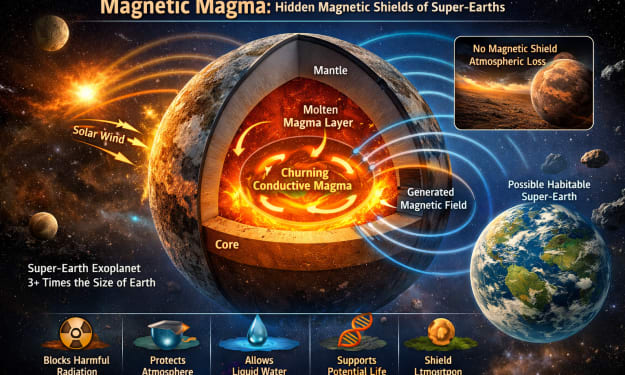
Super-Earths are rocky exoplanets more than three times the size of our planet, with far greater internal pressures and temperatures. For years, scientists assumed that if these worlds had magnetic fields, they would form the same way Earth’s does — through movement in a molten iron core. However, new laboratory experiments suggest something very different may be happening deep inside these massive planets. Under extreme pressure, certain molten rocks become electrically conductive. When these materials churn and circulate between the core and the mantle, they can generate magnetic fields on their own. This means a super-Earth might not rely solely on its core for protection. Instead, a thick, dynamic layer of magma could act as a natural magnetic shield, powered by internal heat and motion.
By USA daily update a day ago in Earth
“Do Not Copy This Site’s Content”: Why Originality Matters More Than Ever in the Digital Age
“Do not copy this site’s content.” It’s a warning most internet users have seen countless times, often at the bottom of webpages or buried in terms and conditions. Many scroll past it without a second thought. But in today’s digital world, that simple sentence carries far more weight than people realize.
By Muhammad Hassan5 days ago in Earth



Comments
There are no comments for this story
Be the first to respond and start the conversation.