
Why Do Stars Shine?
The Secret Light of Distant Suns and the Science Behind Their Glow

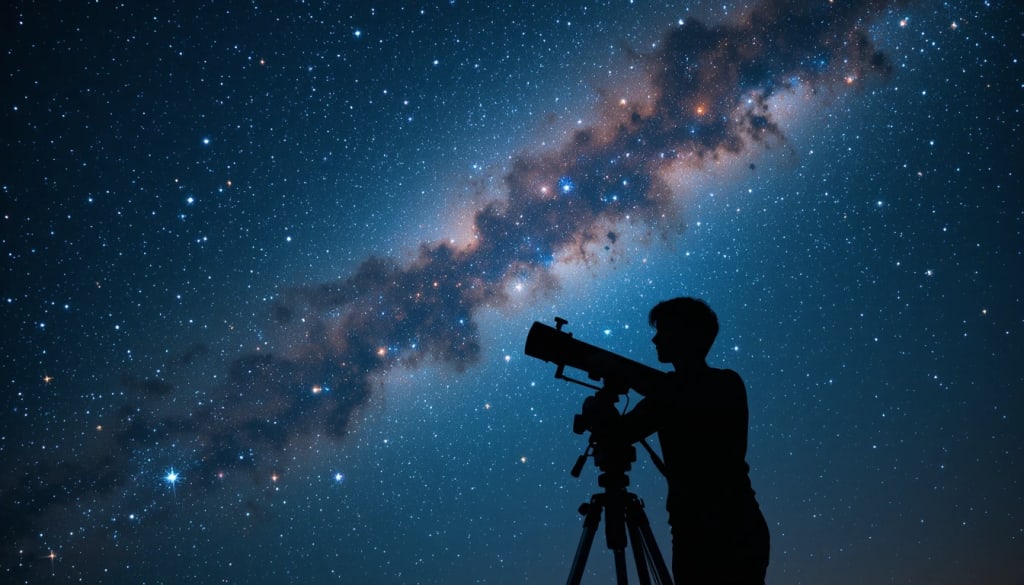
On a cool summer night, a curious boy named Arman lay on the roof of his house in a small village. The sky above him was full of stars, glowing like little lamps. He often wondered, “Why do stars shine?”
One night, he asked his grandfather, Baba Jan, who loved telling stories.
“Baba Jan, why do the stars shine in the sky?”
Baba Jan smiled and sat beside him. “That is a question many people have asked for hundreds of years,” he said. “Let me tell you a story. A story about light, life, and the stars.”
Long Ago, When the Universe Was Born
A very long time ago, there was nothing. No stars, no moon, no sun. Just darkness and emptiness. Then, suddenly, there was a big explosion — the Big Bang. That was the beginning of everything: time, space, and matter.
From this event, tiny particles of gas began to float in space. These gases were mostly hydrogen and helium. Over millions of years, they came together because of gravity and formed huge clouds.
In the center of these clouds, the gas became hotter and hotter. The pressure grew so strong that something amazing happened — a star was born!
The Heart of a Star
Baba Jan pointed at a star. “Inside every star, there is a powerful engine. That engine is called nuclear fusion.”
“What is that?” Arman asked.
“It is like fire, but much stronger,” said Baba Jan. “In the center of a star, the hydrogen gas becomes so hot that the atoms crash into each other and stick together. When they do this, they release energy. That energy is light and heat. This is why stars shine.”
Arman’s eyes lit up. “So stars make their own light?”
“Yes,” Baba Jan nodded. “They shine from the inside out.”
Stars Are Like Big Factories
“Stars are like big factories in the sky,” Baba Jan continued. “They don’t only make light. They also make the building blocks of life.”
“What do you mean?” Arman asked.
“When stars get older, they make other elements like carbon, oxygen, and iron. When a star dies, it spreads these things into space. Later, these elements become part of new stars, planets, and even people like us.”
“So we are made of stars?” Arman asked in surprise.
“Yes, my boy. You, me, the trees, and even the birds — we all have atoms that once came from stars.”
The Life of a Star
Every star is born, lives, and then dies. Small stars, like our Sun, live for billions of years. They burn slowly and gently. When they run out of fuel, they grow into red giants and then become white dwarfs — small, quiet stars.
Big stars burn brighter and faster. When they die, they explode in a big blast called a supernova. After that, they become black holes or neutron stars.
Even though stars die, their light travels across space. Some of the stars we see in the night sky may already be gone. Their light just takes a long time to reach us.
Different Colors, Different Stars
“Have you noticed that some stars look white, others blue, and some even red?” Baba Jan asked.
“Yes!” said Arman. “Why is that?”
“It is because of their temperature,” Baba Jan explained. “Hotter stars look blue. Cooler stars look red. Our Sun is yellow because it is in the middle — not too hot, not too cool.”
“So stars are different in color and size?”
“Yes,” Baba Jan smiled. “Some are small and quiet. Others are giant and loud. But all of them shine because of the same reason — fusion.”
The Sun: Our Special Star
Arman looked toward the east, where the Sun would rise in a few hours.
“Is the Sun also a star?” he asked.
“Of course,” said Baba Jan. “It is the closest star to us. That’s why it looks bigger and brighter than other stars. The Sun gives us light, heat, and life.”
Without the Sun, Earth would be dark and cold. There would be no plants, no animals, and no people. Every day when the Sun rises, it gives us the energy we need to live.
What If Stars Did Not Shine?
“Imagine a sky without shining stars,” Baba Jan said.
Arman looked up. “It would be sad and empty.”
“Yes,” Baba Jan agreed. “The stars are not only beautiful. They also remind us that the universe is alive. Their light gives us hope. Their story gives us meaning.”
A Child of the Stars
Arman closed his eyes and thought about everything he had learned. He imagined giant clouds turning into stars, explosions in space, and atoms flying across the universe to become part of a tree, a fish, or a boy like him.
“I think I understand now,” he said softly. “Stars shine because they are full of life.”
Baba Jan smiled and nodded. “That’s right. And remember, Arman, just like stars, you also have a light inside you. Never forget to let it shine.”
Years Later... Arman grew up to become a scientist. He studied the stars and the sky, but he never forgot the stories his grandfather told him. Whenever he saw a star, he remembered the quiet nights on the roof and the magic of the universe.
And sometimes, when children asked him, “Why do stars shine?” he would smile, look up at the sky, and begin the story all over again.
About the Creator
Bilal Mohammadi
welcome to Bilal Mohammadi articles please follow my page
Keep reading
More stories from Bilal Mohammadi and writers in Earth and other communities.
Journey Beyond Earth: What It Feels Like to Travel to Space
I had always looked up at the night sky and wondered what it would feel like to float among the stars. As a child, I used to lie on the roof, staring at the moon and the blinking lights above. They seemed so far away, almost like a dream. I never thought that one day I would actually go there.
By Bilal Mohammadi9 months ago in Earth


Comments
There are no comments for this story
Be the first to respond and start the conversation.