
Why Clouds Don’t Fall
The surprising weight and hidden science behind floating giants.

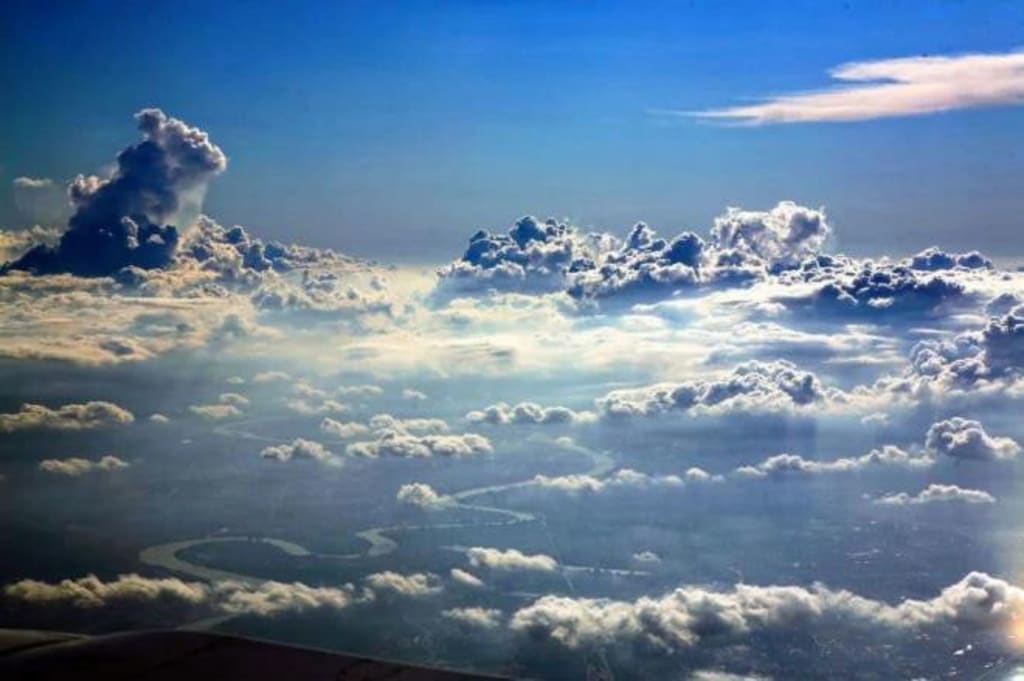
A clear blue sky, fluffy white clouds, and vast green fields—this is one of the most picturesque scenes in our imagination. Sometimes, as you lie on the grass, watching the clouds drift by, a curious thought crosses your mind: **How much does a cotton candy-like cloud weigh? Could it ever suddenly fall from the sky?**
Don't be fooled by their soft, dreamy appearance—each cloud can weigh hundreds of tons! Clouds are a crucial part of Earth's water cycle. When the sun heats the Earth's surface, water evaporates, turning into water vapor that rises into the sky with air currents. As it ascends, the temperature drops—on average, by **0.65°C for every 100 meters of elevation.**
At a certain temperature, the water vapor condenses when it meets cold air, gathering around dust particles to form tiny droplets. These droplets accumulate to create clouds. Even a medium-sized cloud can weigh **more than 500 tons**. With such a massive weight, how do clouds remain suspended in the sky instead of falling due to gravity?
### Why Don't Clouds Fall from the Sky?
Water molecules consist of one oxygen atom and two hydrogen atoms. The Earth's atmosphere is mainly composed of nitrogen and oxygen, both of which are heavier than hydrogen. This makes water vapor **lighter than air**. Since equal volumes of gases contain the same number of molecules at the same temperature and pressure, regions with high concentrations of water vapor are **lighter** than the surrounding air, causing water molecules to rise.
However, no matter how light they are, water molecules are still subject to **gravity**. This means that clouds, too, experience the Earth's gravitational pull. The reason they don’t fall immediately lies in **terminal velocity**—a concept in physics that describes how fast small objects, like water droplets, fall through the air. The smaller the object, the slower it falls. Since cloud droplets are **extremely tiny**, they fall at a rate so slow that they appear to **float in the air**.
Even though these droplets do eventually descend, they often **evaporate before reaching the ground**, rising again to form new droplets. This continuous process keeps clouds in a state of **dynamic balance**.
### Why Do Clouds Sometimes Bring Rain, Snow, or Hail?
The answer lies in **temperature and atmospheric conditions**.
At high altitudes, the water droplets in clouds often exist as **ice crystals or snowflakes**. A small, isolated cloud won’t generate enough energy to cause rain. However, when **many clouds gather**, strong air currents create **turbulent convection**. Ice crystals collide, rub against each other, and grow heavier until they become too heavy to stay aloft, eventually falling as precipitation.
If the temperature **near the Earth's surface is above 0°C**, the falling ice melts and turns into **rain**.
Some might wonder: "Why do we sometimes get **snow or even hail in summer**?" This happens because of **extreme weather conditions**. In **summer**, strong convective air currents frequently occur, forming massive **cumulonimbus clouds**. These towering clouds can reach heights of over **10,000 meters**, where temperatures drop to **-30 to -40°C**.
Within these clouds, **supercooled water droplets** exist in a liquid state despite being below freezing. As **updrafts** push these droplets higher, they encounter ice crystals and snowflakes, **freezing upon contact to form hailstones**.
These hailstones cycle **up and down** within the cloud, accumulating more layers like a snowball. Eventually, when the **updrafts can no longer support their weight**, they plummet to the ground as **hail**.
### The Ever-Changing Beauty of Clouds
Clouds bring the essence of each season to life. **In summer, the sky is a deep, brilliant blue; in autumn, fluffy white clouds float serenely; in winter, dark clouds shroud the setting sun; and in spring, gentle breezes push clouds across the sky.**
So next time you have a moment to spare, look up. You might just find a cloud that captures your imagination.
About the Creator
Eleanor Grace
"Dream big.Start small.Act now."
Keep reading
More stories from Eleanor Grace and writers in Earth and other communities.
Ghana Wheat Market Size & Forecast 2025–2033
Introduction Ghana’s wheat market is steadily emerging as an essential segment of the country’s food economy. Driven by rapid urbanization, changing dietary habits, and the expansion of bakeries, fast-food outlets, and packaged food manufacturing, wheat has become a key ingredient in everyday Ghanaian diets. According to Renub Research, the Ghana wheat market was valued at US$ 46.20 million in 2024 and is projected to reach US$ 79.89 million by 2033, growing at a compound annual growth rate (CAGR) of 6.27% during 2025–2033.
By Marthan Sir7 days ago in Earth
Met Office Issues Yellow Fog Warnings After Parts of UK Battered by Rain
After days of relentless rainfall sweeping across large parts of the United Kingdom, the Met Office has issued yellow fog warnings, cautioning residents and travelers to prepare for reduced visibility and hazardous conditions. The sudden shift from heavy rain to dense fog highlights the volatile nature of the UK’s winter weather and underscores the challenges it poses to transport, public safety, and daily life. From Heavy Rain to Thick Fog The recent spell of intense rain saturated the ground across England, Wales, and parts of Scotland, leaving rivers swollen and fields waterlogged. As calmer weather followed the downpours, a combination of high moisture levels, falling temperatures, and light winds created ideal conditions for fog formation. According to meteorologists, this type of fog—often called radiation fog—develops when moisture near the ground condenses overnight, forming thick, low-lying clouds that can linger well into the morning. The Met Office’s yellow warning signals that fog could significantly reduce visibility, in some areas dropping below 100 meters. While not the most severe level of weather alert, yellow warnings are designed to prompt awareness and caution, particularly for motorists, cyclists, and pedestrians who may be caught off guard during early morning commutes. Travel Disruptions and Safety Concerns Fog is one of the most dangerous weather conditions for road travel, as it can dramatically shorten reaction times and obscure hazards. Authorities have urged drivers to slow down, use fog lights appropriately, and maintain greater distances between vehicles. Motorways and rural roads alike are vulnerable, with sudden patches of thick fog appearing without much warning. Rail services may also experience delays, as drivers are required to reduce speeds when visibility drops. At airports, fog can disrupt flight schedules, causing delays or cancellations, particularly during peak morning hours. Aviation authorities closely monitor visibility thresholds, and even a short-lived fog bank can ripple through tightly scheduled operations. Emergency services have emphasized that pedestrians and cyclists should wear reflective clothing where possible, especially during early mornings and evenings. With darker winter days already limiting visibility, fog compounds the risks for vulnerable road users. Why Fog Follows Heavy Rain Meteorologists explain that fog warnings often follow periods of heavy rainfall. When rain saturates the ground, it leaves behind large amounts of surface moisture. If skies then clear and winds ease, the ground cools rapidly overnight, allowing moisture to condense into fog. This pattern is becoming increasingly familiar in the UK, where weather systems are growing more erratic. Climate scientists note that a warming atmosphere holds more moisture, increasing the likelihood of intense rainfall events followed by fog, frost, or sudden temperature drops. Regional Impact Across the UK The yellow fog warnings are not uniform across the country. Low-lying areas, river valleys, and rural regions are particularly susceptible. Parts of southern England, the Midlands, and eastern regions are among those most at risk, though localized fog could appear almost anywhere conditions align. In Scotland and northern England, lingering wet ground combined with colder overnight temperatures raises the possibility of fog forming alongside icy patches. This mix of hazards further complicates travel and increases the risk of accidents. What a Yellow Warning Really Means A yellow weather warning does not mean severe disruption is guaranteed, but it does indicate a heightened likelihood of impacts. The Met Office uses yellow alerts to encourage the public to stay informed and take sensible precautions. For fog, that means checking travel updates, allowing extra journey time, and staying alert to rapidly changing conditions. Weather experts stress that fog can be highly variable. One area may experience clear skies while another, just a few miles away, is blanketed in thick mist. This unpredictability is what makes fog particularly dangerous. Looking Ahead: More Changeable Weather Forecasts suggest that unsettled weather will continue in the coming days, with further spells of rain interspersed with calmer, colder nights—conditions that could lead to additional fog warnings. While no prolonged severe weather is currently expected, the pattern reflects the broader trend of increasingly changeable winters in the UK. For many residents, this serves as another reminder that winter weather is no longer defined by just cold or snow. Instead, a mix of heavy rain, flooding risks, fog, and sudden temperature shifts is becoming the new normal. Staying Prepared The Met Office advises the public to regularly check forecasts, especially before traveling, and to remain flexible with plans during periods of weather warnings. Simple measures—such as cleaning car windows, ensuring lights are functioning, and staying updated via official channels—can significantly reduce risk. As the UK continues to navigate this wet and fog-prone winter, awareness and preparation remain the best defenses. While the fog may lift by midday in many areas, its early impact serves as a timely reminder that even seemingly mild weather hazards can have serious consequences.
By Fiaz Ahmed 5 days ago in Earth
Thoughts on Vocal and the way the world is
"Death cannot stop true love, only delay it." – Wesley in The Princess Bride. I decided to come back to Vocal on a very cold and dark night at the end of December. I had been, and still am, convalescing from a horrible staph infection that had gone misdiagnosed for months. This, paired with the increasing challenges of being healthy, making the best choices for my co-parented child, being a wife, and being a director at a new job, was a lot to manage.
By Jazzy 2 days ago in Confessions



Comments
There are no comments for this story
Be the first to respond and start the conversation.