
The First Underwater House
Pioneering Soviet divers tested human life underwater in Crimea, marking a historic moment in ocean exploration.

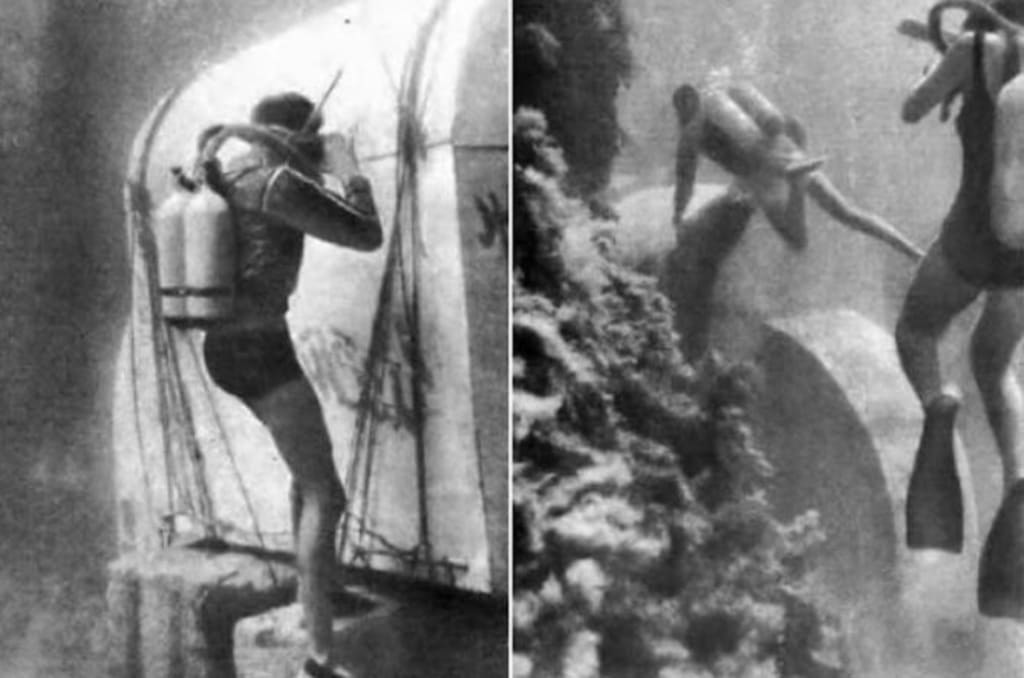
The first experiments in the world about human life underwater were conducted in the waters of Crimea, which was part of the former Soviet Union.
"On the first day underwater. Right in front of me is a rock, covered with shrubs. It’s full of life. The crab Mitka is nestled in a rock crevice. Occasionally, it leaves its shelter, crawls up the rock with flair, and is always chewing on something while waiting. Night falls. Glimmering flashes appear from other windows. They are bioluminescent microorganisms," wrote diver Alexander Haes, the first resident of the underwater house in the Soviet Union, in his diary in August 1966.
In the 1960s, the Soviet Union was eager not only to explore the vastness of outer space but also the depths of the oceans. The divers from Donetsk were the pioneers of underwater living trials. They were inspired by the successful experiments of the famous French explorer Jacques-Yves Cousteau. In 1962, he placed the first underwater house in the world, named "Conshelf I," on the ocean floor. A year later, he constructed an entire underwater village in the Red Sea.
While in the West, the construction and testing of underwater homes were carried out by experts, in the Soviet Union, the first efforts were undertaken by an amateur team. These were members of the "Ichthyander" diving club, named after a character in the science fiction novel "Amphibian Man" by Soviet author Alexander Belyaev.
The team began assembling the underwater house in the fall of 1965 from metal pieces and old, even discarded equipment. The first underwater house in the Soviet Union was shaped like a small aircraft hangar with a domed roof. It measured six square meters, just enough for two people. Inside, there was a bunk bed, a desk with a telephone, monitoring equipment, medical devices, and a toilet. Four windows allowed views of the outside world. The ventilation system was designed so that divers could smoke inside using air tanks.
According to the plan, electricity, fresh water, and air were to be pumped from the shore via pipes and cables. A 5,000-calorie meal was brought daily by other divers.
On August 5, 1966, this specially designed house was brought to Tarkhankut Cape in Crimea. On the cape, the project team set up a camp for 100 people. Engineers and rescue personnel were on standby onshore to ensure the experiment would proceed safely. Doctors monitored the divers' breathing, blood circulation, metabolism, and mental reactions. Meanwhile, news teams filmed this historic moment. A total of three pioneering divers would live underwater.
The first attempt to lower the house to a depth of 11 meters beneath the surface, with the help of five half-ton concrete blocks, was made on August 19. However, a three-day storm ravaged the bay, ruining the plan. The second attempt, on August 23, succeeded.
Alexander Haes, the president of the "Ichthyander" diving club and a surgeon, became the first resident of the underwater house. He was accompanied by his colleague Zhora Tunin as they descended into the deep sea. Haes spent the first day alone.
"The house shook all night. Several times, I woke up in terror. I lost my sense of space; sometimes, it seemed like the cable was about to snap, and I had to run to find an escape route, but where was it, from which direction? How could I find the rock where the emergency diving equipment was hidden? Each time, I anxiously called the base, but a confident voice always responded, 'Sasha, everything is fine.' Now, I have no doubts. Our experiment was a success," Haes wrote in his diary.
At 7:30 a.m. on August 24, Haes was examined by doctors, who checked his health. By 8:30 a.m., another diver brought him breakfast. Later that evening, engineer Dmitry Galaktionov from Moscow joined Haes in the house. On August 26, miner Yuri Sovetov from Donetsk replaced Haes and brought him back to the surface.
Before resurfacing, Dr. Haes had to undergo a process called "decompression" in the underwater house—expelling nitrogen from his body by first breathing a mixture of oxygen and helium, then pure oxygen. During the ascent, he stopped for 20 minutes at a depth of seven meters and then again at three meters. These pauses were meant to release excess nitrogen slowly from his body. After 60 minutes of recovery on land, the first "ocean astronaut" of the Soviet Union was healthy again after three days underwater.
The next day, August 27, a storm arrived. At 8 a.m., doctors dove down to check on the health of the two "aquanauts," Galaktionov and Sovetov. However, by 2 p.m., they decided to cancel the entire experiment.
When the "Ichthyander" project team returned to Donetsk, they received a late notification from the Underwater Sports Federation about a ban on the experiment. However, a few months later, the Federation awarded the divers their graduation certificates.
The 1966 "Ichthyander" project was the beginning of a series of underwater living experiments by Donetsk divers. On August 28, 1967, in Crimea, they lowered the "Ichthyander-67" house to a depth of 12 meters. This house, consisting of four rooms, was large enough for five people, featuring a kitchen, a bedroom, a bathroom, and a laboratory. The "aquanauts" lived underwater for 14 days in shifts. Their goal was to examine how the human body would react to an unnatural living environment. They also brought guinea pigs, rabbits, and cats to the bottom of the sea. The divers were also subjected to psychological tests after two incidents in which water leaked into the house.
The final "Ichthyander" underwater house was lowered to the sea in 1968 in Laspi Bay. This time, the goal was to conduct geological research, as an active drilling rig was nearby. However, the project was halted after four days due to the effects of a storm. And that was the last experiment conducted by the amateur divers of the Soviet Union.
In 1970, a commemorative plaque for the first underwater house in the Soviet Union was installed at Tarkhankut Cape, with the inscription: "Look forward and never look back." In 2006, 40 years after the first experiment, three black-and-white striped cubes were installed nearby to symbolize the shape of the second "Ichthyander" house.
About the Creator
Eleanor Grace
"Dream big.Start small.Act now."
Keep reading
More stories from Eleanor Grace and writers in Earth and other communities.
Climate Change Could Trigger New Ice Age
Recent research indicates that climate change could cause ocean currents to freeze, gradually transforming the Northern Hemisphere back into an ice age. This alarming prediction could reshape our world in ways that have never been imagined before.
By Eleanor Grace10 months ago in Earth
White Mushroom Market Size and Forecast 2025–2033
Introduction White mushrooms—scientifically known as Agaricus bisporus—are no longer confined to salads, pizzas, and soups. Once considered a humble kitchen staple, they are now emerging as a strategic crop in the global agrifood ecosystem. Driven by sustainability trends, plant-based eating, and rising health consciousness, white mushrooms have carved out a powerful position in both consumer markets and foodservice industries.
By jaiklin Fanandish4 days ago in Earth
Medicinal herbs of the Carpathians
According to popular beliefs, the Carpathians are considered a healing "place of power" and there is no mysticism in this. Air with a unique composition and medicinal Carpathian herbs can work real miracles. Since ancient times, the Hutsuls have used them to treat various diseases. Today, herbal medicine in the Carpathians is experiencing its revival, attracting more and more attention from both locals and tourists.
By Olaf Podolskiabout 18 hours ago in Earth


Comments
There are no comments for this story
Be the first to respond and start the conversation.