
Why are we having summer when the earth is far from the sun?
When the heat of summer comes

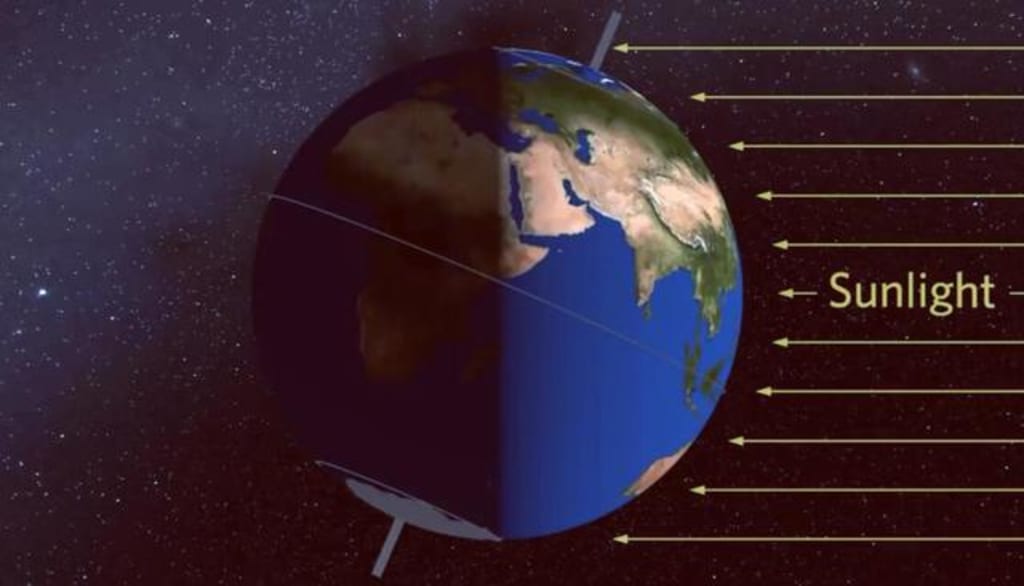
Every moment, the Earth is revolving around the Sun. Since the Earth has an elliptical orbit, the distance between the Earth and the Sun is not constant in the process of revolving around the Sun, sometimes the Earth is far away from the Sun, and sometimes it is closer to the Sun.
For us living on Earth, every revolution of the Earth, we have spent a year, but also experienced a cycle of the seasons, according to common sense, the temperature on Earth should be closer to the sun the hotter, the farther the colder, so a reasonable assumption is that when the hot summer comes, the Earth should be closer to the sun is right.
But this does not seem to be the case, because the Earth will run to the aphelion at the beginning of July every year, when we are having summer, so the question arises, why are we having summer when the Earth is far away from the Sun? Isn't it supposed to get colder as it gets farther away? Let's talk about this topic.
According to the inverse square law, the radiation intensity of the sun is inversely proportional to the square of the distance. It is known that the distance between the aphelion of the Earth's orbit and the sun is about 152 million kilometers, and the distance between the perihelion and the sun is about 147 million kilometers. A simple calculation shows that the difference between the solar energy received by the Earth's surface unit area at the aphelion and perihelion is about 6.4%.
From this point of view, the temperature of the Earth should indeed be lower when the Earth is far from the Sun, however, there is another important factor that affects the temperature of the Earth, and that is the angle of incidence of sunlight on the Earth's surface, to illustrate this point, we can take a common flashlight to give an example.
If we turn on a flashlight, and then let the light from the flashlight shine on the wall, then the wall will appear as a spot of light, at this time we can change the area and brightness of the spot by adjusting the angle of incidence of light on the wall.
A simple experiment can know that when the light is perpendicular to the wall, the area of the spot is the smallest, and its brightness is also the highest, and with the increase in the tilt of the light, the area of the spot is larger, the brightness is also lower.
This shows that the light received per unit area of the spot is closely related to the angle of incidence of the light from the flashlight on the wall. The smaller the tilt of the light, the more light is received per unit area of the spot, and the most light is received per unit area of the spot when the light is directed to the wall.
Now let's imagine the sun as an oversized flashlight, then the angle of incidence of sunlight will appear different in different areas of the earth's surface. Why? Because the Earth is a sphere.
By the same token, the area of the Earth's surface where the sun's rays are directed receives the most solar energy per unit area and the highest temperature, while in other areas, the greater the tilt of the sun's rays, the less solar energy per unit area of the Earth's surface is received and its temperature decreases.
Since the Earth's axis of rotation has an axial inclination of about 23°26′ concerning the ecliptic plane (i.e., the plane where the Earth's orbit is located), this causes the area of direct sunlight on the Earth's surface to move back and forth in the north-south direction as the Earth rotates.
The northernmost and southernmost limits of direct sunlight on the Earth's surface are called the "Tropic of Cancer" (at approximately 23°26′N) and the "Tropic of Capricorn" (at approximately 23°26′S), respectively, which means that during the year, the sunlight, In this case, the solar energy received per unit area varies for a particular area of the Earth's surface.
The extent of this variation varies depending on latitude and can be as high as 50% near the Tropic of Cancer and Tropic of Capricorn, compared to the 6.4% difference between the solar energy received per unit area of the Earth's surface at aphelion and perihelion. In contrast, the difference in solar energy per unit area of the Earth's surface between aphelion and perihelion is only about 6.4%, which means that what determines the temperature of the Earth's surface is the angle of incidence of sunlight.
For us living in the northern hemisphere, when the earth is far from the sun (that is, located near the aphelion), the direct sunlight area is actually near the "Tropic of Cancer", in this case, the surface of the northern hemisphere receives more solar energy per unit area, the temperature is also higher, so we are living in summer.
After reaching the Tropic of Cancer, the direct sunlight area will begin to move south, and the temperature of the northern hemisphere will gradually drop. When it moves to the equator, we're in the fall, when it moves to the Tropic of Capricorn, we're in the winter, and when the direct sunlight moves north again to the equator, we're in the spring, then the summer, and so on.
Yes, this is the reason why there are four seasons on Earth, but it should be noted that for humans living in the southern hemisphere when the direct sunlight is near the Tropic of Capricorn, it is summer, which means that the seasons change in the southern hemisphere in the opposite way to the northern hemisphere.
As for the area near the equator on the earth's surface, because the direct sunlight will experience twice a year, and when the direct sunlight area is away from the equator, it is not too far from the equator, so the temperature in the area near the equator is higher all year round, and there is no obvious difference between the four seasons.
About the Creator
Robert Jack
One of the secrets of emotional stability for adults is to keep the expectations of others to a minimum.
Keep reading
More stories from Robert Jack and writers in Earth and other communities.
Easy-Care Houseplants for Busy People: Plants That Thrive on Neglect
You want plants in your home. You love the idea of greenery softening corners, purifying the air, and bringing life to your space. But your life is full—work, family, travel, social obligations. You worry that plants will become one more thing to fail at, one more guilty reminder of good intentions unmet.
By Emma Wallace7 days ago in Earth


Comments
There are no comments for this story
Be the first to respond and start the conversation.