
More than 800 stars have disappeared in strange ways
In the starry universe

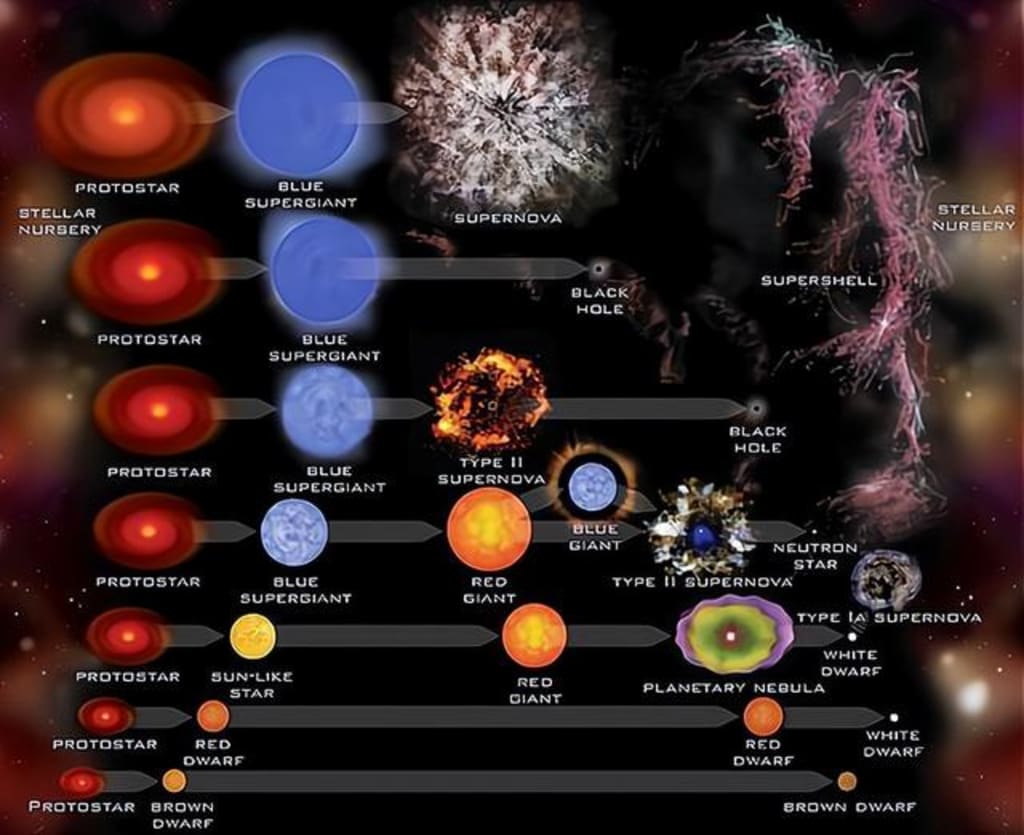
We live in a star-studded universe, and we can observe a large number of stars in any direction, but the stars in the universe do not shine forever.
After that, stars of different masses will evolve in different ways, with small masses evolving smoothly into white dwarfs, dense objects that resist gravitational collapse by "electron abbreviation and pressure". They are still able to emit light with their residual heat and thus be observed.
An intermediate-mass star expands into a red giant, and over time, the outer material of the star is ejected in large quantities to form a gorgeous planetary nebula, while the remaining core evolves into a white dwarf.
A massive star would undergo a spectacular "supernova explosion", in which most of the material of the star would be thrown into deep space, and depending on the mass, the remaining core could evolve into a neutron star or a black hole.
So reasonable speculation is that even if the main sequence star phase of a star comes to an end, they should not disappear into thin air; they will either fade away or create a lot of commotion in the universe. However, this does not seem to be the case, as a study has shown that more than 800 stars have disappeared in just over 70 years.
The study, by a team of more than 20 scientists from around the world, was conducted in 2017 by a team called VASCO and can be described simply as a comparison of astronomical observations from different periods in the past to see if there were any anomalies.
In the study, the researchers carefully compared a huge amount of observational data, the oldest of which dates back to 1950, and as early as 2019, the team published a paper stating that 100 strangely disappearing stars had been found, and as the study continued, the number kept increasing, and so far, the number of strangely disappearing stars has been more than 800.
Why do we say that these stars are "strange disappearances"? The reason is that their disappearance process has the same characteristics: they existed at one point in the past, and at the next point in time, they suddenly disappeared without "fading" or "making a big noise in the universe". How could this happen?
Why would this happen? Scientists have given various explanations for this.
One of the goals of VASCO is to search for evidence of the possible existence of extraterrestrial civilizations, so the team has proposed the following three speculations related to extraterrestrial civilizations.
1. An extraterrestrial civilization might build a huge energy harvesting device around the star, or what we often hear as a "Dyson sphere", according to this scenario, if the "Dyson sphere" could wrap the whole star in it, then the light from the star would be blocked by it. The light from the star would be blocked, and the star would appear to us to have disappeared.
2. This could be a giant beacon built by an alien civilization in space, when they are "on", or their light is pointing at us, they look like stars to us, and when they are "off", or their light is not pointing at us. When they are "off", or their light does not point to us, then in our eyes, these "stars" disappear.
3. These so-called "stars" may be giant interstellar spaceships built by alien civilizations, and when we find that these "stars" have disappeared, they have simply flown away.
Here I need to add, according to my understanding, this speculation should be like this: the alien civilization may have mastered hyperspace technology like "wormhole travel", but before the hyperspace flight, it may take a long time to gather a large amount of energy, in our opinion, this is similar to the star, and when When the starship departs, it will disappear instantly because it enters a space-time tunnel like a "wormhole".
It must be said that in any of the above speculations of alien civilizations, their technology can be said to be too high for us to imagine. Of course, alien civilization is not the only explanation scientists have also explained it from the perspective of natural phenomena, which can be divided into the following four views.
1. The relatively low level of observation in the past probably mislabeled the intense light released from some short-lived cosmic high-energy events (such as supernova explosions, neutron star collisions, etc.) as stars.
2. these stars may have been swallowed up by black holes.
3. The nuclei of distant active galaxies may have been mislabeled as stars in the past, and when the nuclei stop accreting material, we will not be able to observe them.
4. These stars may be "failed supernovae", which are theoretically massive stars that, in certain circumstances, do not have to undergo a supernova explosion and collapse directly into a black hole, as has been the case in past observations.
For example, a star named "N6946-BH1" in the direction of Cygnus disappeared from the optical field of view in 2015, but in a follow-up study, researchers found in the mid-and near-infrared bands that it did not disappear, but collapsed into a black hole.
As you can see, although the above four views seem to have some justification, these views are described by the small probability of events, to explain the "just 70 years, more than 800 stars disappeared" this phenomenon, which seems a little forced.
In this regard, "VASCO" research team astronomer Beatriz Villarroel (Beatriz Villarroel) said: "Any sufficiently advanced technology is no different from magic, if the natural phenomenon can not reasonably explain the phenomenon, then the impact of extraterrestrial The influence of civilizations would be a more likely explanation."
About the Creator
Robert Jack
One of the secrets of emotional stability for adults is to keep the expectations of others to a minimum.
Keep reading
More stories from Robert Jack and writers in Earth and other communities.
How much gold is there on the planet?
Among all the metals on earth, the most loved by human beings is undoubtedly gold human beings have loved gold for a long time, and from the current archaeological data, all the known ancient civilizations on earth regarded gold as a precious thing.
By Robert Jack4 years ago in Earth


Comments
There are no comments for this story
Be the first to respond and start the conversation.