
Why Are Salmon So Weird?
A common fish's well kept secrets.

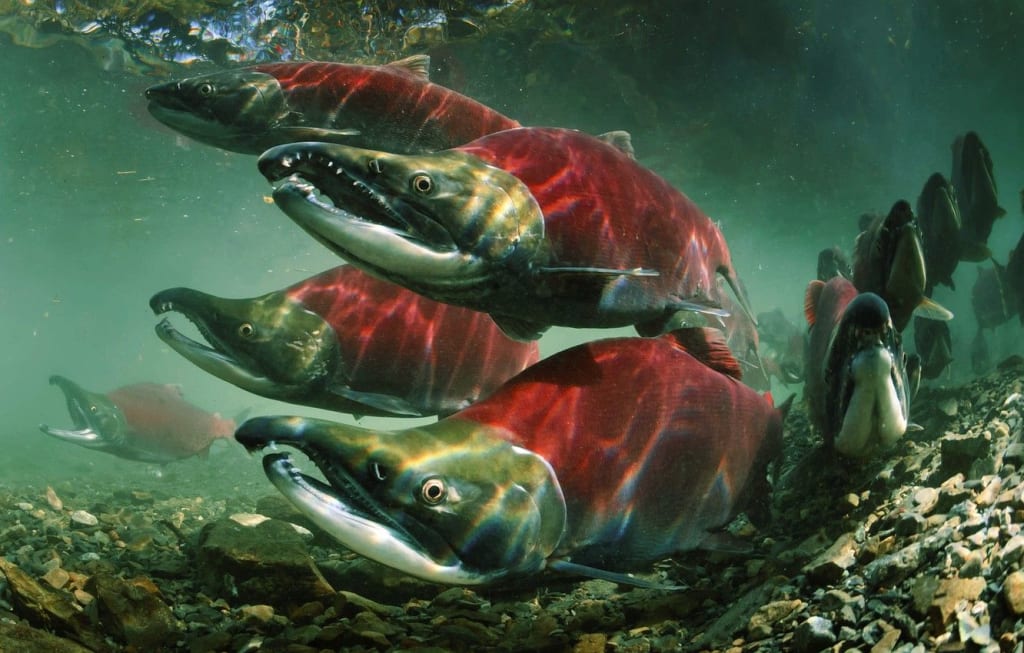
Salmon are often thought of as being a common, mundane fish found in rivers and oceans around the world. If you live in the Pacific Northwest, you may even take them for granted. But they are nothing less than icons. One theory suggests their name is rooted in the latin word salire "to leap."
Upon closer examination, it becomes clear that there are many strange and unique characteristics that help these staples of nature stand out and blend in among the crowded shoals. There are many species of salmon: chinook, sockeye, chum, pink and Atlantic are just a few. Here is an introduction to the top five reasons why salmon are weird:
______
1. Salmon can smell things. Not only do salmon have an incredible sense of smell, but they rely on their sniffers to avoid predators and navigate their way back home. They are able to pick up on minute chemical changes in the water and use this sense to navigate back to their birthplace and reproduce, sometimes traveling thousands of miles through treacherous waters.
2. Salmon change their appearance as they mature. When they are young, salmon are known as "fry" and tend to have a silver coloration. As they grow, they develop a more colorful appearance and become known as "smolts." When salmon are fully mature the hues of their scales ripen into depper and richer colors. Sometimes, if they are old enough they might even turn a bit black (i.e the Atlantic salmon).
3. Salmon have a unique life cycle. They are born in freshwater streams and rivers, but migrate to the ocean as adults. After spending several years in the ocean, they return to the freshwater to spawn and lay their eggs. This process, known as "anadromy," is found in very few other species of fish. They also have an extra stage in their life cycle, before they are considered fry they hatch as alevins. These tiny fish still have the yolk sac of their egg attached to their bellies. Once they finish their yolk and gain its nutrients they become fry and are ready to leave their nests.
4. Some species of salmon are able to jump incredibly high. The record for the highest jump by a salmon is held by the chinook salmon, which can leap over 9 feet out of the water. This ability helps them navigate past obstacles such as waterfalls and dams. Some scientists suspect an additional motivation for jumping, some say that they jump to dislodge ... sea-lice. It takes an average of 56 jumps to dislodge one sea-lice.
5. Salmon have a remarkable sense of direction. Despite being able to travel thousands of miles through the vastness of the ocean, they are able to find their way back to the exact spot where they were born to lay their eggs. Most agree that salmon, and fish at large, use the Earth's magnetic field to navigate their way across the globe. This ability is still not fully understood by scientists, and is the subject of ongoing research.
______
Not long ago, salmon populations were much more abundant. They were harvested sustainably and fed entire Native American populations on the Pacific Coast from present-day Mexico to Alaska. Now their numbers have dwindled due to overfishing, chemicals and other toxicities. Even the rise in CO2 in the water may affect their ability to smell and avoid danger. Ongoing efforts to help increase the populations of these fish are worldwide. People in their own communities are working together to turn the pattern of decline around.
Check out these links to learn more about ways you can get involved:
https://www.wildsalmon.org
http://www.carkeekpark.org/salmon-program-volunteers/
https://worldsalmoncouncil.org/new-volunteer-registration/
If none of the links above are for the area you reside in, try entering your location in your search engine to find more opportunities!
Citations
“The Salmon Life Cycle.” National Parks Service, U.S. Department of the Interior, https://www.nps.gov/olym/learn/nature/the-salmon-life-cycle.htm.
Fisheries, NOAA. “Salmon May Lose the Ability to Smell Danger as Carbon Emissions Rise.” NOAA, 6 Aug. 2019, https://www.fisheries.noaa.gov/feature-story/salmon-may-lose-ability-smell-danger-carbon-emissions-rise.
Learn, Joshua Rapp. “Why Are These Salmon Jumping? | Science | AAAS.” Science.org, 13 July 2018, https://www.science.org/content/article/why-are-these-salmon-jumping.
University, Oregon State. “Land-Locked Atlantic Salmon Also Use Magnetic Field to Navigate.” ScienceDaily, ScienceDaily, 8 Oct. 2018, https://www.sciencedaily.com/releases/2018/10/181008183352.htm.
“Salmon (n.).” Etymology, https://www.etymonline.com/word/Salmon.
Anderson, Cheri, and Sean Connolly. “Salmon...A Pacific Northwest Icon: U.S. Fish & Wildlife Service.” FWS.gov, 7 June 2022, https://fws.gov/story/2022-06/salmona-pacific-northwest-icon.
“Adult Salmon Abundance.” State of Salmon, 13 Jan. 2021, https://stateofsalmon.wa.gov/statewide-data/salmon/.
About the Creator
Prema Smith
Born and raised in the PNW by my Indian mother and Scottish father. I split my time between the city and the countryside, growing up somewhere in-between.
Keep reading
More stories from Prema Smith and writers in Earth and other communities.
Inside Trump's $11 Billion Health Plan to Replace “Neo-Colonial” USAID
In the landscape of global health aid, few proposals have stirred as much debate as former President Donald Trump’s ambitious plan to restructure American assistance abroad. Dubbed an $11 billion health initiative aimed at replacing USAID’s current framework, the plan seeks to pivot away from what Trump and his allies have criticized as the “neo-colonial” approach of U.S. foreign aid. While the plan promises greater efficiency and impact, experts are split on whether it is a practical solution or a politically driven gamble. Trump’s Critique of USAID The United States Agency for International Development (USAID) has long been a central pillar of American foreign assistance, distributing billions in aid annually to address health crises, food insecurity, and development challenges worldwide. However, Trump’s administration and its supporters have often described USAID’s approach as bureaucratic, inefficient, and reflective of a “neo-colonial” mindset. In public statements, Trump argued that the U.S. was spending taxpayer dollars on programs that benefited foreign governments or contractors more than the intended local communities. Critics of the plan say that while USAID has flaws—as any large bureaucracy does—its extensive networks and decades of experience provide an unmatched capacity to deliver aid efficiently and safely. The Core of the $11 Billion Proposal At the heart of Trump’s proposal is an $11 billion fund designed to consolidate, modernize, and streamline U.S. health aid. Unlike the traditional USAID model, which relies heavily on long-term partnerships with governments and NGOs, the new plan emphasizes: Direct Impact Funding: Allocating resources to frontline health workers and local initiatives rather than intermediaries. Data-Driven Investments: Using real-time health data to target outbreaks and crises more efficiently. Private Sector Partnerships: Leveraging U.S. pharmaceutical companies, tech firms, and healthcare startups to deliver vaccines, treatments, and medical infrastructure. Shorter Program Cycles: Moving away from multi-year funding commitments in favor of more flexible, results-oriented programs. Proponents argue that this approach could reduce bureaucratic overhead and ensure U.S. aid reaches communities faster. By “cutting out the middlemen,” Trump supporters claim, America can avoid the pitfalls of slow-moving aid programs that sometimes fail to adapt to crises. Reactions from the Global Health Community Global health experts, however, have expressed concern about both the logistics and philosophy of the plan. Dr. Melissa Ortega, a senior researcher at the Global Health Policy Institute, explained, “The idea of bypassing established structures like USAID may sound appealing on paper, but in practice, it risks undermining decades of institutional knowledge. Health systems are complex, and short-term projects cannot replace long-term capacity building.” Some critics have also questioned the characterization of USAID as “neo-colonial.” While U.S. foreign aid has historically been tied to geopolitical interests, many programs today are designed collaboratively with recipient countries and local organizations. Reducing oversight could unintentionally increase the risk of misuse, corruption, or health inequities. On the other hand, supporters of Trump’s plan point to examples of inefficiency in USAID programs, citing cases where aid was delayed or mismanaged. By introducing more direct funding models, they argue, U.S. taxpayer dollars could achieve a higher “return on health outcomes.” Political Implications Trump’s health aid overhaul proposal is not just about international development—it is also deeply political. Framing USAID as a “neo-colonial” institution resonates with a populist narrative that America should prioritize its own citizens and assert greater control over how taxpayer money is spent abroad. Domestically, the $11 billion plan faces scrutiny from Congress. Lawmakers from both parties have questioned whether dismantling USAID’s systems could destabilize ongoing health programs in countries where the U.S. has long-term commitments. The potential impact on global health security—including the fight against pandemics like COVID-19—adds another layer of concern. Internationally, U.S. allies and partner nations are watching closely. Sudden shifts in aid delivery could disrupt health programs in low- and middle-income countries, many of which rely on predictable funding cycles to maintain vaccination campaigns, maternal health services, and disease surveillance. Possible Benefits and Risks If executed carefully, the Trump-backed model could bring several benefits: Faster Response Times: Direct funding could accelerate delivery of vaccines, treatments, and emergency support. Innovation Boost: By partnering with private sector companies, the plan could accelerate development of new health technologies. Accountability: With performance-based metrics, the plan may better measure the impact of U.S. aid. However, the risks are equally significant: Disruption of Existing Programs: Abrupt changes could destabilize ongoing health projects. Loss of Expertise: USAID’s decades of experience in navigating local governance, supply chains, and community engagement may be hard to replace. Geopolitical Fallout: Allies accustomed to collaborating with USAID might see the move as destabilizing, reducing cooperation on global health initiatives. Looking Ahead As Trump and his allies continue to advocate for this $11 billion overhaul, the debate over the future of U.S. health aid is intensifying. Proponents view it as a necessary modernization of an outdated system, while critics fear it could undercut decades of carefully built infrastructure and global partnerships. Ultimately, the success of this plan will hinge on its ability to balance efficiency with stability, innovation with oversight, and political objectives with humanitarian needs. For now, the proposal remains controversial, representing a dramatic departure from traditional approaches to U.S. foreign aid. Whether it will reshape global health for the better—or simply create more uncertainty—remains to be seen. In the end, the Trump health plan is as much about ideology as it is about dollars. It challenges the conventional wisdom of international development and asks whether a more streamlined, results-focused approach can truly replace a system built over decades. As the world watches, the stakes could not be higher: the future of U.S. global health aid—and the lives it touches—hangs in the balance.
By Muhammad Hassan5 days ago in Earth
Nitrogen is necessary for young tropical rain forests to combat climate change.
By absorbing carbon dioxide from the atmosphere and storing it in wood, tropical rainforests contribute to the slowing of climate change. Forests that develop quickly are even more important because they absorb carbon more quickly.
By Francis Dami4 days ago in Earth



Comments
There are no comments for this story
Be the first to respond and start the conversation.