
Who set the start of our Universe?
Where it all started
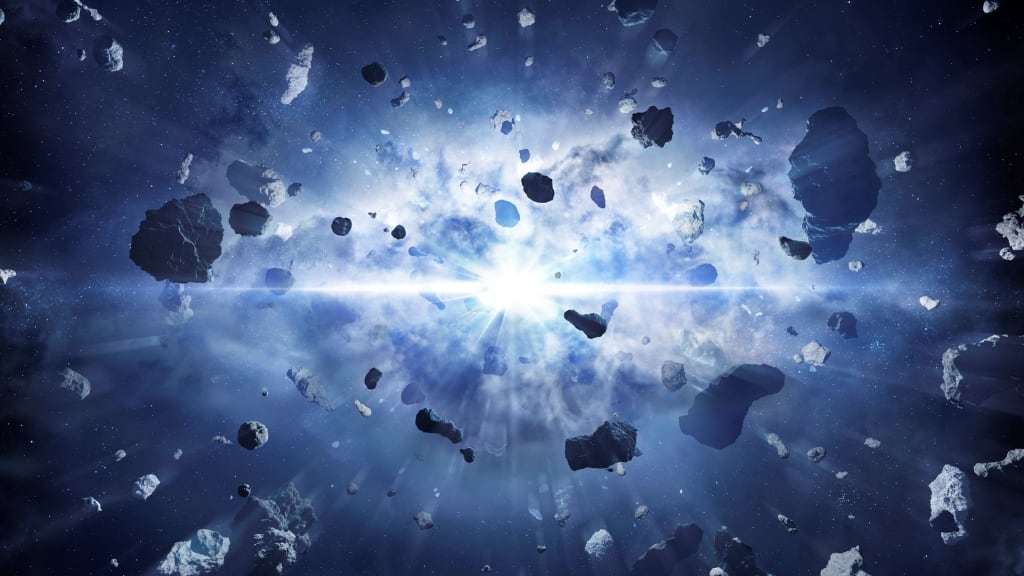
The inquiry into the origins of our Universe is a formidable challenge. Furthermore, the question of what existed prior to its inception is equally perplexing. Despite the magnitude of this inquiry, scientists have made significant strides in the 20th century. The pioneering work of Edwin Hubble, for instance, has shed light on this enigma. While observing the sky from Mount Wilson in Southern California, Hubble discovered that the seemingly random clouds of gas were, in fact, other galaxies. This revelation was groundbreaking, as it revealed that the Universe was expanding. This expansion, in turn, suggested that the Universe had a beginning. By tracing time backward, scientists were able to develop the Big Bang Theory, which provides a comprehensive explanation for the origins of our Universe.
The notion that nothing has ever existed anywhere due to the absence of both time and space is a widely accepted concept. However, there was one exception to this, namely the Cosmic Singularity, a state of the Universe characterized by its incredibly small size, high density, and extreme temperature. If one were to imagine the Universe compressed into a small ball, the pressure and temperature inside would be immense, eventually leading to the Big Bang, an explosion of energy and matter that created the fundamental physical forces that govern our world, as well as time and space. The resulting scattering of quarks, the tiny particles that make up our world, occurred in a boiling Cosmic broth, which eventually cooled down, allowing gravity to attract them to each other, leading to the formation of atoms, molecules, and eventually stars, marking the beginning of the Universe some 12 to 14 billion years ago.
Despite our understanding of the Universe's creation, the question of what existed before the Big Bang remains a mystery. Alan Harvey Guth, an American theoretical physicist and cosmologist, has dedicated his life to unraveling this enigma. After studying the Big Bang Theory, Guth identified certain flaws, such as the even distribution of matter, which should not have been the case. To illustrate this, one can imagine a balloon filled with paint hanging from the ceiling and a white canvas on the floor. If the balloon were to burst, the resulting chaos would be a random scattering of spots. However, this is not what the Universe looked like. Instead, Guth's Theory of inflation suggests that even before the Big Bang, there was a force that could give the Bang a strong acceleration, distributing everything in space instantly and evenly. This theory has been widely accepted by most scientists, although some continue to question the birth of the Universe.
Martin Bojawald, a German professor of physics, posits that the Universe was born in a manner distinct from conventional understanding. Bojawald's theory of Cosmic Singularity describes the Universe as small, infinitely dense, and super hot. However, the question of the Singularity's origin remains unanswered. Bojawald draws an analogy to a pendulum on an old clock to illustrate the concept of Quantum time, which is segmented and punctuated by pauses. According to the Big Bang Theory, the Universe began to expand and inflate like a balloon, but will eventually shrink and return to the state of cosmic Singularity, leading to another big bang. Bojawald's Theory suggests that each Universe's beginning is the end of the previous one, and millions of similar universes existed before and will exist after ours. While this theory is logical, it lacks sufficient evidence to be conclusive.
Other scientists, such as Turek, a South African physicist, and Paul Steinhardt, an American theoretical physicist, propose even more unconventional theories. They suggest that our universe is not the first, and there will be an infinite number of them, all stuck in a cycle of endless rebirths of parallel worlds. According to their theory, our universe is located inside a so-called brain, an elastic surface capable of contracting, stretching, and oscillating. These parallel universes are located near each other, and each one has a neighbor. When two brains collide, they create two big bangs and two parallel universes. While this idea may seem nonsensical, it is based on string theory and M Theory, two giants of quantum mechanics. Creating a theory is a complex process that requires extensive calculations and the ability to think in 11 dimensions simultaneously. Unfortunately, Turok and Steinhardt's theory was initially met with ridicule. They argue that scientists are regular people who fear change and the unknown, and it is scary to question everything we once believed in. However, they plan to continue their research, as the evidence currently available suggests that each of the three theories is equally possible. Until we have more evidence, we can only theorize about the origins of the Universe. Perhaps one day, we will find something that will open our eyes once and for all and solve the mystery of how our Universe came to be.
About the Creator
Keep reading
More stories from writers in Earth and other communities.
Unusually Early Arctic Breakdown Forming in February: Meteorologists Sound the Alarm
Meteorologists worldwide are issuing an unprecedented warning: an Arctic breakdown—a major disturbance in the polar atmosphere—is forming earlier than expected this February. This early event could reshape weather across the Northern Hemisphere, leading to unusual cold snaps, heat waves, and storm activity.
By Ayesha Lashari3 days ago in Earth



Comments
There are no comments for this story
Be the first to respond and start the conversation.