
When the night sky whispers of other worlds..
A cosmic moon swap and the earth unbound
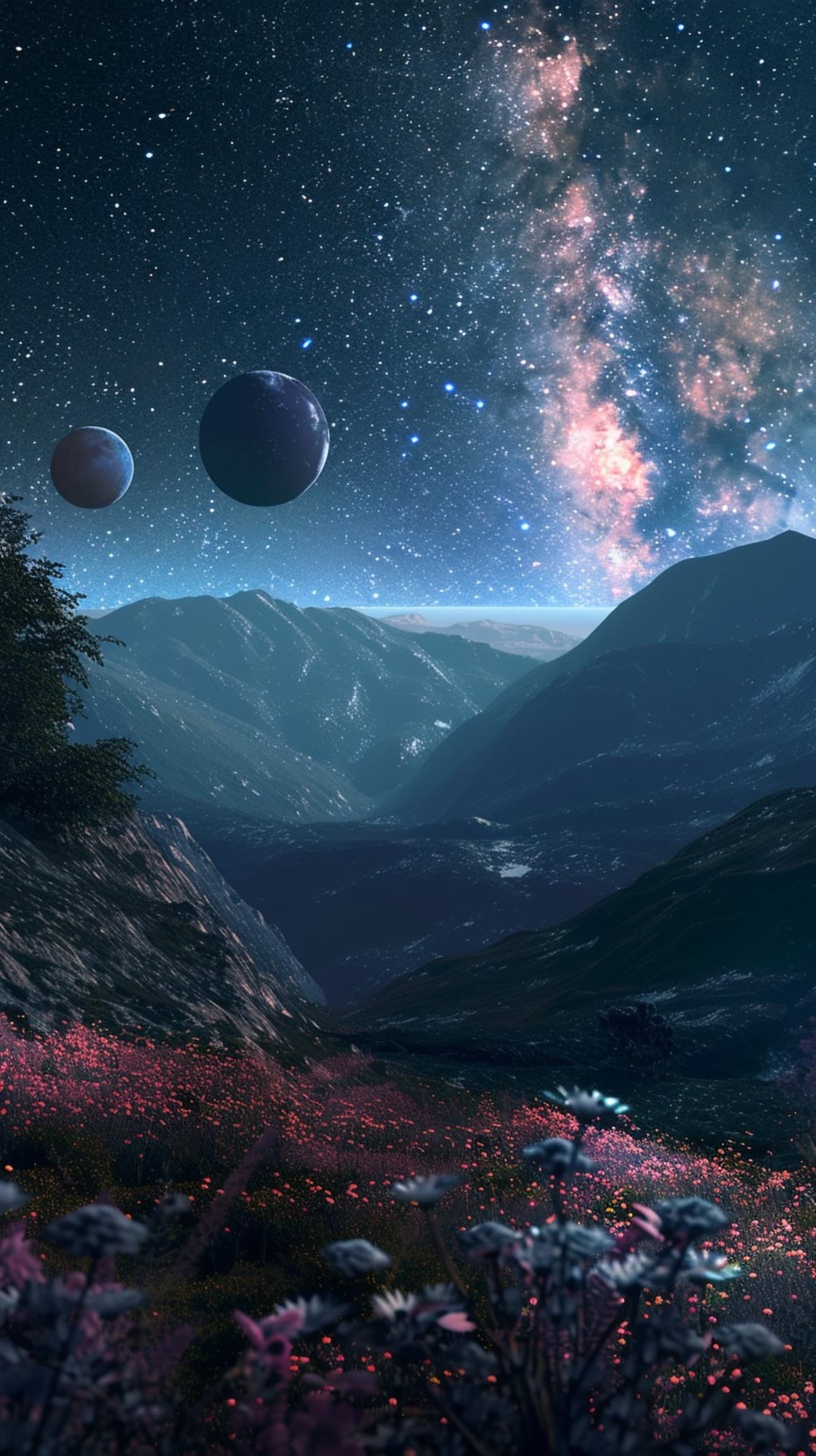
Imagine a dawn where the familiar silver disc is gone, replaced by the ruddy stare of Mars, a celestial ember hanging in the inky black. Or picture the velvet night pierced by the ethereal rings of Saturn, a cosmic halo where our gentle moon once resided. This isn't science fiction; it's a thought experiment that peels back the layers of our planetary existence, revealing the delicate gravitational dance that keeps Earth... well, Earth.
We often serenade the Moon, but rarely acknowledge its silent stewardship. It's the cosmic anchor that steadies our axial tilt, preventing a catastrophic wobble that would unleash climate change with the fury of a supernova. It's the puppeteer of our tides, the rhythmic breath of the oceans that nourishes coastal life. To lose it would be to unravel the very fabric of our world.
But what if, in a grand cosmic reshuffle, we gained a new celestial partner? What if another planet took center stage in our night sky? Prepare for a journey into the 'what ifs' that could turn our pale blue dot into an alien landscape.
Pluto's Pale Imitation: A Fading Serenade
Envision Pluto, the former ninth wanderer, stepping into the Moon's shoes. Initially, the change might seem subtle, a dimmer, more distant disc. But beneath this veneer of similarity lies a dangerous weakness. Pluto's feeble gravitational grasp would be a poor substitute for the Moon's firm hold. Earth would begin a tipsy sway, a drunken pirouette in space, triggering climate pandemonium and a symphony of natural disasters. The robust ocean tides we rely on would dwindle to mere whispers, leaving coastal ecosystems gasping for life.
Mercury's Mirror Image: A Quiet Harmony?
Now, picture Mercury, a swift, sun-kissed world, taking its place. Roughly moon-sized and etched with asteroid scars, it would be a familiar, if slightly dimmer, presence. Its slightly heftier gravity hints at a less turbulent transition. While subtle shifts in tides and weather might occur, Mercury offers the closest semblance of stability, a quiet harmony in our newly rearranged cosmic neighborhood.
Mars's Crimson Kiss: A World Bathed in Red
Imagine the night sky ablaze with the rusty glow of Mars, a celestial ember casting an eerie red stain across our world. This wouldn't just be a visual spectacle; it would be a planetary power shift. Mars's stronger gravitational pull would surprisingly tame the fury of tsunamis but amplify the relentless surge of normal waves. Moreover, its tidal influence would act like a cosmic brake, gradually lengthening our days, turning our 24-hour cycle into an ever-expanding stretch. Would the allure of a Martian moonset outweigh the dawn of the 16-hour workday?
Venus's Blazing Embrace: A Dance of Light and Destruction
Envision Venus, the solar system's dazzling jewel, usurping the Moon's throne. Our nights would be banished, replaced by a perpetual, brilliant twilight, courtesy of Venus's intensely reflective clouds. But this radiant beauty masks a perilous reality. Three and a half times the Moon's size, Venus would seize Earth in a gravitational tango, forcing us into a binary planetary waltz. Such cosmic pairings often end in violent collisions or mergers, a breathtakingly beautiful prelude to our planet's demise.
The Ice Giants' Azure Reign: A World Drenched and Stinking
Imagine the night sky dominated by the colossal azure orbs of Neptune or Uranus, each a world 14 to 15 times the Moon's size. Their sheer gravitational might would wreak havoc on Earth's rotation and tides, unleashing monstrous waves that would swallow coastlines whole. And let's not forget Uranus's pungent methane emissions, a cosmic flatulence that would add an olfactory assault to our already overwhelmed senses.
Saturn's Ringed Majesty: A Captive Audience
Picture the celestial ballet of Saturn's rings gracing our night, a pale yellow jewel suspended in the black velvet. It would be a sight of unparalleled grandeur, yet a harbinger of our planet's subjugation. Saturn's immense gravity would swiftly claim Earth as its moon, pulling us into its orbit. The Earth we know, tethered to the Sun, would cease to exist, forever circling the ringed giant.
Jupiter's Gargantuan Grip: A Planet Torn Asunder
Finally, imagine Jupiter, the solar system's behemoth, looming where our gentle Moon once shone. Forty-one times the Moon's size, it would blot out a significant portion of the sky, its swirling storms a constant, terrifying presence. Earth's fate would be swift and brutal. Captured by Jupiter's colossal gravity, our planet would experience tidal forces of unimaginable magnitude, stretching and squeezing our world until it fractured, a spectacular but ultimately fatal display of cosmic power.
This cosmic game of musical chairs, while purely hypothetical, underscores the profound and often invisible influence of our seemingly small lunar companion. It reminds us that the familiar silver disc in our night sky isn't just a pretty face; it's a vital partner in the intricate dance that allows life to flourish on our pale blue dot. Sometimes, the most unassuming companions are the ones we can least afford to lose.
About the Creator
Maria Avg Lopez
stairway to the stars ....
Keep reading
More stories from writers in Earth and other communities.
A Green Solution to Urban Pollution
Air pollution has become one of the most serious environmental challenges facing modern cities. Rapid industrialization, increasing vehicle emissions, and expanding urban populations have significantly degraded air quality around the world. Polluted air not only harms ecosystems but also poses severe health risks to humans, contributing to respiratory diseases, heart conditions, and reduced life expectancy. Among the many strategies proposed to combat this problem, planting and preserving trees stands out as one of the most natural, cost-effective, and sustainable solutions.
By Irshad Abbasi 2 days ago in Earth


Comments (1)
Dear Maria - Welcome to the VillageBucketNeighborhood. Interesting article; would like to know the origin and more about the writer. *I've subscribed with pleasure to see what you may post next. I'm just a retired legal professional morphed into a silly storyteller with my goofy sketches leading into them. I don't touch Ai - too many are doing that these days. My only advice to you, Maria, is to be you: A good thing. j.in.l.a.