
When the Earth Learned to Weep
A story of a planet carrying our mistakes
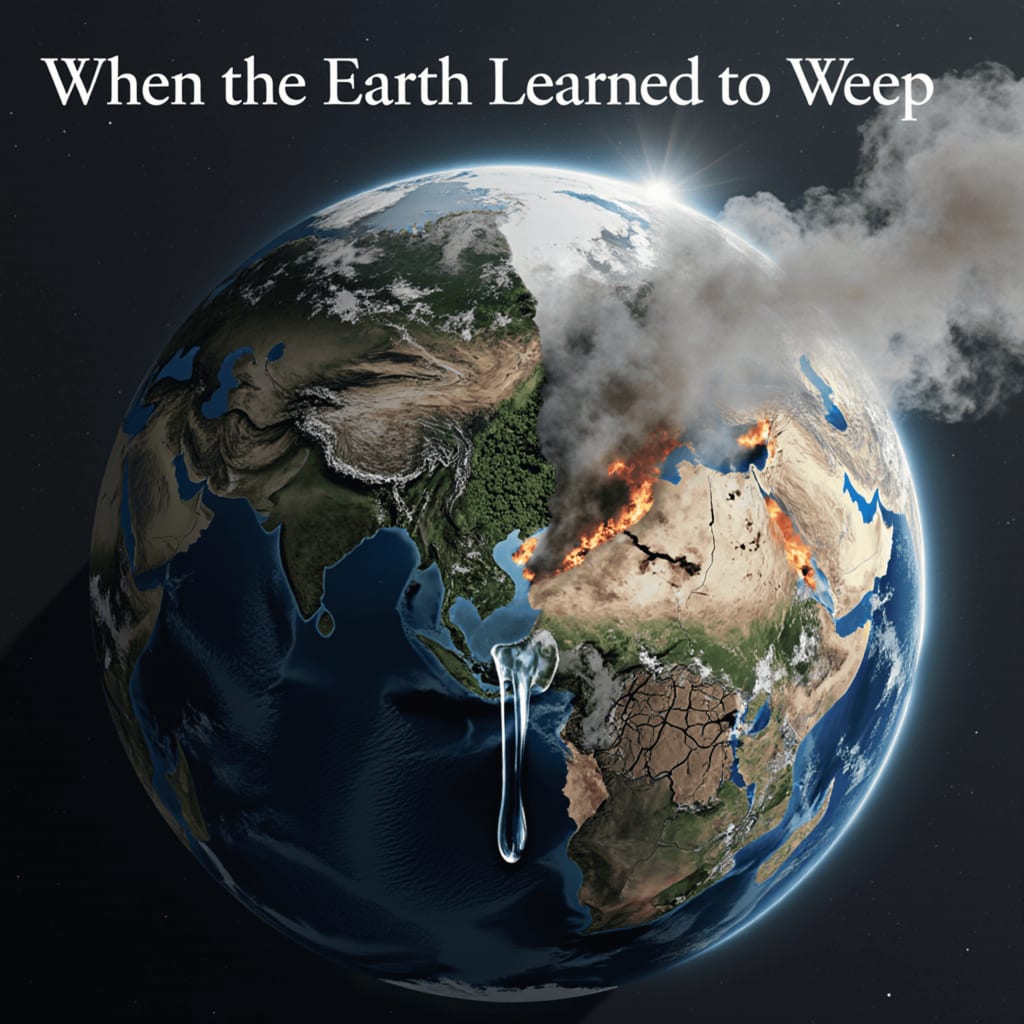
There are times in the history of humanity that are defined by progress, innovation, and genius. But there are times when we walked away from harmony with the world that nourished us. Somewhere along that timeline — though no book documents the date — the Earth learned to cry.
Its tears are different from ours. They flow as rising oceans, blazing forests, storms that howl with greater fury each season, and glaciers that melt silently in the sunlight. And in these tears is a tale to be told: the sadness of a world that once smiled at us with abandon.
The Day the Skies Grew Heavy
The initial tear showed up in the heavens. Fumes and smoke started thickening the air, blurring lines that had before been painted in stark blue. So-called "progress" coated the air with particles to blur the morning sun.
The sighs of the Earth were borne in polluted cities and in children's coughs as they fought to catch their breath. We did not listen for the grief — we named it progress, and forgot that air is not a luxury, but a right.
Forests That Fell Silent
The Earth's voice was once a rustle of leaves and birdsong. But as the forests were chopped down, that song disappeared. Centuries-old trees were cut down in a matter of days, and the creatures that lived among them became homeless.
This silence is weeping too. It is not the angry shout, but the quiet sorrow of what has been taken away. The spaces where the forests were indicate that the Earth does not have to scream; its sorrow is evident in what is missing.
Oceans With Salted Tears
If the world wept in water, it would be in the oceans. They bulge with ascending tides, engulfing coastlines and remapping geography. Plastic sails on waves like wounds, and coral reefs — former gardens under the sea — are bleaching out and dying.
The ocean's salt is old, but now it seems like grief. Each dying reef and each beached whale reminds us of how much the Earth hurts.
The Heat That Burns Like Fever
The Earth also weeps in warmth. Summers become more brutal, droughts persist longer, and fires burn with an insatiable hunger that devours whole landscapes. This fever is not haphazard; it is an indicator of imbalance.
As a body that hurts when ill, the planet's heating tells us something important: it is ill, and we are responsible.
The Tears We Cannot Ignore
When speaking of climate change, extinction, or pollution, we have a tendency to speak in numbers. But the Earth's sorrow cannot be quantified simply in statistics. It is an experienced reality — floods tearing through neighborhoods, families displaced from ancestral homes, and species gone forever.
The world's tears are warnings, inscribed in storms, drought, and melting ice. We can no longer ignore them.
Hope in the Healing
We must remember, however: while the Earth has learned to cry, it has not forgotten how to heal. Forests may grow back, rivers can be restored, and threatened species can be safeguarded if we care enough to act.
Each small thing — planting a tree, minimizing waste, saving water — is akin to giving comfort to a bereaved friend. And when nations and communities make this effort together, the healing becomes manyfold.
The tears of the Earth are not the last. They are an appeal, a call to us to go back to balance before it is too late.
Listening to the Weeping
Whether the Earth weeps is not the question. The question is whether we are listening. Because in each tear there is also an invitation: to respond, to defend, to live in another way.
One day, maybe, the clouds will lift, the trees will sing once more, and the seas will glimmer with life rather than sorrow. On that day, the Earth will perhaps learn to smile again. But until then, we need to recall the truth — it has learned to cry due to us.
About the Creator
Chinese Planetary Engineering: The Great Green Wall and the Reclamation of Climate
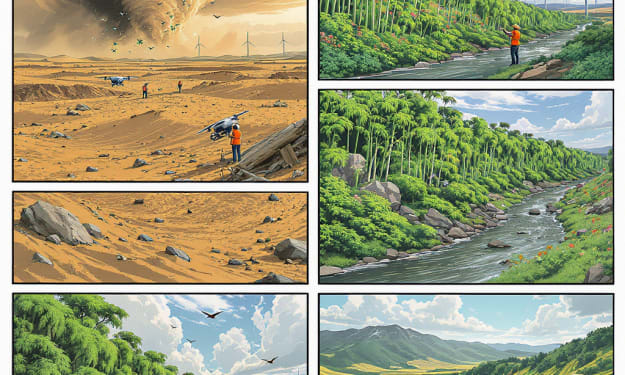
There are junctures in history where a civilization no longer chooses between comfort and progress, but between adaptation and extinction. At the dawn of the new millennium, China hit one of those silent thresholds where geography ceases to be a backdrop and becomes an adversary. The desert was advancing, not as a metaphor for decay, but as a physical, methodical, and relentless force. Sand was devouring the horizon, winds grew heavy with dust, and the soil lost its fertile memory, taking with it the promise of social stability.
By Laurenceau Porte3 days ago in Earth


Comments
There are no comments for this story
Be the first to respond and start the conversation.